

1. Introduction: The Wide Applications of Industrial borescopes
As a non-destructive testing tool that enables internal visual inspection without dismantling equipment, industrial borescopes have become indispensable across almost all high-end manufacturing sectors. According to data from DIResearch, the global market reached USD 714 million in 2025, with China alone reaching RMB 13.755 billion. Within this expanding landscape, the handheld borescope has emerged as the primary solution for field inspections. Driven by an integrated, portable design and true plug-and-play efficiency, the handheld borescope is attracting ever-increasing market attention, and for good reason.
2. Classification of Industrial borescopes by Fixation Method
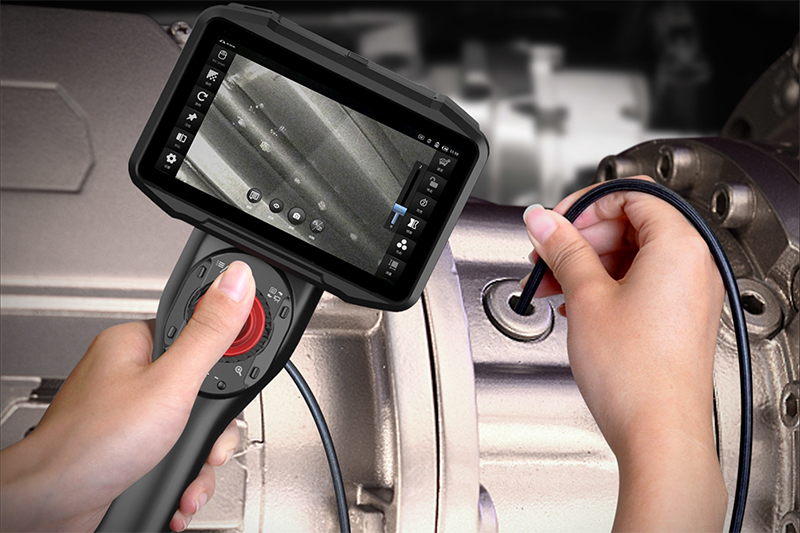
Based on how they are fixed in position during operation, industrial borescopes can be categorized into five main types. Among them, the handheld borescope stands out for its unparalleled combination of advantages.
Fixation Type | Core Characteristics | Typical Application Scenarios | Advantages & Limitations |
Handheld Borescope | Integrated, lightweight design for one-handed operation; highly self-contained | Field inspections, work-at-height, outdoor surveys, automotive repair | Advantages: the handheld borescope is highly portable and flexible, instant operation; Limitations: stability depends on the operator |
Benchtop Industrial borescope | Main unit fixed on a desk or workbench, connected to a separate probe | Laboratory precision analysis, production-line batch inspection, multi-person consultation | Advantages: superior stability, powerful features; Limitations: bulky, difficult to move |
Fixed Industrial borescope | Probe permanently or semi-permanently installed via rigid connections at a specific location | Online monitoring of pipes, reactors, and storage tanks | Advantages: reliable long-term monitoring; Limitations: fixed position, low flexibility |
Stand/Trolley-mounted Industrial borescope | Equipment integrated onto a movable cart or floor stand | Laboratories, beside production lines, and scenarios requiring both mobility and stability | Advantages: combines mobility with stability; Limitations: moderate portability |
Special Fixation Type | Temporarily secured using non-standard methods such as magnetic mounts, vacuum suction, or clamps | Scientific research, specialized industrial inspections, hands-free operations | Advantages: highly flexible fixation; Limitations: limited range of applicable scenarios |
As the table illustrates, a handheld borescope achieves the optimal balance of portability, operational efficiency, and environmental adaptability, making handheld borescopes the most widely adopted fixation type in the industry.
3. Core Advantages of Handheld Borescopes
The strengths of a handheld borescope lie in how this tool redefines convenience and efficiency in field inspection.
(1) High Integration, Ultimate Portability. A handheld borescope features an all-in-one body powered by a lithium-ion battery, with the entire unit weighing as little as 1.16 kg. Paired with an ergonomic grip, the handheld borescope allows an operator to easily climb to the top of a wind turbine nacelle and perform true one-handed inspection in confined spaces, a task impossible for bulkier equipment.
(2) Instant Operation, Multiplied Efficiency. A handheld borescope requires no cumbersome assembly or dedicated workstation. The handheld borescope is ready to use the moment it is powered on, enabling a single technician with a handheld borescope to complete a task that previously required two or three people. In wind turbine gearbox inspection, a handheld borescope can compress an inspection cycle that once took several hours down to under one hour.
(3) Excellent Imaging, Intelligent Measurement. Portability does not come at the expense of image quality. A top-tier handheld borescope is equipped with a megapixel-class sensor and 3D phase-scanning measurement technology, clearly revealing minute defects with measurement accuracy up to 95%. This makes the handheld borescope a precision instrument, not just a quick-look tool.
(4) Multi-functionality, Broad Adaptability. A handheld borescope supports interchangeable probes of various diameters, side-view lenses, and measurement tips, allowing quick changeovers between aerospace, automotive, and power generation sectors. This versatility of a handheld borescope significantly reduces equipment investment costs for companies with multi-scenario inspection needs.
(5) High Cost-effectiveness, Economical and Practical. The purchase cost of a handheld borescope is typically only one-third to one-half that of a benchtop model. With simple maintenance and no need for a dedicated workstation, a handheld borescope is a high-return choice for small and medium-sized enterprises and routine inspection tasks. Simply put, a handheld borescope delivers exceptional value.
4. Market Position of Handheld Borescopes
Market research indicates that handheld borescopes (portable industrial videoscopes) are experiencing steady global growth. The global market for portable industrial videoscopes was approximately USD 200 million in 2023 and is projected to reach USD 280 million by 2030. China's market growth outpaces the global average, with particularly robust demand for handheld borescopes coming from automotive (approx. 25% market share), aerospace (approx. 20%), and petrochemical (approx. 15%) industries. The trends toward lightweight design and intelligent features continue to solidify the handheld borescope's central market position.
5. Typical Application Areas for Handheld Borescopes
Handheld borescopes cover virtually every industrial scenario requiring remote visual inspection:
- Aerospace: Handheld borescopes are used to inspect turbine blades for cracks, check combustion chambers for carbon deposits, and verify airframe piping for blockages.
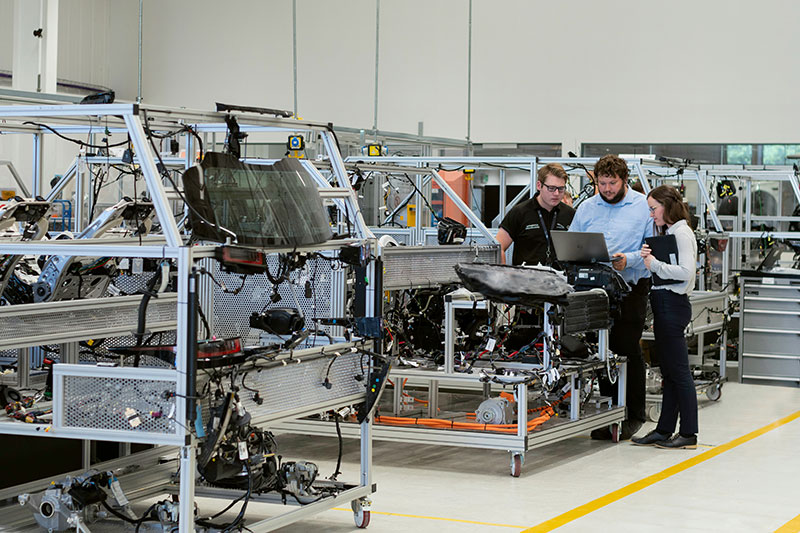
- Automotive Manufacturing & Repair: A handheld borescope can inspect engine cylinders and transmission valve bodies for internal defects without disassembly, dramatically improving maintenance efficiency.
- Energy & Power: Assessing tooth surface wear in wind turbine gearboxes or examining pipe welds in nuclear power plants is unthinkable without a handheld borescope.
- Petrochemicals: In the inspection of pressure vessel inner-wall corrosion and weld quality, a handheld borescope is a critical tool for ensuring safe operations.
- Rail Transit: The rapid screening of bogie bearing bores and pantograph carbon strip damage also relies on handheld borescopes.
Whether the job is in the skies, deep underground, or in a hazardous confined space, the handheld borescope has become the indispensable visual assistant for field engineers everywhere.
6. Key Purchasing Considerations for a Handheld Borescope
When selecting the right handheld borescope, focus on these critical factors:
1. Define Your Inspection Needs: Determine the required protection rating and any explosion-proof certifications for your handheld borescope based on the pipe's inner diameter, length, temperature, and the media present.
2. Probe Diameter & Cable Length: Ensure the probe of the handheld borescope can pass smoothly through the smallest access port and that the insertion tube length covers the entire inspection path.
3. Imaging System Quality: A high-resolution sensor and a high-brightness display are the foundation of any handheld borescope's ability to reveal defect details clearly.
4. Illumination System: An adjustable LED is standard on any handheld borescope. For special conditions, consider options for infrared or ultraviolet illumination.
5. Probe Flexibility: 360° electric articulation and a wide bending angle allow the handheld borescope to navigate complex piping without dead zones.
6. Portability & Battery Life: A lightweight body and a dual-battery design ensure your handheld borescope can support continuous operation for over four hours.
7. Protection Rating: Only a handheld borescope with an IP68-rated probe can truly hold its own in harsh environments filled with oil, water, and dust.
8. Data Transfer & Support: A handheld borescope that supports seamless data transfer and is backed by a reliable brand offers greater long-term value. Choose a handheld borescope from a manufacturer known for quality and service.
7. Conclusion
With its core advantages of portability, high efficiency, and superior cost-effectiveness, the handheld borescope has firmly established itself at the center of the industrial inspection market. As technologies like 5G and AI become more deeply integrated, the handheld borescope will continue to evolve toward even smarter and lighter designs. The future of on-site non-destructive testing is clear: it belongs to the handheld borescope.
Copyright © 2025. Coantec Ltd. All rights reserved. sitemap