

What can a 0.95 mm micro borescope actually inspect?
The C40, M40, and X5 series bring industrial inspection into spaces that conventional borescopes simply cannot reach.
A standard toothpick measures about 1.5 mm in diameter. The M40 micro borescope features a probe diameter of only 0.95 mm — thinner than a toothpick. In industrial applications, equipment of this type is widely known as a micro borescope.
Its ultra-thin 0.95 mm probe can enter extremely small openings and deep cavities that are impossible to inspect directly with the naked eye, revealing hidden defects with exceptional clarity.
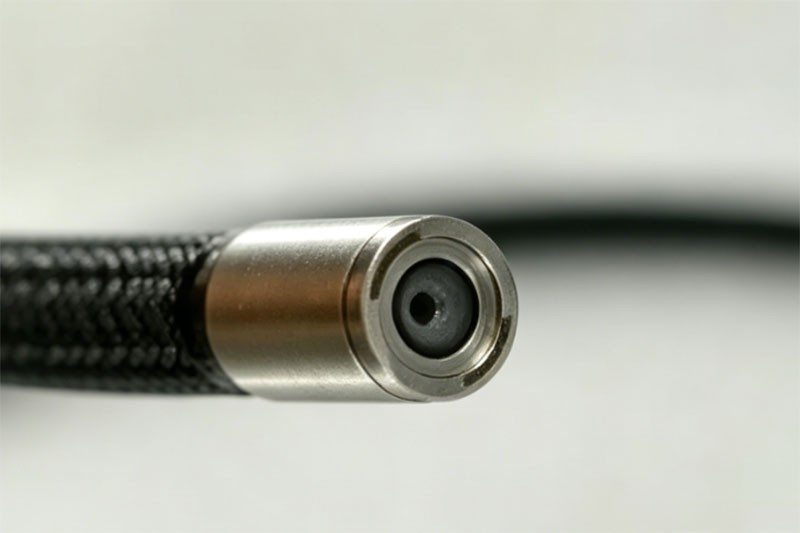
So where can a micro borescope this thin actually be used? We tested several real-world inspection scenarios to see how different models perform.
Fuel injector openings are typically between 0.5–1 mm in diameter. Internal burrs or carbon buildup can directly affect fuel atomization performance. Traditional inspection methods often require cutting the component open — destructive, expensive, and inefficient.

The M40 micro borescope can insert its 0.95 mm probe directly into the injector opening. Combined with rear fiber-optic illumination, it clearly displays machining marks, burrs, and carbon deposits on the 5-inch HD display. The hard-alloy probe housing withstands repeated insertion into metal openings without wear.
For larger injector channels or more budget-conscious applications, the C40 series supports probes down to 2 mm and is suitable for routine micro inspection work. While not designed for extreme ultra-fine access, it handles most standard micro borescope applications with ease.
Cooling channels inside precision molds are often only 1–2 mm wide and highly curved. Scale buildup or corrosion inside these channels can lead to uneven cooling and product deformation.
The articulated micro borescope on the M40 features 360° mechanical articulation and a tungsten-braided insertion tube, allowing smooth navigation even through sharp bends. The system clearly displays scale thickness and corrosion areas, helping technicians quickly determine whether cleaning or insert replacement is required.
For applications requiring quantitative corrosion analysis, the X5 series offers high-precision 3D measurement with 0.01 mm accuracy. Although its minimum probe diameter is 2 mm, it provides highly accurate defect evaluation and serves as an ideal measurement-focused complement to ultra-thin micro borescopes.
Bolt holes inside turbine discs are typically around 1 mm in diameter. Tiny debris or micro-cracks inside these holes can become catastrophic under high rotational speeds. In the past, inspectors could only perform limited visual checks without seeing deep inside the hole.
The M40 micro borescope combines a 0.95 mm probe with a macro lens, reducing the focal distance to just 2–3 mm. Its rear high-power illumination increases deep-hole brightness by up to three times, making debris particles and crack propagation paths clearly visible.
In aerospace applications, this type of equipment is commonly referred to as an aviation borescope or aerospace borescope.
For advanced 3D crack-depth analysis, the X5 can be used alongside the M40. Although its probe is slightly larger at 2 mm, its 9 measurement modes allow precise evaluation of defects down to 0.01 mm accuracy — creating an ideal workflow of “detect first, measure precisely later.”
When locksmiths encounter jammed pins or foreign objects inside lock cylinders, the M40 ultra-thin micro borescope can be inserted directly through the keyhole. The internal condition appears instantly on the screen, allowing fast diagnosis without dismantling the lock.
This is also a great example of how a micro borescope extends beyond industrial inspection into practical everyday applications.
Minimum probe diameter: 0.95 mm
Fully modular design
1–10 m insertion tubes
Rear high-power illumination
Aerospace-grade aluminum heat dissipation
Best for ultra-small openings, deep cavities, complex bends, and intensive continuous inspections.
Minimum probe diameter: 2 mm
Replaceable insertion tubes
IP67 waterproof protection
Red Dot Design Award winner
Ideal for routine micro inspections, municipal pipelines, and automotive maintenance.
Minimum probe diameter: 2 mm
High-precision 3D measurement
0.01 mm accuracy
9 measurement modes
Electric articulation control
Designed for precision inspection requiring quantitative crack-depth or corrosion-area analysis.
Each model is optimized for different inspection needs.
Choose the M40 if ultra-fine access is your priority. With its 0.95 mm probe, it is a true high-performance micro borescope for precision inspection.
Choose the C40 for versatile routine inspection with excellent overall value.
Choose the X5 when accurate measurement data and quantitative defect analysis are required.
In the past, what existed inside openings thinner than a toothpick remained impossible to inspect clearly. Today, the M40 micro borescope makes those hidden spaces visible.
Whether used in aerospace, automotive, mold manufacturing, or precision maintenance, a micro borescope helps inspectors access areas that were previously unreachable and makes hidden defects clearly visible.

Copyright © 2025. Coantec Ltd. All rights reserved. sitemap