

Quick Answer
A handheld borescope is the preferred choice for many industrial inspections because it combines portability, ergonomic operation, high-quality imaging, and advanced inspection features in a compact device. Compared with benchtop or fixed inspection systems, handheld borescopes enable faster deployment, easier operation in confined spaces, and lower overall maintenance costs. When selecting a handheld borescope, buyers should evaluate six key factors: portability, ergonomics, durability, image quality, articulation, and intelligent inspection capabilities.
Why Handheld Borescopes Have Become the New Standard
With the rapid advancement of predictive maintenance and non-destructive testing (NDT), the industrial borescope has evolved into an indispensable tool for equipment inspection, fault diagnosis, and preventive maintenance. Compared with traditional benchtop or fixed systems, the handheld borescope offers distinct advantages in terms of lightweight portability and on-site inspection capabilities, making it a growing choice across industries such as automotive repair, aerospace, energy and power, and general manufacturing.
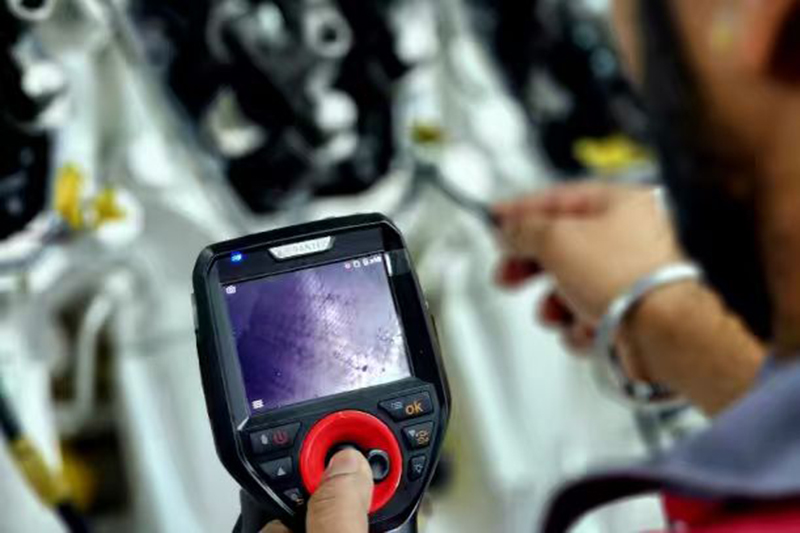
However, not all handheld borescopes deliver the same inspection experience. From field efficiency and image quality to long-term cost of ownership, a truly superior product must strike a careful balance between design, performance, and intelligent functionality.
Who Should Use a Handheld Borescope?
Handheld borescopes are ideal for professionals who need fast, flexible inspections in challenging environments, including:
Automotive service and engine maintenance technicians
Aerospace MRO engineers
Power plant maintenance teams
Oil & gas inspectors
Manufacturing quality control engineers
HVAC technicians
Railway maintenance professionals
6 Key Factors to Consider Before Buying
1. Portability: Improve Inspection Efficiency
Unlike benchtop borescopes that rely on fixed workstations or supporting equipment, a handheld borescope features an all-in-one design that is ready for use at power-on. It enables single-person operation without complex setup, making it particularly well-suited for field inspections, emergency repairs, and work in confined spaces or elevated locations.
For industries that require frequent movement or cross-site operations, the lightweight design of a handheld borescope not only improves inspection efficiency but also reduces equipment setup and downtime. Today, premium models weigh approximately 0.89 kg (including battery), allowing comfortable extended use and significantly reducing the physical burden on inspectors.
2. Ergonomic Design: Reduce Operator Fatigue
For inspection tasks that last tens of minutes or even hours, how the device feels in your hand is just as important as its technical specifications.
A well-designed handheld borescope should provide comfortable ergonomics, balanced weight distribution, and intuitive controls, enabling inspectors to perform articulation, photo capture, video recording, and brightness adjustment with one hand. This reduces the need to reposition or interrupt the line of sight, improving both efficiency and accuracy.
Details such as button layout, joystick resistance, screen angle, and overall weight balance may seem minor, but they directly affect comfort during prolonged use — and often represent some of the most significant differences between competing brands.
3. Durability: Built for Harsh Industrial Environments
Industrial inspections frequently take place in dusty, oily, humid, or high-temperature environments.
When selecting a handheld borescope, buyers should evaluate:
IP protection rating for both the main unit and insertion tube
Abrasion resistance of the insertion tube
Probe durability
Illumination performance in deep cavities and dark spaces
Many professional systems now feature IP67 or IP68 protection, tungsten-alloy braided insertion tubes, and high-intensity LED illumination to ensure reliable performance in demanding industrial conditions.
4. Image Quality: Look Beyond Resolution
Many buyers focus on camera resolution first, but experienced inspectors understand that true image quality depends on the complete optical system — the lens, image sensor, illumination, and image processing — rather than megapixels alone.
For detecting fine defects such as cracks, corrosion, weld discontinuities, and carbon deposits, clear, accurate images are far more valuable than high resolution alone.
In recent years, AI image enhancement has begun to enter the industrial inspection field. Through intelligent noise reduction, detail enhancement, and colour optimisation, AI-assisted imaging helps inspectors identify defects more reliably — even in low-light or high-glare conditions.
5. Articulation: Inspect Complex Structures More Easily
The internal structures of engines, heat exchangers, gas turbines, and other complex equipment often present inspection challenges that a rigid straight probe cannot fully address.
A handheld borescope with articulation allows the probe tip to be steered in multiple directions, enabling comprehensive viewing angles without extensive equipment disassembly — significantly improving both inspection speed and coverage.
Current articulation systems fall into two main categories: mechanical and motorised. Mechanical articulation offers direct, responsive control and is well-suited for routine industrial inspections. Motorised articulation, on the other hand, provides greater precision and is ideal for demanding applications in aerospace, power generation, and scenarios requiring 3D measurement.
6. Intelligent Features: The New Buying Standard
As industrial inspection moves toward digitalisation, the handheld borescope is no longer just a viewing device — it is becoming a critical data entry point for equipment management.
Models that support high-resolution photo capture, video recording, inspection report generation, and AI-assisted analysis help organisations build comprehensive maintenance records, improving traceability and team collaboration. Features such as voice control, automatic defect recognition, and smart report generation are also emerging as key tools for enhancing inspection efficiency.
Looking Beyond Specifications
Choosing a handheld borescope is no longer just about selecting the highest resolution camera or the smallest probe diameter. The best inspection system is the one that combines portability, ergonomics, image quality, articulation, durability, and intelligent software into a practical solution for real-world inspection tasks.
Coantec applies these principles across its handheld borescope portfolio. The award-winning C40 established the company's ergonomic design philosophy, while the modular M40 Series provides greater flexibility through interchangeable probes. For advanced inspections, the X5 Series combines motorised articulation with 3D measurement, and the BLX Series integrates AI image enhancement, voice control, and intelligent defect recognition to improve inspection efficiency and reporting.
By combining ergonomic design, intelligent imaging, and professional inspection technologies, Coantec helps customers in automotive, aerospace, energy, manufacturing, and other industries improve inspection efficiency, reduce maintenance costs, and make more informed maintenance decisions.
Copyright © 2025. Coantec Ltd. All rights reserved. sitemap