

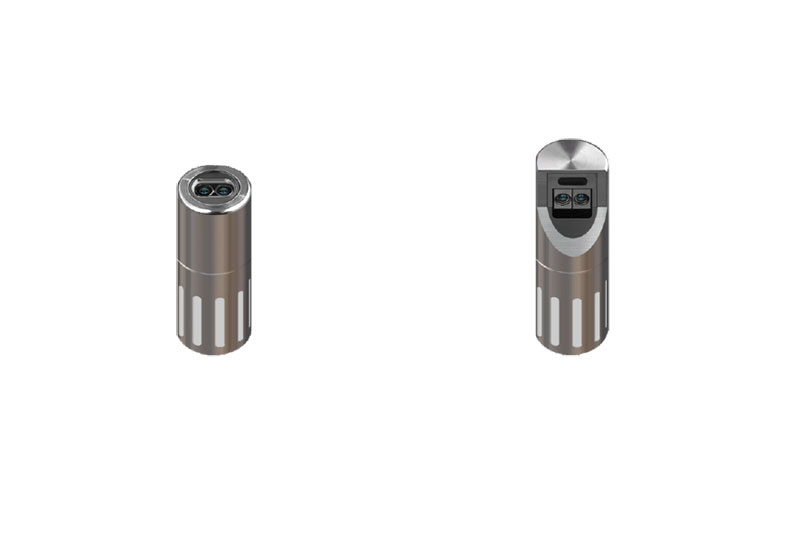
In modern industrial inspection, the industrial borescope camera—an electronic video borescope with a miniature camera built directly into the probe tip—has become the mainstream inspection method. When evaluating the imaging capability of an industrial borescope camera, two core parameters are unavoidable: probe diameter and camera resolution. These two parameters are locked in a fundamental tradeoff dictated by physics: under the same technical conditions, the smaller the diameter of an industrial borescope camera, the more its achievable resolution is inherently constrained.
Understanding this relationship is key to selecting the right industrial borescope camera and avoiding misleading specifications.
I. Physical Space: The Root of the Trade-Off
The millimeter-scale diameter of an industrial borescope camera directly limits the physical space available for the camera module. Inside the probe, there is more than just the image sensor—it must also accommodate illumination LEDs, signal wiring, and articulation cables. This premium real estate creates three fundamental limitations:
1. Limited image sensor size
This is the core factor determining resolution. A larger diameter borescope camera (e.g., 6 mm, 8 mm) has room for a arger format CMOS sensor, easily achieving megapixel resolution. In contrast, a micro‑diameter borescope camera (e.g., 2.8 mm, 2.0 mm) can only fit a very small sensor, naturally limiting total pixel count.
2. Simplified optical lens system
A larger diameter camera can incorporate a multi‑element lens assembly that corrects aberrations, delivering a sharp optical image. A small-diameterr camera relies on a very compact fixed‑focus lens with limited aberration control. Even if the sensor pixel count appears reasonably high, the effective resolution is compromised.
3. Competition for internal space
Illumination is also critical for effective inspection. A slender probe must set aside cross‑sectional area for light sources, further squeezing the space available for the sensor and optics. Every borescope camera design is a millimeter‑level trade‑off between the imaging region and the illumination region.
II. Sensor Technology: Bridging Diameter and Resolution
The relationship between diameter and resolution is quantified through the image sensor. In the constrained environment of an borescope camera, due diligence requires looking beyond raw pixel counts:
Pixel count ceiling effect
As the sensor format shrinks with probe diameter, individual pixel size must also shrink. If pixels become too small, light sensitivity drops and image noise increases significantly. Therefore, small‑diameter borescope cameras do not blindly increase pixel count; instead, they balance pixel count against sensitivity.
Spatial resolution as the true metric
The professional measure of imaging fineness is spatial frequency (line pairs per millimeter). A larger‑diameter borescope camera may achieve resolving power above 50 lp/mm, capable of revealing fine cracks. An ultra‑small‑diameter camera, limited by its optics and sensor, often delivers only around 10–20 lp/mm, making it much harder to see tiny defects.
III. Real‑World Mapping of Diameter vs. Resolution
On the market, the step‑wise distribution of resolution against probe diameter follows a consistent pattern:
Diameter Class | Probe Diameter Range | Typical Pixel Count | Video Resolution Capability | Characteristics / Typical Use |
Ultra-fine | 0.95 mm – 2.0 mm | ~160 k pixels | Basic video | Qualitative inspection in very narrow passages |
Mainstream fine | 2.8 mm – 4.0 mm | 0.3 MP – 1.0 MP | 720p | Common compromise for precision inspection |
General medium | 5.5 mm – 6.0 mm | >1.0 MP | 1280×720 to 1080p | — |
Large diameter / HD | >6 mm (typically ≥8 mm) | 2.0 MP – 5.0 MP | 1080p and above | Aero engines, precision castings, etc. |
IV. Special Case: Dual Cameras in the Same Diameter
Some borescope cameras integrate two independent camera modules inside one probe—typically to enable 3D measurement or provide both forward and side views without rotating the probe. Given a fixed probe diameter, this dual‑camera design intensifies competition for interior space, potentially limiting the resolution of each individual camera.
For example, in a 6.0 mm probe, a single‑camera version might reach 2.0 MP, whereas a forward‑&‑side dual‑camera version typically fits only ≈1.0 MP per camera due to space constraints. At the 4.0 mm level, the image‑quality trade‑off of dual cameras is even more pronounced. Note that in such designs, the two sensors usually have identical pixel counts to maintain uniform detail between views—but this does not mean they can match the higher pixel count of a single‑camera version in the same diameter.
V. Selection Trade‑Off: Accessibility vs. Resolution
Knowing this relationship makes the selection process straightforward: you are choosing the right compromise for your inspection task.
If your primary goal is to enter a tight passage, prioritize a sufficiently small probe diameter and accept a basic resolution level.
If space is ample and you need to resolve micron‑level defects, choose a larger‑diameter (≥6 mm) borescope camera to obtain the clarity needed for accurate defect assessment.
If your inspection requires frequent view‑switching (e.g., forward and side) to avoid repeated probe repositioning, a forward‑/side‑view dual‑camera borescope offers significant convenience.
If you need dual‑camera measurement with high accuracy, select a larger probe diameter to maintain enough resolution per camera.
In summary, the resolution of an industrial borescope camera and its probe diameter are physically and inextricably linked by the rigid constraints of space. Understanding this fundamental relationship enables you to strike a rational balance between real‑world inspection needs and the objective boundaries of the technology.
Copyright © 2025. Coantec Ltd. All rights reserved. sitemap