
¿Qué tipos de iluminación se utilizan en los boroscopios industriales? Comparación de LED, fibra óptica y láser

2026-09-08

En industrias como la aeroespacial, las turbinas de gas, el procesamiento petroquímico y la fabricación de automóviles, muchos componentes críticos se encuentran dentro de espacios estrechos, cerrados o inaccesibles.

Los boroscopios industriales permiten a los inspectores acceder a estas áreas a través de un tubo de inserción flexible y mostrar las condiciones internas en tiempo real, lo que los convierte en una herramienta de inspección visual esencial para pruebas no destructivas (END).
LED, Fiber-Optic and Laser Compared

Sin embargo, lograr imágenes de inspección claras y fiables depende de algo más que la cámara y la óptica.

En la mayoría de los entornos de inspección industrial, el área que se inspecciona tiene poca o ninguna luz ambiental y puede estar completamente oscura. Por lo tanto, la cantidad de información de imagen útil capturada por el sistema de imágenes depende en gran medida de la iluminación disponible en el punto de inspección.

Por esta razón, la iluminación es una parte crítica de un sistema de imágenes por boroscopio industrial y uno de los factores clave que afectan el desempeño de la inspección en el mundo real.

Entonces, ¿qué tipos de iluminación se utilizan habitualmente en los boroscopios industriales? ¿Cuáles son las diferencias entre iluminación LED, fibra óptica y láser? ¿Y qué tecnologías se adaptan mejor a las diferentes aplicaciones de inspección?

¿Por qué los boroscopios industriales necesitan iluminación?

Para comprender el papel de la iluminación, es útil comprender primero cómo un boroscopio industrial forma una imagen.

En términos simples, la fuente de luz ilumina la superficie objetivo. La óptica del boroscopio recoge la luz reflejada y el sensor de imagen convierte esa información óptica en señales electrónicas, que luego se procesan y muestran como una imagen.

Por tanto, el proceso de obtención de imágenes se puede resumir como:

La luz ilumina el objetivo → La luz reflejada ingresa a la óptica → El sensor de imagen captura la información → Procesamiento de imágenes → Visualización

Sin suficiente iluminación, incluso un sensor de imagen de alta resolución puede tener dificultades para producir una imagen clara y utilizable.

Esto es particularmente importante en la inspección industrial, donde los inspectores a menudo necesitan identificar características y defectos superficiales muy pequeños. Las grietas, la corrosión, los daños por quemaduras, la erosión y los rayones en los componentes de la turbina o del motor pueden quedar fácilmente oscurecidos por una iluminación insuficiente, áreas sombreadas o ruido en la imagen.

Por lo tanto, la capacidad de obtención de imágenes de un boroscopio industrial no debe evaluarse únicamente por la resolución o el tamaño de la pantalla. El rendimiento del sistema de iluminación, la óptica, el sensor de imagen y la tecnología de procesamiento de imágenes también debe considerarse como un sistema integrado.

Iluminación LED: la tecnología de iluminación más común en boroscopios industriales

La iluminación LED es actualmente la solución de iluminación más utilizada en boroscopios y videoscopios industriales.

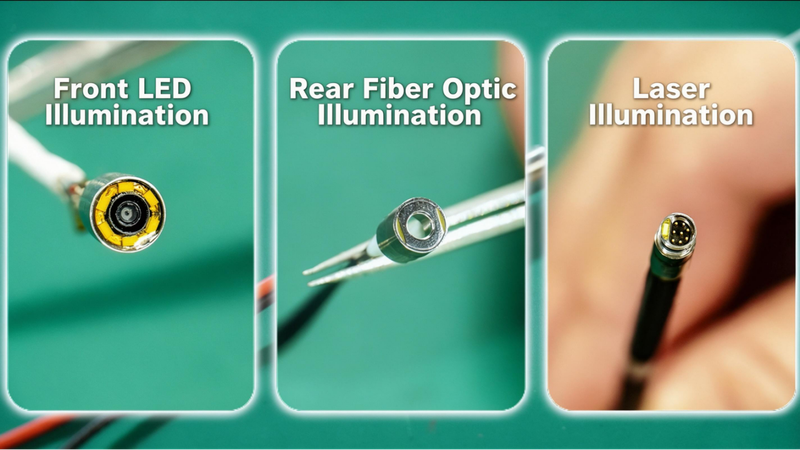
Los LED son compactos, energéticamente eficientes, duraderos y relativamente fáciles de controlar, lo que los hace especialmente adecuados para equipos con espacio interno extremadamente limitado. En muchos boroscopios industriales, se integran LED en miniatura cerca de la cámara en el extremo distal del tubo de inserción, lo que proporciona iluminación directa del área de inspección.

Para aplicaciones como inspección de motores de automóviles, inspección de componentes mecánicos, inspección de tuberías internas y mantenimiento de rutina de equipos, las distancias de inspección suelen ser relativamente cortas. En estas condiciones, la iluminación LED puede cumplir con los requisitos de la mayoría de las inspecciones visuales de rutina.

Estas ventajas han convertido a la tecnología LED en la solución de iluminación dominante en el mercado de los boroscopios industriales.

Sin embargo, los LED no funcionan igual de bien en todos los entornos de inspección.

A medida que el espacio de inspección se hace más grande y la distancia de visión aumenta, la luz se extiende naturalmente sobre un área más amplia. Por tanto, se reduce la cantidad de iluminación útil que llega a un objetivo distante. Es posible que los inspectores necesiten reposicionar la sonda repetidamente y acercar el extremo distal al objetivo para obtener suficiente brillo y detalle de la imagen.

Por lo tanto, para entornos de inspección grandes y profundos, mejorar la iluminación efectiva de larga distancia se convierte en un desafío cada vez más importante.

Iluminación por fibra óptica: entrega de luz al extremo distal

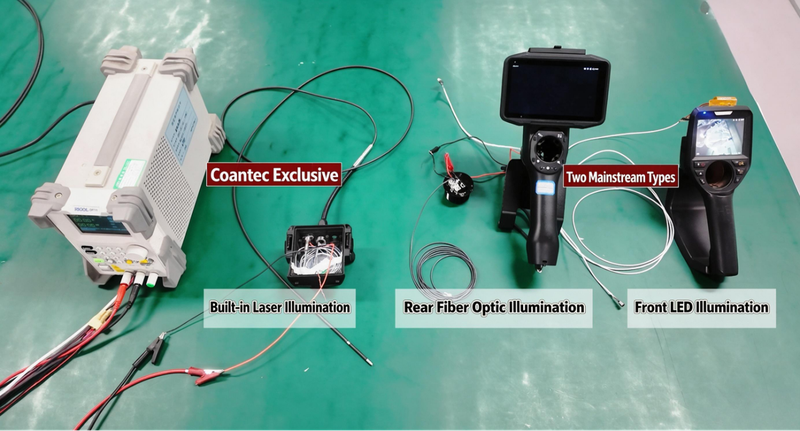
A diferencia de los LED montados directamente cerca de la cámara, la iluminación de fibra óptica separa la fuente de luz del extremo distal del boroscopio.

La fuente de iluminación puede ubicarse en la unidad principal o en una fuente de luz externa separada, mientras que las fibras ópticas transmiten la luz al extremo distal del instrumento.

Esta tecnología se utiliza desde hace mucho tiempo en sistemas de inspección endoscópica industriales profesionales.

Debido a que la fuente de luz no está limitada por el espacio extremadamente limitado disponible en la punta de la sonda, el sistema puede proporcionar una mayor flexibilidad en la selección de fuentes de iluminación de mayor salida o más especializadas.

Por lo tanto, para aplicaciones de inspección profesional con mayores requisitos de iluminación, los sistemas de fibra óptica pueden ofrecer una mayor flexibilidad en el diseño general del sistema óptico.

Sin embargo, la iluminación por fibra óptica también puede aumentar la complejidad del sistema. La fuente de luz, el haz de fibras y el sistema de boroscopio deben estar conectados y combinados adecuadamente, mientras que la operación de campo puede implicar equipos, conexiones y requisitos de acoplamiento óptico adicionales.

Desde una perspectiva técnica, La iluminación de fibra óptica enfatiza la separación de la fuente de luz y la sonda., lo que permite una mayor flexibilidad en la configuración de la fuente de luz. La iluminación LED, en comparación, se centra más en la integración compacta y la conveniencia.

Iluminación láser: ¿por qué atrae la atención en la inspección industrial?

En comparación con la iluminación LED y la fibra óptica convencional, la iluminación láser representa una dirección técnica más especializada en aplicaciones de boroscopios industriales.

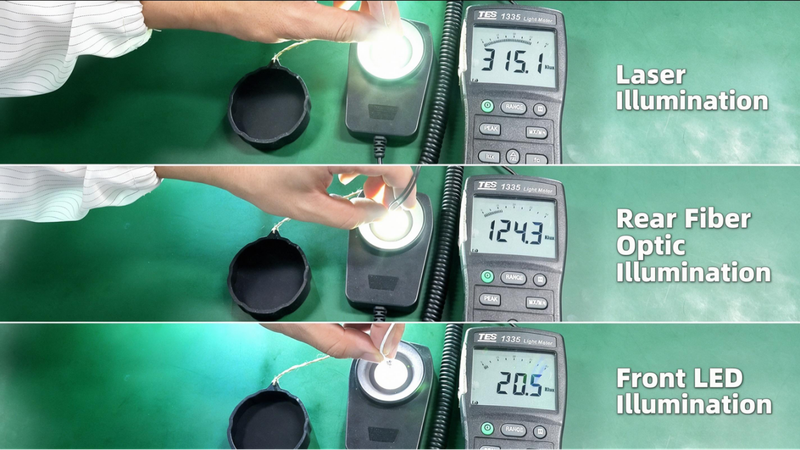
Una de las características clave de la luz láser es su fuerte direccionalidad y alta concentración de energía.

In industries such as aerospace, gas turbines, petrochemical processing and automotive manufacturing, many critical components are located inside narrow, enclosed, or otherwise inaccessible spaces. Industrial borescopes enable inspectors to access these areas through a flexible insertion tube and display internal conditions in real time, making them an essential visual inspection tool for non-destructive testing (NDT). However, achieving clear and reliable inspection images depends on more than just the camera and optics. In most industrial inspection environments, the area being inspected has little or no ambient light and may be completely dark. The amount of useful image information captured by the imaging system therefore depends heavily on the illumination available at the inspection point. For this reason, illumination is a critical part of an industrial borescope imaging system and one of the key factors affecting real-world inspection performance. So, what types of illumination are commonly used in industrial borescopes? What are the differences between LED, fiber-optic and laser illumination? And which technologies are better suited to different inspection applications? Why Do Industrial Borescopes Need Illumination? To understand the role of illumination, it is helpful to first understand how an industrial borescope forms an image. In simple terms, the light source illuminates the target surface. The borescope optics collect the reflected light, and the image sensor converts that optical information into electronic signals, which are then processed and displayed as an image. The imaging process can therefore be summarized as: Light illuminates the target → Reflected light enters the optics → The image sensor captures the information → Image processing → Display Without sufficient illumination, even a high-resolution image sensor may struggle to produce a clear and usable image. This is particularly important in industrial inspection, where inspectors often need to identify very small surface features and defects. Cracks, corrosion, burn damage, erosion and scratches on turbine or engine components can easily be obscured by insufficient illumination, shadowed areas or image noise. Therefore, the imaging capability of an industrial borescope should not be evaluated solely by resolution or display size. The performance of the illumination system, optics, image sensor and image-processing technology must also be considered as an integrated system. LED Illumination: The Most Common Lighting Technology in Industrial Borescopes LED illumination is currently the most widely used lighting solution in industrial borescopes and videoscopes. LEDs are compact, energy-efficient, long-lasting and relatively easy to control, making them particularly suitable for equipment with extremely limited internal space. In many industrial borescopes, miniature LEDs are integrated close to the camera at the distal end of the insertion tube, providing direct illumination of the inspection area. For applications such as automotive engine inspection, mechanical component inspection, internal pipe inspection and routine equipment maintenance, inspection distances are typically relatively short. Under these conditions, LED illumination can meet the requirements of most routine visual inspections. These advantages have made LED technology the dominant illumination solution in the industrial borescope market. However, LEDs do not perform equally well in every inspection environment. As the inspection space becomes larger and the viewing distance increases, light naturally spreads over a wider area. The amount of useful illumination reaching a distant target is therefore reduced. Inspectors may need to reposition the probe repeatedly and move the distal end closer to the target in order to obtain sufficient image brightness and detail. For large and deep inspection environments, improving effective long-distance illumination therefore becomes an increasingly important challenge. Fiber-Optic Illumination: Delivering Light to the Distal End Unlike LEDs mounted directly near the camera, fiber-optic illumination separates the light source from the distal end of the borescope. The illumination source can be located in the main unit or in a separate external light source, while optical fibers transmit the light to the distal end of the instrument. This technology has long been used in professional industrial endoscopic inspection systems. Because the light source is not constrained by the extremely limited space available at the probe tip, the system can provide greater flexibility in selecting higher-output or more specialized illumination sources. For professional inspection applications with higher illumination requirements, fiber-optic systems can therefore offer greater flexibility in overall optical system design. However, fiber-optic illumination can also increase system complexity. The light source, fiber bundle and borescope system must be properly connected and matched, while field operation may involve additional equipment, connections and optical coupling requirements. From a technical perspective, fiber-optic illumination emphasizes the separation of the light source and the probe, allowing more flexibility in light-source configuration. LED illumination, by comparison, focuses more on compact integration and convenience. Laser Illumination: Why Is It Attracting Attention in Industrial Inspection? Compared with LED and conventional fiber-optic illumination, laser illumination represents a more specialized technical direction in industrial borescope applications. One of the key characteristics of laser light is its strong directionality and high energy concentration. This does not simply mean that a laser is “brighter than an LED.” More importantly, with appropriate optical design, laser energy can be directed and distributed more effectively toward the inspection target, creating new possibilities for illuminating objects at longer distances and in deep inspection environments. This can be particularly valuable when inspecting large and complex industrial equipment. For example, during the inspection of large aero engines, gas turbines and other complex equipment, the inspector may not always be observing a small target located close to the distal end of the borescope. Instead, the inspection target may include turbine blades, combustion chambers or other structures located within a large and deep internal space. If illumination is effective only at close range, the inspector may need to repeatedly reposition the insertion tube or divide a large inspection area into multiple sections. More effective long-distance illumination can make it possible to observe larger target areas from a more suitable working distance, creating additional flexibility for inspection in large and deep spaces. Therefore, the value of laser illumination is not simply about achieving higher brightness. Its real significance lies in improving illumination efficiency for specific long-distance and large-volume inspection environments where conventional lighting technologies may face limitations. Of course, laser illumination also requires careful optical system design. Industrial equipment often contains highly reflective metallic surfaces. Strong reflections can produce localized highlights or overexposure. For this reason, the laser illumination system must be properly matched with the optical design, image sensor and image-processing algorithms in order to deliver useful inspection performance. LED vs. Fiber-Optic vs. Laser Illumination: What Is the Difference? In practical applications, these three illumination technologies should not simply be classified as “advanced” or “outdated.” Instead, each represents a different technical approach designed for different inspection requirements.  Illumination Technology Key Characteristics Typical Applications  LED Illumination Compact, easy to integrate, mature technology Routine industrial inspection at short distances  Fiber-Optic Illumination Separates the light source from the probe and supports more flexible light-source configurations Professional inspections with higher illumination requirements  Laser Illumination Strong directionality and concentrated optical energy, offering potential advantages for long-distance illumination Large, deep and long-distance industrial inspection environments  Therefore, when selecting an industrial borescope, it is not accurate to assume that laser illumination is automatically better than LED illumination. For routine close-range inspection of mechanical components, LED illumination can provide stable and reliable performance. For specialized applications requiring greater illumination capability or longer observation distances, fiber-optic or laser-based solutions may offer additional advantages. The most suitable illumination technology depends on the inspection object, working distance, internal space and the specific characteristics of the defects being inspected. Why Are Modern Industrial Borescopes Moving Toward Multi-Source Illumination? As industrial inspection targets become increasingly complex, a single white-light source may not be sufficient for every application. Different materials and surface conditions reflect light differently. The same defect may also appear differently under different illumination conditions. As a result, some next-generation industrial borescopes are beginning to offer a wider range of specialized illumination options, including different wavelengths and illumination methods. The purpose of multi-source illumination is not simply to add more lights to the system. Its real value is to provide inspectors with more suitable observation conditions for different inspection objects and tasks. In other words, the key question is changing. In the past, the focus was often: “Is the light bright enough?” Today, the more important question is becoming: “What type of illumination can help the inspector identify the target features more effectively?” Industrial Borescope Illumination Is Evolving from “Lighting” to “Effective Imaging” The development of industrial borescope illumination reflects the changing requirements of industrial inspection. In the early stages, illumination primarily needed to solve one problem: Making the invisible visible. As high-definition imaging technology developed, the focus shifted toward: Seeing more clearly. Today, as industrial inspection increasingly involves large-scale equipment and intelligent visual inspection technologies, illumination systems must also address new requirements: Seeing farther. Seeing more. And working more effectively with imaging algorithms. As a result, the illumination system is no longer simply an independent light source module. It is becoming increasingly integrated into the overall imaging system. The light source determines how the target is illuminated. The optical system determines how reflected light is collected. The image sensor records the information, while image-processing algorithms influence how the final image is presented and analyzed. Only when these elements work together effectively can an industrial borescope deliver meaningful visual inspection performance. The Next Step for Laser Illumination: From Specialized Light Sources to Integrated Systems As laser illumination enters industrial borescope applications, one important development direction is miniaturization and system integration. Traditional professional laser illumination systems often rely on separate light-source modules. While this approach may be acceptable for large stationary inspection systems, it can reduce convenience and operational efficiency for handheld industrial borescopes designed for field inspection. The more equipment and connections required, the greater the impact on portability and ease of use. This raises an important technical question: Can the laser emission system be integrated directly into the handheld industrial borescope itself? This is not simply a matter of adding a laser to the device. Integrating a laser emission module into a handheld borescope requires careful consideration of power supply, thermal management, optical coupling, internal space and overall system reliability. For this reason, integrated laser illumination is fundamentally a test of a manufacturer's system-level engineering and integration capabilities. The Coantec BLX Series AI Industrial Borescope represents one approach to this development direction by integrating the laser emission module directly into the handheld main unit, combining laser illumination with the overall borescope system in a more compact design. Currently, Coantec BLX is the only integrated handheld industrial borescope solution in China that incorporates the laser emission module directly into the main unit. This development reflects a broader trend in which laser illumination is gradually evolving from a separate professional light-source technology toward more compact and portable industrial visual inspection systems. Conclusion: Clear Industrial Inspection Starts with the Right Light The primary purpose of an industrial borescope is to inspect areas that cannot be directly observed. However, the ability to achieve a clear inspection image depends on far more than the camera alone. From LED illumination to fiber-optic light transmission and laser illumination, different technologies have emerged in response to changing industrial inspection requirements. LED illumination meets the needs of most routine close-range inspections. Fiber-optic illumination provides greater flexibility for professional light-source configurations. Laser illumination, meanwhile, is opening new possibilities for long-distance, large-space and deep-cavity inspection. As aerospace engines, gas turbines and other high-end industrial equipment place increasingly demanding requirements on visual inspection, illumination will continue to evolve from a simple supplementary lighting function into a critical component of the overall imaging system. Future competition in industrial borescope technology will therefore extend beyond specifications such as resolution, display size and probe diameter. It will increasingly focus on the integration and coordination of: Illumination · Optics · Imaging · Algorithms · System Engineering The transition of laser illumination from specialized external light sources toward integrated handheld systems may become an important part of this evolution. A high-performance industrial borescope does more than help inspectors see inside. With the right illumination, it helps them see the details that truly matter.

Esto no significa simplemente que un láser sea "más brillante que un LED".

Más importante aún, con un diseño óptico apropiado, la energía láser se puede dirigir y distribuir de manera más efectiva hacia el objetivo de inspección, creando nuevas posibilidades para iluminar objetos a distancias más largas y en entornos de inspección profunda.

Esto puede resultar especialmente valioso al inspeccionar equipos industriales grandes y complejos.

Por ejemplo, durante la inspección de grandes motores aeronáuticos, turbinas de gas y otros equipos complejos, es posible que el inspector no siempre observe un objetivo pequeño ubicado cerca del extremo distal del boroscopio. En cambio, el objetivo de la inspección puede incluir álabes de turbina, cámaras de combustión u otras estructuras ubicadas dentro de un espacio interno grande y profundo.

Si la iluminación sólo es eficaz a corta distancia, es posible que el inspector deba reposicionar repetidamente el tubo de inserción o dividir un área de inspección grande en varias secciones.

Una iluminación de larga distancia más eficaz puede hacer posible observar áreas objetivo más grandes desde una distancia de trabajo más adecuada, creando flexibilidad adicional para la inspección en espacios grandes y profundos.

Por lo tanto, El valor de la iluminación láser no consiste simplemente en lograr un mayor brillo. Su verdadera importancia radica en mejorar la eficiencia de la iluminación para entornos de inspección específicos de larga distancia y de gran volumen donde las tecnologías de iluminación convencionales pueden enfrentar limitaciones.

Por supuesto, la iluminación láser también requiere un diseño cuidadoso del sistema óptico.

Los equipos industriales suelen contener superficies metálicas altamente reflectantes. Los reflejos fuertes pueden producir reflejos localizados o sobreexposición. Por esta razón, el sistema de iluminación láser debe combinarse adecuadamente con el diseño óptico, el sensor de imagen y los algoritmos de procesamiento de imágenes para ofrecer un rendimiento de inspección útil.

Iluminación LED, fibra óptica o láser: ¿cuál es la diferencia?

En aplicaciones prácticas, estas tres tecnologías de iluminación no deberían clasificarse simplemente como “avanzadas” u “obsoletas”.

Más bien, cada uno representa un enfoque técnico diferente diseñado para diferentes requisitos de inspección.

In industries such as aerospace, gas turbines, petrochemical processing and automotive manufacturing, many critical components are located inside narrow, enclosed, or otherwise inaccessible spaces. Industrial borescopes enable inspectors to access these areas through a flexible insertion tube and display internal conditions in real time, making them an essential visual inspection tool for non-destructive testing (NDT). However, achieving clear and reliable inspection images depends on more than just the camera and optics. In most industrial inspection environments, the area being inspected has little or no ambient light and may be completely dark. The amount of useful image information captured by the imaging system therefore depends heavily on the illumination available at the inspection point. For this reason, illumination is a critical part of an industrial borescope imaging system and one of the key factors affecting real-world inspection performance. So, what types of illumination are commonly used in industrial borescopes? What are the differences between LED, fiber-optic and laser illumination? And which technologies are better suited to different inspection applications? Why Do Industrial Borescopes Need Illumination? To understand the role of illumination, it is helpful to first understand how an industrial borescope forms an image. In simple terms, the light source illuminates the target surface. The borescope optics collect the reflected light, and the image sensor converts that optical information into electronic signals, which are then processed and displayed as an image. The imaging process can therefore be summarized as: Light illuminates the target → Reflected light enters the optics → The image sensor captures the information → Image processing → Display Without sufficient illumination, even a high-resolution image sensor may struggle to produce a clear and usable image. This is particularly important in industrial inspection, where inspectors often need to identify very small surface features and defects. Cracks, corrosion, burn damage, erosion and scratches on turbine or engine components can easily be obscured by insufficient illumination, shadowed areas or image noise. Therefore, the imaging capability of an industrial borescope should not be evaluated solely by resolution or display size. The performance of the illumination system, optics, image sensor and image-processing technology must also be considered as an integrated system. LED Illumination: The Most Common Lighting Technology in Industrial Borescopes LED illumination is currently the most widely used lighting solution in industrial borescopes and videoscopes. LEDs are compact, energy-efficient, long-lasting and relatively easy to control, making them particularly suitable for equipment with extremely limited internal space. In many industrial borescopes, miniature LEDs are integrated close to the camera at the distal end of the insertion tube, providing direct illumination of the inspection area. For applications such as automotive engine inspection, mechanical component inspection, internal pipe inspection and routine equipment maintenance, inspection distances are typically relatively short. Under these conditions, LED illumination can meet the requirements of most routine visual inspections. These advantages have made LED technology the dominant illumination solution in the industrial borescope market. However, LEDs do not perform equally well in every inspection environment. As the inspection space becomes larger and the viewing distance increases, light naturally spreads over a wider area. The amount of useful illumination reaching a distant target is therefore reduced. Inspectors may need to reposition the probe repeatedly and move the distal end closer to the target in order to obtain sufficient image brightness and detail. For large and deep inspection environments, improving effective long-distance illumination therefore becomes an increasingly important challenge. Fiber-Optic Illumination: Delivering Light to the Distal End Unlike LEDs mounted directly near the camera, fiber-optic illumination separates the light source from the distal end of the borescope. The illumination source can be located in the main unit or in a separate external light source, while optical fibers transmit the light to the distal end of the instrument. This technology has long been used in professional industrial endoscopic inspection systems. Because the light source is not constrained by the extremely limited space available at the probe tip, the system can provide greater flexibility in selecting higher-output or more specialized illumination sources. For professional inspection applications with higher illumination requirements, fiber-optic systems can therefore offer greater flexibility in overall optical system design. However, fiber-optic illumination can also increase system complexity. The light source, fiber bundle and borescope system must be properly connected and matched, while field operation may involve additional equipment, connections and optical coupling requirements. From a technical perspective, fiber-optic illumination emphasizes the separation of the light source and the probe, allowing more flexibility in light-source configuration. LED illumination, by comparison, focuses more on compact integration and convenience. Laser Illumination: Why Is It Attracting Attention in Industrial Inspection? Compared with LED and conventional fiber-optic illumination, laser illumination represents a more specialized technical direction in industrial borescope applications. One of the key characteristics of laser light is its strong directionality and high energy concentration. This does not simply mean that a laser is “brighter than an LED.” More importantly, with appropriate optical design, laser energy can be directed and distributed more effectively toward the inspection target, creating new possibilities for illuminating objects at longer distances and in deep inspection environments. This can be particularly valuable when inspecting large and complex industrial equipment. For example, during the inspection of large aero engines, gas turbines and other complex equipment, the inspector may not always be observing a small target located close to the distal end of the borescope. Instead, the inspection target may include turbine blades, combustion chambers or other structures located within a large and deep internal space. If illumination is effective only at close range, the inspector may need to repeatedly reposition the insertion tube or divide a large inspection area into multiple sections. More effective long-distance illumination can make it possible to observe larger target areas from a more suitable working distance, creating additional flexibility for inspection in large and deep spaces. Therefore, the value of laser illumination is not simply about achieving higher brightness. Its real significance lies in improving illumination efficiency for specific long-distance and large-volume inspection environments where conventional lighting technologies may face limitations. Of course, laser illumination also requires careful optical system design. Industrial equipment often contains highly reflective metallic surfaces. Strong reflections can produce localized highlights or overexposure. For this reason, the laser illumination system must be properly matched with the optical design, image sensor and image-processing algorithms in order to deliver useful inspection performance. LED vs. Fiber-Optic vs. Laser Illumination: What Is the Difference? In practical applications, these three illumination technologies should not simply be classified as “advanced” or “outdated.” Instead, each represents a different technical approach designed for different inspection requirements.  Illumination Technology Key Characteristics Typical Applications  LED Illumination Compact, easy to integrate, mature technology Routine industrial inspection at short distances  Fiber-Optic Illumination Separates the light source from the probe and supports more flexible light-source configurations Professional inspections with higher illumination requirements  Laser Illumination Strong directionality and concentrated optical energy, offering potential advantages for long-distance illumination Large, deep and long-distance industrial inspection environments  Therefore, when selecting an industrial borescope, it is not accurate to assume that laser illumination is automatically better than LED illumination. For routine close-range inspection of mechanical components, LED illumination can provide stable and reliable performance. For specialized applications requiring greater illumination capability or longer observation distances, fiber-optic or laser-based solutions may offer additional advantages. The most suitable illumination technology depends on the inspection object, working distance, internal space and the specific characteristics of the defects being inspected. Why Are Modern Industrial Borescopes Moving Toward Multi-Source Illumination? As industrial inspection targets become increasingly complex, a single white-light source may not be sufficient for every application. Different materials and surface conditions reflect light differently. The same defect may also appear differently under different illumination conditions. As a result, some next-generation industrial borescopes are beginning to offer a wider range of specialized illumination options, including different wavelengths and illumination methods. The purpose of multi-source illumination is not simply to add more lights to the system. Its real value is to provide inspectors with more suitable observation conditions for different inspection objects and tasks. In other words, the key question is changing. In the past, the focus was often: “Is the light bright enough?” Today, the more important question is becoming: “What type of illumination can help the inspector identify the target features more effectively?” Industrial Borescope Illumination Is Evolving from “Lighting” to “Effective Imaging” The development of industrial borescope illumination reflects the changing requirements of industrial inspection. In the early stages, illumination primarily needed to solve one problem: Making the invisible visible. As high-definition imaging technology developed, the focus shifted toward: Seeing more clearly. Today, as industrial inspection increasingly involves large-scale equipment and intelligent visual inspection technologies, illumination systems must also address new requirements: Seeing farther. Seeing more. And working more effectively with imaging algorithms. As a result, the illumination system is no longer simply an independent light source module. It is becoming increasingly integrated into the overall imaging system. The light source determines how the target is illuminated. The optical system determines how reflected light is collected. The image sensor records the information, while image-processing algorithms influence how the final image is presented and analyzed. Only when these elements work together effectively can an industrial borescope deliver meaningful visual inspection performance. The Next Step for Laser Illumination: From Specialized Light Sources to Integrated Systems As laser illumination enters industrial borescope applications, one important development direction is miniaturization and system integration. Traditional professional laser illumination systems often rely on separate light-source modules. While this approach may be acceptable for large stationary inspection systems, it can reduce convenience and operational efficiency for handheld industrial borescopes designed for field inspection. The more equipment and connections required, the greater the impact on portability and ease of use. This raises an important technical question: Can the laser emission system be integrated directly into the handheld industrial borescope itself? This is not simply a matter of adding a laser to the device. Integrating a laser emission module into a handheld borescope requires careful consideration of power supply, thermal management, optical coupling, internal space and overall system reliability. For this reason, integrated laser illumination is fundamentally a test of a manufacturer's system-level engineering and integration capabilities. The Coantec BLX Series AI Industrial Borescope represents one approach to this development direction by integrating the laser emission module directly into the handheld main unit, combining laser illumination with the overall borescope system in a more compact design. Currently, Coantec BLX is the only integrated handheld industrial borescope solution in China that incorporates the laser emission module directly into the main unit. This development reflects a broader trend in which laser illumination is gradually evolving from a separate professional light-source technology toward more compact and portable industrial visual inspection systems. Conclusion: Clear Industrial Inspection Starts with the Right Light The primary purpose of an industrial borescope is to inspect areas that cannot be directly observed. However, the ability to achieve a clear inspection image depends on far more than the camera alone. From LED illumination to fiber-optic light transmission and laser illumination, different technologies have emerged in response to changing industrial inspection requirements. LED illumination meets the needs of most routine close-range inspections. Fiber-optic illumination provides greater flexibility for professional light-source configurations. Laser illumination, meanwhile, is opening new possibilities for long-distance, large-space and deep-cavity inspection. As aerospace engines, gas turbines and other high-end industrial equipment place increasingly demanding requirements on visual inspection, illumination will continue to evolve from a simple supplementary lighting function into a critical component of the overall imaging system. Future competition in industrial borescope technology will therefore extend beyond specifications such as resolution, display size and probe diameter. It will increasingly focus on the integration and coordination of: Illumination · Optics · Imaging · Algorithms · System Engineering The transition of laser illumination from specialized external light sources toward integrated handheld systems may become an important part of this evolution. A high-performance industrial borescope does more than help inspectors see inside. With the right illumination, it helps them see the details that truly matter.


Tecnología de iluminación

Características clave

Aplicaciones típicas

Iluminación LED

Tecnología madura, compacta y fácil de integrar

Inspección industrial rutinaria en distancias cortas

Iluminación de fibra óptica

Separa la fuente de luz de la sonda y admite configuraciones de fuente de luz más flexibles

Inspecciones profesionales con mayores requisitos de iluminación

Iluminación láser

Fuerte direccionalidad y energía óptica concentrada, que ofrecen ventajas potenciales para la iluminación a larga distancia.

Entornos de inspección industrial grandes, profundos y de larga distancia

Por lo tanto, al seleccionar un boroscopio industrial, no es exacto asumir que la iluminación láser es automáticamente mejor que la iluminación LED.

Para la inspección rutinaria de cerca de componentes mecánicos, la iluminación LED puede proporcionar un rendimiento estable y confiable. Para aplicaciones especializadas que requieren mayor capacidad de iluminación o distancias de observación más largas, las soluciones basadas en fibra óptica o láser pueden ofrecer ventajas adicionales.

La tecnología de iluminación más adecuada depende del objeto de inspección, la distancia de trabajo, el espacio interno y las características específicas de los defectos que se inspeccionan.

¿Por qué los boroscopios industriales modernos están avanzando hacia la iluminación de fuentes múltiples?

A medida que los objetivos de inspección industrial se vuelven cada vez más complejos, es posible que una única fuente de luz blanca no sea suficiente para todas las aplicaciones.

Los diferentes materiales y condiciones de la superficie reflejan la luz de manera diferente. El mismo defecto también puede aparecer de manera diferente bajo diferentes condiciones de iluminación.

Como resultado, algunos boroscopios industriales de próxima generación están comenzando a ofrecer una gama más amplia de opciones de iluminación especializadas, incluidas diferentes longitudes de onda y métodos de iluminación.

El propósito de la iluminación de fuentes múltiples no es simplemente agregar más luces al sistema.

Su valor real es proporcionar a los inspectores condiciones de observación más adecuadas para diferentes objetos y tareas de inspección.

En otras palabras, la cuestión clave está cambiando.

En el pasado, la atención se centraba a menudo en:

"¿La luz es lo suficientemente brillante?"

Hoy en día, la pregunta más importante se está volviendo:

"¿Qué tipo de iluminación puede ayudar al inspector a identificar las características del objetivo de manera más efectiva?"

La iluminación por boroscopio industrial está evolucionando de “iluminación” a “imágenes efectivas”

El desarrollo de la iluminación por boroscopio industrial refleja los requisitos cambiantes de la inspección industrial.

En las primeras etapas, la iluminación necesitaba principalmente resolver un problema:

Hacer visible lo invisible.

A medida que se desarrolló la tecnología de imágenes de alta definición, la atención se centró en:

Ver más claramente.

Hoy en día, a medida que la inspección industrial implica cada vez más equipos a gran escala y tecnologías de inspección visual inteligentes, los sistemas de iluminación también deben abordar nuevos requisitos:

Ver más lejos. Ver más. Y trabajar de forma más eficaz con algoritmos de imágenes.

Como resultado, el sistema de iluminación ya no es simplemente un módulo de fuente de luz independiente. Se está integrando cada vez más en el sistema general de imágenes.

La fuente de luz determina cómo se ilumina el objetivo. El sistema óptico determina cómo se recoge la luz reflejada. El sensor de imagen registra la información, mientras que los algoritmos de procesamiento de imágenes influyen en cómo se presenta y analiza la imagen final.

Sólo cuando estos elementos trabajan juntos de manera efectiva, un boroscopio industrial puede ofrecer un rendimiento de inspección visual significativo.

El siguiente paso para la iluminación láser: de fuentes de luz especializadas a sistemas integrados

A medida que la iluminación láser ingresa a las aplicaciones de boroscopios industriales, una dirección de desarrollo importante es Miniaturización e integración de sistemas..

Los sistemas de iluminación láser profesionales tradicionales suelen depender de módulos de fuente de luz separados. Si bien este enfoque puede ser aceptable para grandes sistemas de inspección estacionarios, puede reducir la conveniencia y la eficiencia operativa de los boroscopios industriales portátiles diseñados para inspección de campo.

Cuantos más equipos y conexiones se requieran, mayor será el impacto en la portabilidad y facilidad de uso.

Esto plantea una cuestión técnica importante:

¿Se puede integrar el sistema de emisión láser directamente en el propio boroscopio industrial portátil?

No se trata simplemente de añadir un láser al dispositivo.

La integración de un módulo de emisión láser en un boroscopio portátil requiere una cuidadosa consideración del suministro de energía, la gestión térmica, el acoplamiento óptico, el espacio interno y la confiabilidad general del sistema.

Por esta razón, La iluminación láser integrada es fundamentalmente una prueba de las capacidades de integración e ingeniería a nivel de sistema del fabricante.

El boroscopio industrial Coantec BLX Series AI representa un enfoque en esta dirección de desarrollo al integrar el módulo de emisión láser directamente en la unidad principal portátil, combinando la iluminación láser con el sistema general del boroscopio en un diseño más compacto.

Actualmente, Coantec BLX es la única solución integrada de boroscopio industrial portátil en China que incorpora el módulo de emisión láser directamente en la unidad principal.

Este desarrollo refleja una tendencia más amplia en la que la iluminación láser está evolucionando gradualmente desde una tecnología de fuente de luz profesional separada hacia sistemas de inspección visual industrial más compactos y portátiles.

Conclusión: una inspección industrial clara comienza con la luz adecuada

El objetivo principal de un boroscopio industrial es inspeccionar áreas que no se pueden observar directamente. Sin embargo, la capacidad de lograr una imagen de inspección clara depende de mucho más que la sola cámara.

Desde iluminación LED hasta transmisión de luz por fibra óptica e iluminación láser, han surgido diferentes tecnologías en respuesta a los cambiantes requisitos de inspección industrial.

La iluminación LED satisface las necesidades de la mayoría de las inspecciones rutinarias de corto alcance. La iluminación de fibra óptica proporciona una mayor flexibilidad para configuraciones profesionales de fuentes de luz. Mientras tanto, la iluminación láser está abriendo nuevas posibilidades para la inspección a larga distancia, en grandes espacios y en cavidades profundas.

A medida que los motores aeroespaciales, las turbinas de gas y otros equipos industriales de alta gama imponen requisitos cada vez más exigentes en materia de inspección visual, la iluminación seguirá evolucionando desde una simple función de iluminación suplementaria hasta convertirse en un componente crítico del sistema general de imágenes.

Por lo tanto, la competencia futura en la tecnología de boroscopios industriales se extenderá más allá de especificaciones como la resolución, el tamaño de la pantalla y el diámetro de la sonda.

Se centrará cada vez más en la integración y coordinación de:

Iluminación · Óptica · Imagen · Algoritmos · Ingeniería de Sistemas

La transición de la iluminación láser desde fuentes de luz externas especializadas hacia sistemas portátiles integrados puede convertirse en una parte importante de esta evolución.

Un boroscopio industrial de alto rendimiento hace más que ayudar a los inspectores a ver el interior. Con la iluminación adecuada, les ayuda a ver los detalles que realmente importan.
flora@chinavideoscope.com

+86-755-89728626

+86 13714520051