

Cuando se utiliza un boroscopio industrial para inspeccionar motores, tuberías, piezas fundidas, moldes y otras estructuras internas, la sonda a menudo necesita moverse hacia adelante o hacia atrás o cambiar su ángulo de visión. Puede notar que la imagen es nítida cuando la lente está cerca del objetivo de inspección, pero se vuelve borrosa a medida que la lente se aleja.
Esto está estrechamente relacionado con la profundidad de campo (DOF) del boroscopio industrial.
Entonces, ¿Qué es la profundidad de campo en un boroscopio industrial? ¿Cómo se forma? ¿Qué factores lo afectan? ¿Siempre es mejor una mayor profundidad de campo? ¿Y cómo se debe evaluar la especificación DOF al seleccionar un boroscopio industrial?
Comprender estos factores puede ayudar a los profesionales de la inspección a determinar si un boroscopio es adecuado para una aplicación de inspección específica.
La profundidad de campo a menudo se describe simplemente como el "rango en el que una imagen permanece enfocada". Sin embargo, desde una perspectiva óptica, esta definición no es del todo precisa.
En realidad, el objetivo está perfectamente enfocado sólo en un plano focal específico. Cuando el objetivo se aleja de este plano, se produce un ligero desenfoque. Sin embargo, mientras el desenfoque resultante sea lo suficientemente pequeño, la imagen aún puede parecer nítida para el ojo humano o el sistema de imágenes.
El desenfoque producido por el desenfoque se conoce como círculo de confusión. Cuando el círculo de confusión permanece por debajo de un límite aceptable, se percibe que el objetivo está enfocado. El rango que se extiende delante y detrás del plano focal es el profundidad de campo.
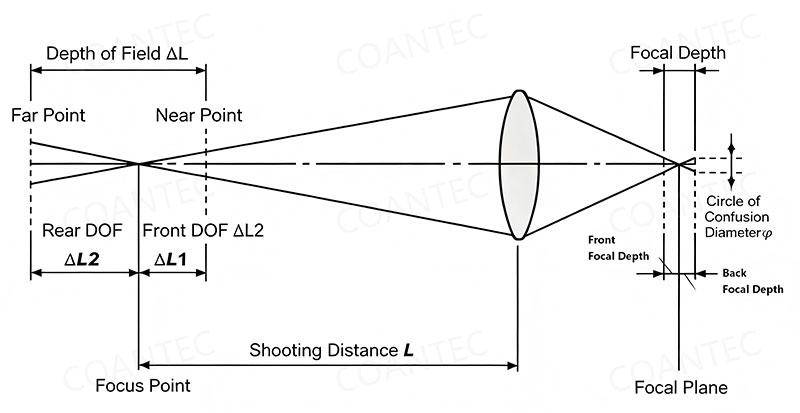
Imagine el espacio delante de la lente como una zona de inspección:
Lente → Región casi clara → Región de mejor enfoque → Región muy clara
Mientras el objetivo de inspección permanezca dentro de la profundidad de campo efectiva, la imagen puede mantener un nivel aceptable de claridad incluso cuando cambia la distancia de inspección.
En términos simples:
La profundidad de campo es el rango de distancias en las que un objetivo de inspección puede permanecer aceptablemente nítido.
Por lo tanto, el DOF no indica simplemente hasta qué punto puede “ver” un boroscopio industrial. En cambio, describe ¿Cuánta variación en la distancia del objetivo se puede acomodar manteniendo una claridad de imagen aceptable?.
En el caso de los boroscopios industriales, la profundidad de campo es también un rango y no una única distancia fija. Su valor práctico es:
Mantenga una claridad de imagen estable y utilizable a medida que la distancia entre la lente y el objetivo de inspección cambia dentro de un rango determinado.
Es importante señalar que la profundidad de campo no es un valor aislado o universalmente fijo. Está influenciada por factores como Diseño de lentes, distancia de trabajo, apertura y condiciones de imagen.. Por lo tanto, las especificaciones DOF siempre deben evaluarse en relación con la aplicación de inspección prevista.
Una de las diferencias clave entre los boroscopios industriales y las cámaras convencionales es que El espacio de inspección es restringido y la distancia al objetivo cambia a menudo durante la inspección..
Por ejemplo, al inspeccionar las palas del motor, es posible que la lente necesite observar superficies a diferentes distancias. Al inspeccionar una cavidad interna de fundición, el objetivo puede extenderse desde una superficie cercana a un área más profunda. Durante la inspección de la tubería, la sonda puede moverse continuamente a través de la tubería.
Si la profundidad de campo efectiva es limitada, incluso un pequeño cambio en la distancia entre la lente y el objetivo puede afectar notablemente la claridad de la imagen. Es posible que el operador necesite reposicionar constantemente la sonda para encontrar la distancia de visualización óptima.
Una profundidad de campo adecuada puede cubrir un rango de inspección efectivo más amplio, lo que permite que la sonda se mueva dentro de ese rango manteniendo una calidad de imagen relativamente estable.
Por lo tanto, desde la perspectiva de la inspección industrial, El valor de la profundidad de campo no es simplemente "ver más lejos". Es la capacidad de mantener una claridad de imagen utilizable a medida que cambia la distancia de inspección.
No necesariamente.
La profundidad de campo es un parámetro de rendimiento óptico importante, pero no debe usarse solo para determinar si un boroscopio industrial es mejor que otro.
Las diferentes tareas de inspección tienen diferentes requisitos de obtención de imágenes.
Por ejemplo:
Grandes cavidades e interiores de equipos: Un rango claro más amplio puede facilitar la observación de estructuras a diferentes distancias.
Soldaduras, grietas, corrosión y rebabas de mecanizado: La resolución de detalles finos y la calidad de la imagen pueden ser más importantes que simplemente maximizar el DOF.
Agujeros profundos y tuberías estrechas: El diámetro de la sonda y la capacidad de inserción también son críticos.
Inspección dimensional: Es necesario considerar las capacidades de medición y la precisión además de la claridad de la imagen.
Por lo tanto:
Un boroscopio industrial no necesariamente funciona mejor simplemente porque tiene una mayor profundidad de campo. El DOF ideal debe coincidir con la distancia de inspección real y los requisitos de identificación de defectos.
La profundidad de campo está estrechamente relacionada con el diseño óptico de la lente y las condiciones en las que se utiliza el boroscopio.
La distancia focal, la apertura y la configuración óptica de la lente afectan la profundidad de campo. Debido a que las sondas de boroscopios industriales suelen tener un diámetro muy pequeño, la lente debe equilibrarse profundidad de campo, resolución, campo de visión y calidad general de la imagen dentro de un espacio muy restringido.
A medida que cambia la distancia entre la lente y el objetivo de inspección, también cambia la condición de la imagen. Por lo tanto, las especificaciones DOF proporcionadas por los fabricantes deben interpretarse junto con sus correspondientes condiciones de prueba en lugar de compararse de forma independiente.
Los entornos industriales internos suelen estar mal iluminados, lo que hace que el sistema de iluminación sea una parte importante del rendimiento general de la imagen.
Es importante distinguir entre los dos:
La profundidad de campo determina qué tan amplio un rango de distancia puede permanecer aceptablemente nítido, mientras que la iluminación determina con qué claridad se pueden ver los detalles dentro de ese rango.
Los dos factores están relacionados con la calidad general de la imagen, pero no deben confundirse.
Diferentes objetivos tienen diferentes requisitos de claridad.
Observar una característica estructural grande es diferente a identificar una pequeña grieta, una mancha de corrosión, un rasguño o un defecto de mecanizado.
Por esta razón, la selección del boroscopio industrial debe comenzar con lo que hay que inspeccionar y luego determinar las características ópticas apropiadas.
Para los profesionales de la inspección, comprender cómo aplicar una especificación DOF es más útil que simplemente conocer su definición.
Una evaluación práctica se puede realizar en tres pasos.
Primero, determine la distancia típica entre la lente y la superficie de inspección una vez que se inserta la sonda en el equipo. Considere también cuánto es probable que cambie esta distancia durante la inspección.
Si la distancia entre la lente y el objetivo varía significativamente, preste especial atención a si el DOF cubre adecuadamente el rango de inspección requerido.
Si el objetivo es simplemente observar estructuras internas, la calidad general de la imagen y la cobertura de visualización pueden ser las principales consideraciones.
Si la inspección requiere identificar grietas, corrosión, porosidad, rayones, rebabas u otros defectos pequeñosTambién se deben evaluar la resolución, la iluminación y el detalle de la imagen.
Al inspeccionar tuberías, motores, piezas fundidas, cajas de cambios y otras estructuras internas complejas, la sonda normalmente necesita moverse continuamente.
Una profundidad de campo adecuada puede mejorar la estabilidad de la imagen durante el movimiento de la sonda. Por lo tanto, la selección del boroscopio industrial debe considerar profundidad de campo, distancia de trabajo, diámetro de la sonda, resolución de imagen, campo de visión, iluminación, articulación y grado de protección como un conjunto completo.
Sólo cuando estas especificaciones coincidan con el objetivo de inspección, el boroscopio podrá ofrecer una solución eficaz de inspección visual interna.
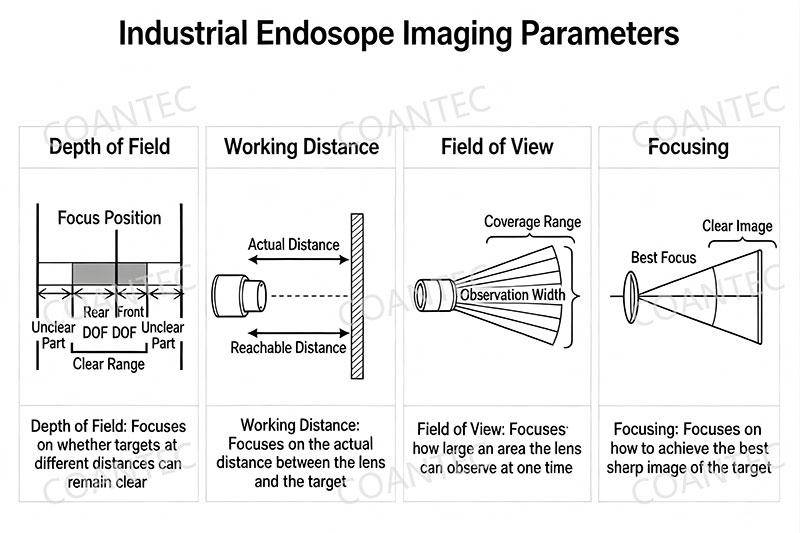
Al revisar las especificaciones del boroscopio industrial, profundidad de campo, distancia de trabajo, campo de visión y enfoque a menudo se enumeran juntos. Sin embargo, describen diferentes aspectos del rendimiento óptico.
Una forma sencilla de distinguirlos es hacer cuatro preguntas:
Distancia de trabajo (WD): ¿A qué distancia está la lente del objetivo de inspección?
Profundidad de campo (DOF): ¿En qué rango de distancia alrededor de la posición focal puede el objetivo permanecer aceptablemente nítido?
Campo de visión (FOV): ¿Qué parte del área objetivo puede capturar la lente a la vez?
Enfocar: ¿Cómo se ajusta o diseña la lente para lograr la imagen más nítida a una distancia determinada?
En términos simples:
La distancia de trabajo determina a qué distancia se inspecciona; la profundidad de campo determina cuánta variación de distancia puede permanecer clara; el campo de visión determina cuánto puedes ver a la vez; y el enfoque determina dónde la imagen es más nítida.
Durante la inspección por boroscopio industrial, la sonda normalmente se mueve hacia adelante, hacia atrás y en diferentes direcciones dentro del equipo. Por tanto, la distancia de trabajo no permanece constante.
Por eso es importante considerar no sólo el distancia mínima de enfoque o una distancia de trabajo nominal única, sino también si la profundidad de campo efectiva cubre el rango de inspección real.
Muchas inspecciones industriales no son fotografías estáticas. En cambio, los operadores Mueva la sonda mientras observa continuamente el objetivo..
Esto es común al inspeccionar tuberías, motores, cajas de cambios, piezas fundidas, moldes y otras estructuras internas.
Una lente con una profundidad de campo efectiva suficientemente amplia puede reducir la necesidad de reposicionamiento frecuente causado por pequeños cambios en la distancia de inspección, haciendo que la inspección visual continua sea más conveniente y eficiente.
Por lo tanto, El valor práctico de DOF radica en mejorar la eficiencia de la inspección y la estabilidad de la imagen durante el movimiento de la sonda.
En aplicaciones prácticas, la profundidad de campo afecta en última instancia Estabilidad de imagen y eficiencia de inspección..
Cuando una sonda se mueve dentro de motores, componentes automotrices, piezas fundidas de precisión, tuberías, moldes y otros espacios confinados, mantener una claridad de imagen estable a lo largo de la distancia de trabajo real facilita la observación continua de las estructuras internas. Esto proporciona una base visual confiable para Identificación de defectos, documentación de imágenes y evaluación posterior..
Por tanto, la profundidad de campo no debe considerarse como una especificación aislada. Necesita trabajar junto con diámetro de la sonda, resolución, campo de visión, iluminación y articulación para cumplir con los requisitos de una tarea de inspección específica.
Coantec tiene una amplia experiencia en tecnologías de inspección por visión industrial y boroscopios industriales, avanzando continuamente en soluciones de imágenes ópticas para diferentes aplicaciones de inspección. Por ejemplo, el Serie Coantec C40 Cuenta con tubos de inserción intercambiables, lo que permite a los usuarios seleccionar diferentes diámetros de sonda, longitudes y configuraciones de profundidad de campo según el espacio de inspección y la distancia del objetivo.
Por lo tanto, al diseñar o seleccionar un boroscopio industrial, El objetivo no es simplemente maximizar el valor DOF, sino hacer coincidir el rango de imagen efectivo con los requisitos de inspección reales.
La profundidad de campo es esencialmente el rango de distancias en las que una lente puede mantener una claridad de imagen aceptable en condiciones de imagen específicas.
No es simplemente una medida de hasta qué punto un boroscopio industrial puede “ver”. Más bien, está estrechamente relacionado con el plano focal, círculo de confusión, apertura, distancia focal, distancia de trabajo y sistema de imágenes.
Para la inspección con boroscopio industrial, la pregunta clave no es si el valor DOF es lo más grande posible, sino si:
La profundidad de campo cubre la distancia de inspección real y proporciona suficiente claridad de imagen para los defectos que se inspeccionan.
Al comprender los principios de profundidad de campo y evaluarlos junto con diámetro de la sonda, resolución, iluminación, campo de visión y articulación, los usuarios pueden seleccionar un boroscopio industrial que se adapte mejor a entornos de inspección complejos, confinados e inaccesibles.
No. La profundidad de campo depende del diseño óptico de la lente, la apertura, la distancia de trabajo y las condiciones de imagen específicas. Por lo tanto, se deben considerar las condiciones de prueba del fabricante y el entorno de inspección real al evaluar el DOF.
Diferentes fabricantes pueden utilizar diferentes definiciones, condiciones de prueba y criterios para una nitidez de imagen aceptable. Al comparar productos, verifique el Configuración de lentes, distancia de trabajo, condiciones de prueba y criterios de imagen. asociado con el DOF indicado.
Algunos boroscopios industriales de enfoque fijo están diseñados ópticamente de modo que las distancias de inspección comunes se encuentren dentro de su rango efectivo de profundidad de campo. Esto permite que la sonda se mueva sin ajustes frecuentes de enfoque, lo que hace que los sistemas de enfoque fijo sean muy adecuados para la inspección interna continua.
Una lente tiene una posición específica de mejor enfoque. Cuando el objetivo se aleja de esta posición, se produce cierto grado de desenfoque. Una vez resultante círculo de confusión excede el límite aceptable, la imagen se vuelve notablemente borrosa.

Derechos de autor © 2025. Coantec Ltd. Todos los derechos reservados. mapa del sitio