
Какие типы освещения используются в промышленных бороскопах? Сравнение светодиодов, оптоволокна и лазера

2026-09-08

В таких отраслях, как аэрокосмическая промышленность, газовые турбины, нефтехимическая обработка и автомобилестроение, многие критически важные компоненты расположены внутри узких, закрытых или иным образом недоступных пространств.

Промышленные бороскопы позволяют инспекторам получать доступ к этим областям через гибкую вставную трубку и отображать внутренние условия в режиме реального времени, что делает их важным инструментом визуального контроля для неразрушающего контроля (NDT).
LED, Fiber-Optic and Laser Compared

Однако получение четких и надежных изображений контроля зависит не только от камеры и оптики.

В большинстве случаев промышленного контроля в проверяемой зоне мало или совсем нет окружающего освещения, и она может быть совершенно темной. Таким образом, количество полезной информации об изображении, получаемой системой визуализации, во многом зависит от освещенности, доступной в точке контроля.

По этой причине освещение является важной частью промышленной системы визуализации бороскопа и одним из ключевых факторов, влияющих на эффективность контроля в реальных условиях.

Итак, какие типы освещения обычно используются в промышленных бороскопах? В чем разница между светодиодным, оптоволоконным и лазерным освещением? И какие технологии лучше подходят для различных задач контроля?

Зачем промышленным бороскопам нужна подсветка?

Чтобы понять роль освещения, полезно сначала понять, как промышленный бороскоп формирует изображение.

Проще говоря, источник света освещает целевую поверхность. Оптика бороскопа собирает отраженный свет, а датчик изображения преобразует эту оптическую информацию в электронные сигналы, которые затем обрабатываются и отображаются в виде изображения.

Таким образом, процесс визуализации можно резюмировать следующим образом:

Свет освещает цель → Отраженный свет попадает в оптику → Датчик изображения фиксирует информацию → Обработка изображения → Отображение

Без достаточного освещения даже датчику изображения с высоким разрешением может быть сложно создать четкое и пригодное для использования изображение.

Это особенно важно при промышленном контроле, где инспекторам часто приходится выявлять очень мелкие особенности поверхности и дефекты. Трещины, коррозия, ожоги, эрозия и царапины на компонентах турбины или двигателя могут быть легко скрыты из-за недостаточного освещения, затененных участков или шума изображения.

Таким образом, возможности визуализации промышленного бороскопа не следует оценивать исключительно по разрешению или размеру дисплея. Работоспособность системы освещения, оптики, датчика изображения и технологии обработки изображений также следует рассматривать как единую систему.

Светодиодное освещение: наиболее распространенная технология освещения в промышленных бороскопах

Светодиодное освещение в настоящее время является наиболее широко используемым решением освещения в промышленных бороскопах и видеоскопах.

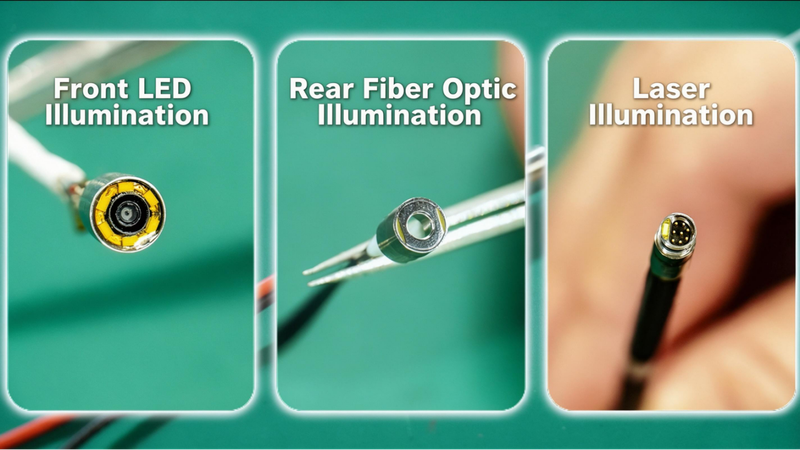
Светодиоды компактны, энергоэффективны, долговечны и относительно просты в управлении, что делает их особенно подходящими для оборудования с крайне ограниченным внутренним пространством. Во многих промышленных бороскопах миниатюрные светодиоды встроены рядом с камерой на дистальном конце вставной трубки, обеспечивая прямое освещение области осмотра.

Для таких применений, как проверка автомобильных двигателей, проверка механических компонентов, проверка внутренних труб и текущее обслуживание оборудования, расстояния проверки обычно относительно короткие. В этих условиях светодиодное освещение может удовлетворить требования большинства плановых визуальных проверок.

Эти преимущества сделали светодиодную технологию доминирующим решением для освещения на рынке промышленных бороскопов.

Однако светодиоды не работают одинаково хорошо в любых условиях проверки.

По мере того как пространство для осмотра становится больше и расстояние обзора увеличивается, свет естественным образом распространяется на более широкую площадь. Таким образом, количество полезного освещения, достигающего удаленной цели, уменьшается. Инспекторам, возможно, придется несколько раз перемещать датчик и перемещать дистальный конец ближе к цели, чтобы получить достаточную яркость и детализацию изображения.

Поэтому для больших и глубоких инспекционных площадей улучшение эффективного освещения на больших расстояниях становится все более важной задачей.

Волоконно-оптическое освещение: доставка света на дистальный конец

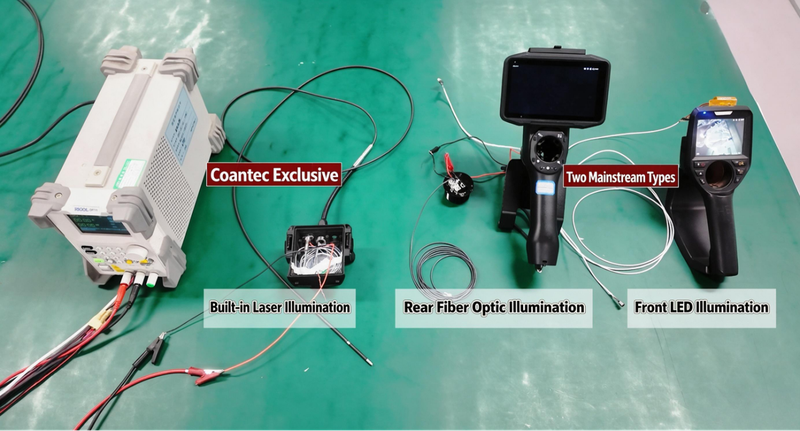
В отличие от светодиодов, установленных непосредственно рядом с камерой, оптоволоконное освещение отделяет источник света от дистального конца бороскопа.

Источник освещения может располагаться в основном блоке или в отдельном внешнем источнике света, при этом световоды передают свет на дистальный конец инструмента.

Эта технология уже давно используется в профессиональных промышленных системах эндоскопического контроля.

Поскольку источник света не ограничен крайне ограниченным пространством, доступным на кончике зонда, система может обеспечить большую гибкость при выборе более мощных или более специализированных источников освещения.

Таким образом, для профессиональных инспекционных задач с более высокими требованиями к освещенности оптоволоконные системы могут обеспечить большую гибкость при проектировании общей оптической системы.

Однако оптоволоконное освещение также может увеличить сложность системы. Источник света, оптоволоконный пучок и система бороскопа должны быть правильно подключены и согласованы, а эксплуатация в полевых условиях может потребовать дополнительного оборудования, соединений и оптической связи.

С технической точки зрения, оптоволоконное освещение подчеркивает разделение источника света и зонда, что обеспечивает большую гибкость в конфигурации источника света. Светодиодное освещение, напротив, больше ориентировано на компактность и удобство.

Лазерное освещение: почему оно привлекает внимание при промышленном контроле?

По сравнению со светодиодным и обычным оптоволоконным освещением, лазерное освещение представляет собой более специализированное техническое направление в промышленных применениях бороскопов.

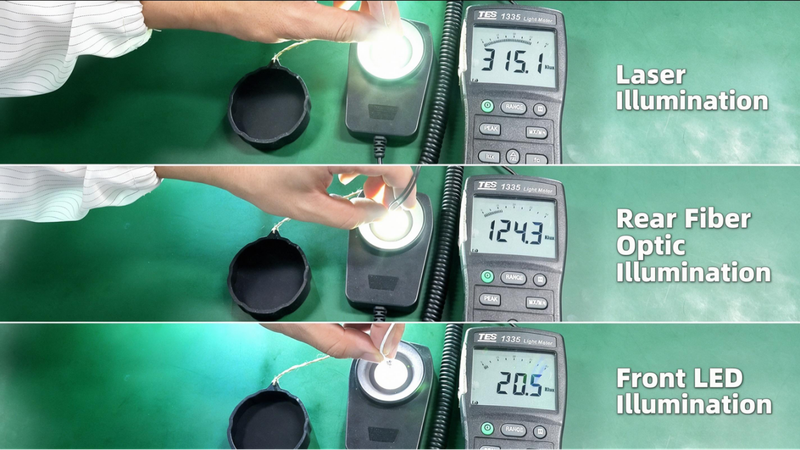
Одной из ключевых характеристик лазерного света является его сильная направленность и высокая концентрация энергии.

In industries such as aerospace, gas turbines, petrochemical processing and automotive manufacturing, many critical components are located inside narrow, enclosed, or otherwise inaccessible spaces. Industrial borescopes enable inspectors to access these areas through a flexible insertion tube and display internal conditions in real time, making them an essential visual inspection tool for non-destructive testing (NDT). However, achieving clear and reliable inspection images depends on more than just the camera and optics. In most industrial inspection environments, the area being inspected has little or no ambient light and may be completely dark. The amount of useful image information captured by the imaging system therefore depends heavily on the illumination available at the inspection point. For this reason, illumination is a critical part of an industrial borescope imaging system and one of the key factors affecting real-world inspection performance. So, what types of illumination are commonly used in industrial borescopes? What are the differences between LED, fiber-optic and laser illumination? And which technologies are better suited to different inspection applications? Why Do Industrial Borescopes Need Illumination? To understand the role of illumination, it is helpful to first understand how an industrial borescope forms an image. In simple terms, the light source illuminates the target surface. The borescope optics collect the reflected light, and the image sensor converts that optical information into electronic signals, which are then processed and displayed as an image. The imaging process can therefore be summarized as: Light illuminates the target → Reflected light enters the optics → The image sensor captures the information → Image processing → Display Without sufficient illumination, even a high-resolution image sensor may struggle to produce a clear and usable image. This is particularly important in industrial inspection, where inspectors often need to identify very small surface features and defects. Cracks, corrosion, burn damage, erosion and scratches on turbine or engine components can easily be obscured by insufficient illumination, shadowed areas or image noise. Therefore, the imaging capability of an industrial borescope should not be evaluated solely by resolution or display size. The performance of the illumination system, optics, image sensor and image-processing technology must also be considered as an integrated system. LED Illumination: The Most Common Lighting Technology in Industrial Borescopes LED illumination is currently the most widely used lighting solution in industrial borescopes and videoscopes. LEDs are compact, energy-efficient, long-lasting and relatively easy to control, making them particularly suitable for equipment with extremely limited internal space. In many industrial borescopes, miniature LEDs are integrated close to the camera at the distal end of the insertion tube, providing direct illumination of the inspection area. For applications such as automotive engine inspection, mechanical component inspection, internal pipe inspection and routine equipment maintenance, inspection distances are typically relatively short. Under these conditions, LED illumination can meet the requirements of most routine visual inspections. These advantages have made LED technology the dominant illumination solution in the industrial borescope market. However, LEDs do not perform equally well in every inspection environment. As the inspection space becomes larger and the viewing distance increases, light naturally spreads over a wider area. The amount of useful illumination reaching a distant target is therefore reduced. Inspectors may need to reposition the probe repeatedly and move the distal end closer to the target in order to obtain sufficient image brightness and detail. For large and deep inspection environments, improving effective long-distance illumination therefore becomes an increasingly important challenge. Fiber-Optic Illumination: Delivering Light to the Distal End Unlike LEDs mounted directly near the camera, fiber-optic illumination separates the light source from the distal end of the borescope. The illumination source can be located in the main unit or in a separate external light source, while optical fibers transmit the light to the distal end of the instrument. This technology has long been used in professional industrial endoscopic inspection systems. Because the light source is not constrained by the extremely limited space available at the probe tip, the system can provide greater flexibility in selecting higher-output or more specialized illumination sources. For professional inspection applications with higher illumination requirements, fiber-optic systems can therefore offer greater flexibility in overall optical system design. However, fiber-optic illumination can also increase system complexity. The light source, fiber bundle and borescope system must be properly connected and matched, while field operation may involve additional equipment, connections and optical coupling requirements. From a technical perspective, fiber-optic illumination emphasizes the separation of the light source and the probe, allowing more flexibility in light-source configuration. LED illumination, by comparison, focuses more on compact integration and convenience. Laser Illumination: Why Is It Attracting Attention in Industrial Inspection? Compared with LED and conventional fiber-optic illumination, laser illumination represents a more specialized technical direction in industrial borescope applications. One of the key characteristics of laser light is its strong directionality and high energy concentration. This does not simply mean that a laser is “brighter than an LED.” More importantly, with appropriate optical design, laser energy can be directed and distributed more effectively toward the inspection target, creating new possibilities for illuminating objects at longer distances and in deep inspection environments. This can be particularly valuable when inspecting large and complex industrial equipment. For example, during the inspection of large aero engines, gas turbines and other complex equipment, the inspector may not always be observing a small target located close to the distal end of the borescope. Instead, the inspection target may include turbine blades, combustion chambers or other structures located within a large and deep internal space. If illumination is effective only at close range, the inspector may need to repeatedly reposition the insertion tube or divide a large inspection area into multiple sections. More effective long-distance illumination can make it possible to observe larger target areas from a more suitable working distance, creating additional flexibility for inspection in large and deep spaces. Therefore, the value of laser illumination is not simply about achieving higher brightness. Its real significance lies in improving illumination efficiency for specific long-distance and large-volume inspection environments where conventional lighting technologies may face limitations. Of course, laser illumination also requires careful optical system design. Industrial equipment often contains highly reflective metallic surfaces. Strong reflections can produce localized highlights or overexposure. For this reason, the laser illumination system must be properly matched with the optical design, image sensor and image-processing algorithms in order to deliver useful inspection performance. LED vs. Fiber-Optic vs. Laser Illumination: What Is the Difference? In practical applications, these three illumination technologies should not simply be classified as “advanced” or “outdated.” Instead, each represents a different technical approach designed for different inspection requirements.  Illumination Technology Key Characteristics Typical Applications  LED Illumination Compact, easy to integrate, mature technology Routine industrial inspection at short distances  Fiber-Optic Illumination Separates the light source from the probe and supports more flexible light-source configurations Professional inspections with higher illumination requirements  Laser Illumination Strong directionality and concentrated optical energy, offering potential advantages for long-distance illumination Large, deep and long-distance industrial inspection environments  Therefore, when selecting an industrial borescope, it is not accurate to assume that laser illumination is automatically better than LED illumination. For routine close-range inspection of mechanical components, LED illumination can provide stable and reliable performance. For specialized applications requiring greater illumination capability or longer observation distances, fiber-optic or laser-based solutions may offer additional advantages. The most suitable illumination technology depends on the inspection object, working distance, internal space and the specific characteristics of the defects being inspected. Why Are Modern Industrial Borescopes Moving Toward Multi-Source Illumination? As industrial inspection targets become increasingly complex, a single white-light source may not be sufficient for every application. Different materials and surface conditions reflect light differently. The same defect may also appear differently under different illumination conditions. As a result, some next-generation industrial borescopes are beginning to offer a wider range of specialized illumination options, including different wavelengths and illumination methods. The purpose of multi-source illumination is not simply to add more lights to the system. Its real value is to provide inspectors with more suitable observation conditions for different inspection objects and tasks. In other words, the key question is changing. In the past, the focus was often: “Is the light bright enough?” Today, the more important question is becoming: “What type of illumination can help the inspector identify the target features more effectively?” Industrial Borescope Illumination Is Evolving from “Lighting” to “Effective Imaging” The development of industrial borescope illumination reflects the changing requirements of industrial inspection. In the early stages, illumination primarily needed to solve one problem: Making the invisible visible. As high-definition imaging technology developed, the focus shifted toward: Seeing more clearly. Today, as industrial inspection increasingly involves large-scale equipment and intelligent visual inspection technologies, illumination systems must also address new requirements: Seeing farther. Seeing more. And working more effectively with imaging algorithms. As a result, the illumination system is no longer simply an independent light source module. It is becoming increasingly integrated into the overall imaging system. The light source determines how the target is illuminated. The optical system determines how reflected light is collected. The image sensor records the information, while image-processing algorithms influence how the final image is presented and analyzed. Only when these elements work together effectively can an industrial borescope deliver meaningful visual inspection performance. The Next Step for Laser Illumination: From Specialized Light Sources to Integrated Systems As laser illumination enters industrial borescope applications, one important development direction is miniaturization and system integration. Traditional professional laser illumination systems often rely on separate light-source modules. While this approach may be acceptable for large stationary inspection systems, it can reduce convenience and operational efficiency for handheld industrial borescopes designed for field inspection. The more equipment and connections required, the greater the impact on portability and ease of use. This raises an important technical question: Can the laser emission system be integrated directly into the handheld industrial borescope itself? This is not simply a matter of adding a laser to the device. Integrating a laser emission module into a handheld borescope requires careful consideration of power supply, thermal management, optical coupling, internal space and overall system reliability. For this reason, integrated laser illumination is fundamentally a test of a manufacturer's system-level engineering and integration capabilities. The Coantec BLX Series AI Industrial Borescope represents one approach to this development direction by integrating the laser emission module directly into the handheld main unit, combining laser illumination with the overall borescope system in a more compact design. Currently, Coantec BLX is the only integrated handheld industrial borescope solution in China that incorporates the laser emission module directly into the main unit. This development reflects a broader trend in which laser illumination is gradually evolving from a separate professional light-source technology toward more compact and portable industrial visual inspection systems. Conclusion: Clear Industrial Inspection Starts with the Right Light The primary purpose of an industrial borescope is to inspect areas that cannot be directly observed. However, the ability to achieve a clear inspection image depends on far more than the camera alone. From LED illumination to fiber-optic light transmission and laser illumination, different technologies have emerged in response to changing industrial inspection requirements. LED illumination meets the needs of most routine close-range inspections. Fiber-optic illumination provides greater flexibility for professional light-source configurations. Laser illumination, meanwhile, is opening new possibilities for long-distance, large-space and deep-cavity inspection. As aerospace engines, gas turbines and other high-end industrial equipment place increasingly demanding requirements on visual inspection, illumination will continue to evolve from a simple supplementary lighting function into a critical component of the overall imaging system. Future competition in industrial borescope technology will therefore extend beyond specifications such as resolution, display size and probe diameter. It will increasingly focus on the integration and coordination of: Illumination · Optics · Imaging · Algorithms · System Engineering The transition of laser illumination from specialized external light sources toward integrated handheld systems may become an important part of this evolution. A high-performance industrial borescope does more than help inspectors see inside. With the right illumination, it helps them see the details that truly matter.

Это не просто означает, что лазер «ярче светодиода».

Что еще более важно, при соответствующей оптической конструкции лазерная энергия может быть более эффективно направлена ​​и распределена по направлению к объекту проверки, создавая новые возможности для освещения объектов на больших расстояниях и в условиях глубокого контроля.

Это может быть особенно ценно при проверке крупного и сложного промышленного оборудования.

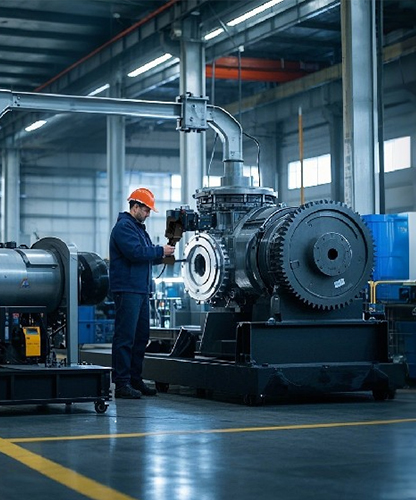
Например, при проверке крупных авиационных двигателей, газовых турбин и другого сложного оборудования инспектор не всегда может наблюдать небольшую цель, расположенную вблизи дистального конца бороскопа. Вместо этого объектом проверки могут быть лопатки турбины, камеры сгорания или другие конструкции, расположенные в большом и глубоком внутреннем пространстве.

Если освещение эффективно только на близком расстоянии, инспектору, возможно, придется несколько раз менять положение вставной трубки или разделить большую зону проверки на несколько секций.

Более эффективное освещение на большом расстоянии может позволить наблюдать большие целевые области с более подходящего рабочего расстояния, создавая дополнительную гибкость при проверке в больших и глубоких пространствах.

Поэтому, Ценность лазерного освещения заключается не только в достижении более высокой яркости. Его реальное значение заключается в повышении эффективности освещения для конкретных условий инспекций на больших расстояниях и в больших объемах, где традиционные технологии освещения могут сталкиваться с ограничениями.

Конечно, лазерное освещение также требует тщательного проектирования оптической системы.

Промышленное оборудование часто содержит металлические поверхности с высокой отражающей способностью. Сильные отражения могут привести к появлению локальных бликов или переэкспонирования. По этой причине система лазерного освещения должна быть правильно согласована с оптической схемой, датчиком изображения и алгоритмами обработки изображений, чтобы обеспечить полезные результаты контроля.

Светодиодное, оптоволоконное и лазерное освещение: в чем разница?

В практическом применении эти три технологии освещения не следует просто классифицировать как «продвинутые» или «устаревшие».

Вместо этого каждый из них представляет собой отдельный технический подход, разработанный для разных требований проверки.

In industries such as aerospace, gas turbines, petrochemical processing and automotive manufacturing, many critical components are located inside narrow, enclosed, or otherwise inaccessible spaces. Industrial borescopes enable inspectors to access these areas through a flexible insertion tube and display internal conditions in real time, making them an essential visual inspection tool for non-destructive testing (NDT). However, achieving clear and reliable inspection images depends on more than just the camera and optics. In most industrial inspection environments, the area being inspected has little or no ambient light and may be completely dark. The amount of useful image information captured by the imaging system therefore depends heavily on the illumination available at the inspection point. For this reason, illumination is a critical part of an industrial borescope imaging system and one of the key factors affecting real-world inspection performance. So, what types of illumination are commonly used in industrial borescopes? What are the differences between LED, fiber-optic and laser illumination? And which technologies are better suited to different inspection applications? Why Do Industrial Borescopes Need Illumination? To understand the role of illumination, it is helpful to first understand how an industrial borescope forms an image. In simple terms, the light source illuminates the target surface. The borescope optics collect the reflected light, and the image sensor converts that optical information into electronic signals, which are then processed and displayed as an image. The imaging process can therefore be summarized as: Light illuminates the target → Reflected light enters the optics → The image sensor captures the information → Image processing → Display Without sufficient illumination, even a high-resolution image sensor may struggle to produce a clear and usable image. This is particularly important in industrial inspection, where inspectors often need to identify very small surface features and defects. Cracks, corrosion, burn damage, erosion and scratches on turbine or engine components can easily be obscured by insufficient illumination, shadowed areas or image noise. Therefore, the imaging capability of an industrial borescope should not be evaluated solely by resolution or display size. The performance of the illumination system, optics, image sensor and image-processing technology must also be considered as an integrated system. LED Illumination: The Most Common Lighting Technology in Industrial Borescopes LED illumination is currently the most widely used lighting solution in industrial borescopes and videoscopes. LEDs are compact, energy-efficient, long-lasting and relatively easy to control, making them particularly suitable for equipment with extremely limited internal space. In many industrial borescopes, miniature LEDs are integrated close to the camera at the distal end of the insertion tube, providing direct illumination of the inspection area. For applications such as automotive engine inspection, mechanical component inspection, internal pipe inspection and routine equipment maintenance, inspection distances are typically relatively short. Under these conditions, LED illumination can meet the requirements of most routine visual inspections. These advantages have made LED technology the dominant illumination solution in the industrial borescope market. However, LEDs do not perform equally well in every inspection environment. As the inspection space becomes larger and the viewing distance increases, light naturally spreads over a wider area. The amount of useful illumination reaching a distant target is therefore reduced. Inspectors may need to reposition the probe repeatedly and move the distal end closer to the target in order to obtain sufficient image brightness and detail. For large and deep inspection environments, improving effective long-distance illumination therefore becomes an increasingly important challenge. Fiber-Optic Illumination: Delivering Light to the Distal End Unlike LEDs mounted directly near the camera, fiber-optic illumination separates the light source from the distal end of the borescope. The illumination source can be located in the main unit or in a separate external light source, while optical fibers transmit the light to the distal end of the instrument. This technology has long been used in professional industrial endoscopic inspection systems. Because the light source is not constrained by the extremely limited space available at the probe tip, the system can provide greater flexibility in selecting higher-output or more specialized illumination sources. For professional inspection applications with higher illumination requirements, fiber-optic systems can therefore offer greater flexibility in overall optical system design. However, fiber-optic illumination can also increase system complexity. The light source, fiber bundle and borescope system must be properly connected and matched, while field operation may involve additional equipment, connections and optical coupling requirements. From a technical perspective, fiber-optic illumination emphasizes the separation of the light source and the probe, allowing more flexibility in light-source configuration. LED illumination, by comparison, focuses more on compact integration and convenience. Laser Illumination: Why Is It Attracting Attention in Industrial Inspection? Compared with LED and conventional fiber-optic illumination, laser illumination represents a more specialized technical direction in industrial borescope applications. One of the key characteristics of laser light is its strong directionality and high energy concentration. This does not simply mean that a laser is “brighter than an LED.” More importantly, with appropriate optical design, laser energy can be directed and distributed more effectively toward the inspection target, creating new possibilities for illuminating objects at longer distances and in deep inspection environments. This can be particularly valuable when inspecting large and complex industrial equipment. For example, during the inspection of large aero engines, gas turbines and other complex equipment, the inspector may not always be observing a small target located close to the distal end of the borescope. Instead, the inspection target may include turbine blades, combustion chambers or other structures located within a large and deep internal space. If illumination is effective only at close range, the inspector may need to repeatedly reposition the insertion tube or divide a large inspection area into multiple sections. More effective long-distance illumination can make it possible to observe larger target areas from a more suitable working distance, creating additional flexibility for inspection in large and deep spaces. Therefore, the value of laser illumination is not simply about achieving higher brightness. Its real significance lies in improving illumination efficiency for specific long-distance and large-volume inspection environments where conventional lighting technologies may face limitations. Of course, laser illumination also requires careful optical system design. Industrial equipment often contains highly reflective metallic surfaces. Strong reflections can produce localized highlights or overexposure. For this reason, the laser illumination system must be properly matched with the optical design, image sensor and image-processing algorithms in order to deliver useful inspection performance. LED vs. Fiber-Optic vs. Laser Illumination: What Is the Difference? In practical applications, these three illumination technologies should not simply be classified as “advanced” or “outdated.” Instead, each represents a different technical approach designed for different inspection requirements.  Illumination Technology Key Characteristics Typical Applications  LED Illumination Compact, easy to integrate, mature technology Routine industrial inspection at short distances  Fiber-Optic Illumination Separates the light source from the probe and supports more flexible light-source configurations Professional inspections with higher illumination requirements  Laser Illumination Strong directionality and concentrated optical energy, offering potential advantages for long-distance illumination Large, deep and long-distance industrial inspection environments  Therefore, when selecting an industrial borescope, it is not accurate to assume that laser illumination is automatically better than LED illumination. For routine close-range inspection of mechanical components, LED illumination can provide stable and reliable performance. For specialized applications requiring greater illumination capability or longer observation distances, fiber-optic or laser-based solutions may offer additional advantages. The most suitable illumination technology depends on the inspection object, working distance, internal space and the specific characteristics of the defects being inspected. Why Are Modern Industrial Borescopes Moving Toward Multi-Source Illumination? As industrial inspection targets become increasingly complex, a single white-light source may not be sufficient for every application. Different materials and surface conditions reflect light differently. The same defect may also appear differently under different illumination conditions. As a result, some next-generation industrial borescopes are beginning to offer a wider range of specialized illumination options, including different wavelengths and illumination methods. The purpose of multi-source illumination is not simply to add more lights to the system. Its real value is to provide inspectors with more suitable observation conditions for different inspection objects and tasks. In other words, the key question is changing. In the past, the focus was often: “Is the light bright enough?” Today, the more important question is becoming: “What type of illumination can help the inspector identify the target features more effectively?” Industrial Borescope Illumination Is Evolving from “Lighting” to “Effective Imaging” The development of industrial borescope illumination reflects the changing requirements of industrial inspection. In the early stages, illumination primarily needed to solve one problem: Making the invisible visible. As high-definition imaging technology developed, the focus shifted toward: Seeing more clearly. Today, as industrial inspection increasingly involves large-scale equipment and intelligent visual inspection technologies, illumination systems must also address new requirements: Seeing farther. Seeing more. And working more effectively with imaging algorithms. As a result, the illumination system is no longer simply an independent light source module. It is becoming increasingly integrated into the overall imaging system. The light source determines how the target is illuminated. The optical system determines how reflected light is collected. The image sensor records the information, while image-processing algorithms influence how the final image is presented and analyzed. Only when these elements work together effectively can an industrial borescope deliver meaningful visual inspection performance. The Next Step for Laser Illumination: From Specialized Light Sources to Integrated Systems As laser illumination enters industrial borescope applications, one important development direction is miniaturization and system integration. Traditional professional laser illumination systems often rely on separate light-source modules. While this approach may be acceptable for large stationary inspection systems, it can reduce convenience and operational efficiency for handheld industrial borescopes designed for field inspection. The more equipment and connections required, the greater the impact on portability and ease of use. This raises an important technical question: Can the laser emission system be integrated directly into the handheld industrial borescope itself? This is not simply a matter of adding a laser to the device. Integrating a laser emission module into a handheld borescope requires careful consideration of power supply, thermal management, optical coupling, internal space and overall system reliability. For this reason, integrated laser illumination is fundamentally a test of a manufacturer's system-level engineering and integration capabilities. The Coantec BLX Series AI Industrial Borescope represents one approach to this development direction by integrating the laser emission module directly into the handheld main unit, combining laser illumination with the overall borescope system in a more compact design. Currently, Coantec BLX is the only integrated handheld industrial borescope solution in China that incorporates the laser emission module directly into the main unit. This development reflects a broader trend in which laser illumination is gradually evolving from a separate professional light-source technology toward more compact and portable industrial visual inspection systems. Conclusion: Clear Industrial Inspection Starts with the Right Light The primary purpose of an industrial borescope is to inspect areas that cannot be directly observed. However, the ability to achieve a clear inspection image depends on far more than the camera alone. From LED illumination to fiber-optic light transmission and laser illumination, different technologies have emerged in response to changing industrial inspection requirements. LED illumination meets the needs of most routine close-range inspections. Fiber-optic illumination provides greater flexibility for professional light-source configurations. Laser illumination, meanwhile, is opening new possibilities for long-distance, large-space and deep-cavity inspection. As aerospace engines, gas turbines and other high-end industrial equipment place increasingly demanding requirements on visual inspection, illumination will continue to evolve from a simple supplementary lighting function into a critical component of the overall imaging system. Future competition in industrial borescope technology will therefore extend beyond specifications such as resolution, display size and probe diameter. It will increasingly focus on the integration and coordination of: Illumination · Optics · Imaging · Algorithms · System Engineering The transition of laser illumination from specialized external light sources toward integrated handheld systems may become an important part of this evolution. A high-performance industrial borescope does more than help inspectors see inside. With the right illumination, it helps them see the details that truly matter.


Технология освещения

Ключевые характеристики

Типичные применения

Светодиодное освещение

Компактная, простая в интеграции, зрелая технология

Плановый производственный контроль на коротких расстояниях

Волоконно-оптическое освещение

Отделяет источник света от зонда и поддерживает более гибкие конфигурации источников света.

Профессиональные проверки с повышенными требованиями к освещенности

Лазерное освещение

Сильная направленность и концентрированная оптическая энергия обеспечивают потенциальные преимущества для освещения на больших расстояниях.

Большие, глубокие и удаленные места промышленного контроля

Поэтому при выборе промышленного бороскопа неверно предполагать, что лазерное освещение автоматически лучше светодиодного.

Светодиодная подсветка может обеспечить стабильную и надежную работу при регулярном осмотре механических компонентов с близкого расстояния. Для специализированных приложений, требующих большей освещенности или больших расстояний наблюдения, волоконно-оптические или лазерные решения могут предложить дополнительные преимущества.

Наиболее подходящая технология освещения зависит от объекта контроля, рабочего расстояния, внутреннего пространства и особенностей проверяемых дефектов.

Почему современные промышленные бороскопы переходят на использование нескольких источников освещения?

Поскольку объекты промышленного контроля становятся все более сложными, одного источника белого света может оказаться недостаточно для каждого применения.

Различные материалы и состояния поверхности по-разному отражают свет. Один и тот же дефект может проявляться по-разному при разных условиях освещенности.

В результате некоторые промышленные бороскопы нового поколения начинают предлагать более широкий спектр специализированных вариантов освещения, включая различные длины волн и методы освещения.

Цель освещения с несколькими источниками — не просто добавить больше света в систему.

Его реальная ценность заключается в том, чтобы предоставить инспекторам более подходящие условия наблюдения для различных объектов и задач проверки.

Другими словами, ключевой вопрос меняется.

Раньше в центре внимания часто было:

— Свет достаточно яркий?

Сегодня более важным вопросом становится:

«Какой тип освещения может помочь инспектору более эффективно идентифицировать целевые объекты?»

Освещение промышленных бороскопов развивается от «освещения» к «эффективному отображению»

Развитие промышленного освещения бороскопов отражает меняющиеся требования промышленного контроля.

На ранних этапах освещение в первую очередь нужно было для решения одной задачи:

Делаем невидимое видимым.

По мере развития технологии визуализации высокой четкости акцент сместился в сторону:

Видеть более ясно.

Сегодня, когда промышленный контроль все чаще включает в себя крупногабаритное оборудование и интеллектуальные технологии визуального контроля, системы освещения также должны отвечать новым требованиям:

Видеть дальше. Видеть больше. И более эффективно работать с алгоритмами визуализации.

В результате система освещения больше не является просто независимым модулем источника света. Он становится все более интегрированным в общую систему визуализации.

Источник света определяет, как освещается цель. Оптическая система определяет, как собирается отраженный свет. Датчик изображения записывает информацию, а алгоритмы обработки изображения влияют на то, как будет представлено и проанализировано окончательное изображение.

Только когда эти элементы эффективно работают вместе, промышленный бороскоп может обеспечить значимые результаты визуального контроля.

Следующий шаг лазерного освещения: от специализированных источников света к интегрированным системам

Поскольку лазерное освещение все чаще применяется в промышленных бороскопах, одним из важных направлений развития является миниатюризация и системная интеграция.

Традиционные профессиональные системы лазерного освещения часто используют отдельные модули источников света. Хотя этот подход может быть приемлем для крупных стационарных систем контроля, он может снизить удобство и эффективность работы портативных промышленных бороскопов, предназначенных для контроля в полевых условиях.

Чем больше оборудования и подключений требуется, тем больше влияние на мобильность и простоту использования.

Возникает важный технический вопрос:

Можно ли интегрировать систему лазерного излучения непосредственно в портативный промышленный бороскоп?

Это не просто вопрос добавления лазера в устройство.

Интеграция модуля лазерного излучения в портативный бороскоп требует тщательного рассмотрения электропитания, управления температурным режимом, оптической связи, внутреннего пространства и общей надежности системы.

По этой причине, Интегрированная лазерная подсветка — это, по сути, проверка инженерных и интеграционных возможностей производителя на системном уровне.

Промышленный бороскоп Coantec серии BLX с искусственным интеллектом представляет собой один из подходов к этому направлению развития, интегрируя модуль лазерного излучения непосредственно в портативный основной блок, сочетая лазерное освещение с всей системой бороскопа в более компактной конструкции.

В настоящее время Coantec BLX является единственным интегрированным портативным промышленным бороскопом в Китае, в котором модуль лазерного излучения встроен непосредственно в основной блок.

Это развитие отражает более широкую тенденцию, в которой лазерное освещение постепенно эволюционирует от технологии отдельного профессионального источника света к более компактным и портативным промышленным системам визуального контроля.

Вывод: четкий промышленный контроль начинается с правильного освещения

Основная цель промышленного бороскопа — осмотр участков, которые невозможно наблюдать напрямую. Однако возможность получения четкого инспекционного изображения зависит не только от камеры.

В ответ на меняющиеся требования промышленного контроля появились различные технологии: от светодиодного освещения до оптоволоконной передачи света и лазерного освещения.

Светодиодное освещение отвечает потребностям большинства рутинных проверок с близкого расстояния. Волоконно-оптическое освещение обеспечивает большую гибкость для профессиональных конфигураций источников света. Лазерное освещение, тем временем, открывает новые возможности для контроля на больших расстояниях, в больших пространствах и глубоких полостях.

Поскольку аэрокосмические двигатели, газовые турбины и другое высокотехнологичное промышленное оборудование предъявляют все более высокие требования к визуальному контролю, освещение будет продолжать превращаться из простой дополнительной функции освещения в важнейший компонент общей системы визуализации.

Таким образом, будущая конкуренция в области технологий промышленных бороскопов выйдет за рамки таких характеристик, как разрешение, размер дисплея и диаметр зонда.

Он будет все больше уделять внимание интеграции и координации:

Освещение · Оптика · Визуализация · Алгоритмы · Системная инженерия

Переход лазерного освещения от специализированных внешних источников света к интегрированным портативным системам может стать важной частью этой эволюции.

Высокопроизводительный промышленный бороскоп делает больше, чем просто помогает инспекторам заглянуть внутрь. Правильное освещение помогает им увидеть действительно важные детали.
flora@chinavideoscope.com

+86-755-89728626

+86 13714520051