
Que tipos de iluminação são usados ​​em boroscópios industriais? LED, fibra óptica e laser comparados

2026-09-08

Em indústrias como a aeroespacial, turbinas a gás, processamento petroquímico e fabricação automotiva, muitos componentes críticos estão localizados em espaços estreitos, fechados ou de outra forma inacessíveis.

Os boroscópios industriais permitem que os inspetores acessem essas áreas através de um tubo de inserção flexível e exibam as condições internas em tempo real, tornando-os uma ferramenta essencial de inspeção visual para testes não destrutivos (END).
LED, Fiber-Optic and Laser Compared

No entanto, obter imagens de inspeção claras e confiáveis ​​depende de mais do que apenas a câmera e a óptica.

Na maioria dos ambientes de inspeção industrial, a área inspecionada tem pouca ou nenhuma luz ambiente e pode estar completamente escura. A quantidade de informação útil da imagem capturada pelo sistema de imagem depende, portanto, fortemente da iluminação disponível no ponto de inspeção.

Por esse motivo, a iluminação é uma parte crítica de um sistema de imagem de boroscópio industrial e um dos principais fatores que afetam o desempenho da inspeção no mundo real.

Então, que tipos de iluminação são comumente usados ​​em boroscópios industriais? Quais são as diferenças entre iluminação LED, fibra óptica e laser? E quais tecnologias são mais adequadas para diferentes aplicações de inspeção?

Por que os boroscópios industriais precisam de iluminação?

Para compreender o papel da iluminação, é útil primeiro compreender como um boroscópio industrial forma uma imagem.

Em termos simples, a fonte de luz ilumina a superfície alvo. A óptica do boroscópio coleta a luz refletida e o sensor de imagem converte essa informação óptica em sinais eletrônicos, que são então processados ​​e exibidos como uma imagem.

O processo de imagem pode, portanto, ser resumido como:

A luz ilumina o alvo → A luz refletida entra na óptica → O sensor de imagem captura a informação → Processamento de imagem → Exibição

Sem iluminação suficiente, mesmo um sensor de imagem de alta resolução pode ter dificuldades para produzir uma imagem nítida e utilizável.

Isto é particularmente importante na inspeção industrial, onde os inspetores muitas vezes precisam identificar características e defeitos superficiais muito pequenos. Rachaduras, corrosão, queimaduras, erosão e arranhões nos componentes da turbina ou do motor podem ser facilmente obscurecidos por iluminação insuficiente, áreas sombreadas ou ruído de imagem.

Portanto, a capacidade de geração de imagens de um boroscópio industrial não deve ser avaliada apenas pela resolução ou tamanho da tela. O desempenho do sistema de iluminação, da óptica, do sensor de imagem e da tecnologia de processamento de imagem também deve ser considerado como um sistema integrado.

Iluminação LED: a tecnologia de iluminação mais comum em boroscópios industriais

A iluminação LED é atualmente a solução de iluminação mais utilizada em boroscópios e videoscópios industriais.

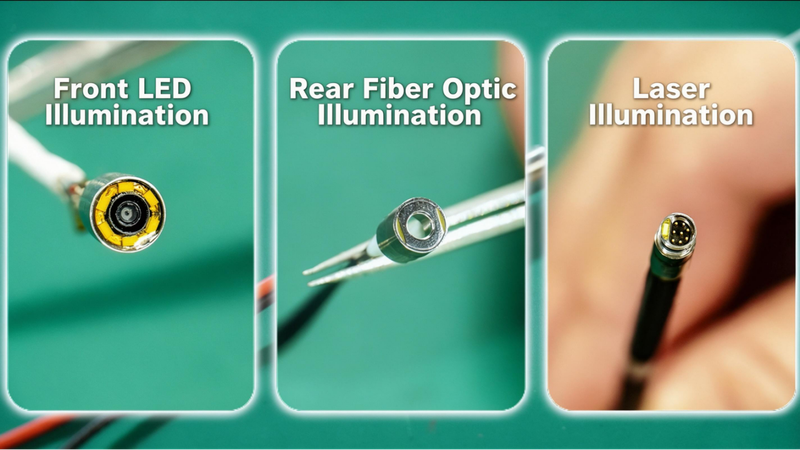
Os LEDs são compactos, energeticamente eficientes, duradouros e relativamente fáceis de controlar, o que os torna particularmente adequados para equipamentos com espaço interno extremamente limitado. Em muitos boroscópios industriais, LEDs em miniatura são integrados próximos à câmera, na extremidade distal do tubo de inserção, proporcionando iluminação direta da área de inspeção.

Para aplicações como inspeção de motores automotivos, inspeção de componentes mecânicos, inspeção de tubulações internas e manutenção de equipamentos de rotina, as distâncias de inspeção são normalmente relativamente curtas. Nessas condições, a iluminação LED pode atender aos requisitos da maioria das inspeções visuais de rotina.

Essas vantagens tornaram a tecnologia LED a solução de iluminação dominante no mercado de boroscópios industriais.

No entanto, os LEDs não funcionam igualmente bem em todos os ambientes de inspeção.

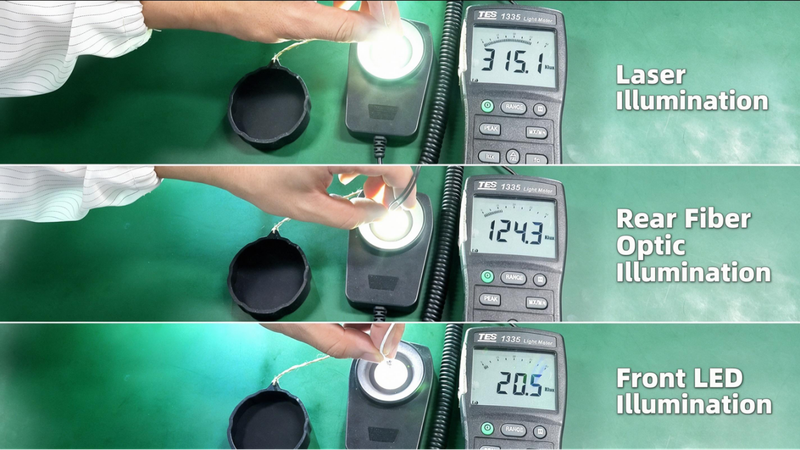
À medida que o espaço de inspeção se torna maior e a distância de visualização aumenta, a luz espalha-se naturalmente por uma área mais ampla. A quantidade de iluminação útil que atinge um alvo distante é, portanto, reduzida. Os inspetores podem precisar reposicionar a sonda repetidamente e mover a extremidade distal para mais perto do alvo, a fim de obter brilho e detalhes suficientes da imagem.

Para ambientes de inspeção grandes e profundos, melhorar a iluminação eficaz de longa distância torna-se, portanto, um desafio cada vez mais importante.

Iluminação de fibra óptica: entregando luz até a extremidade distal

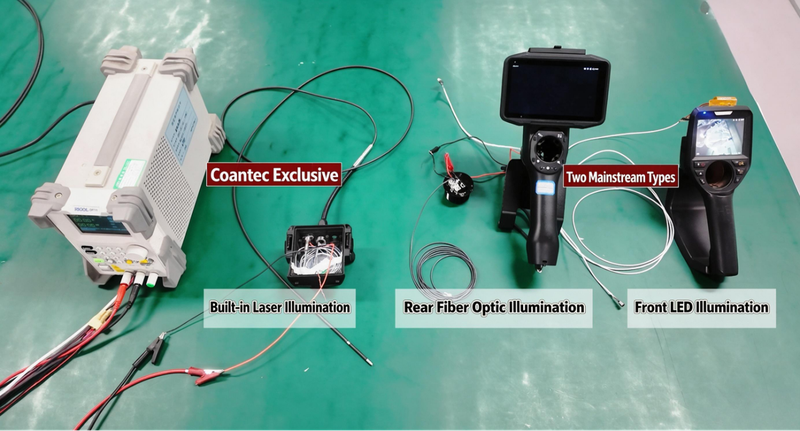
Ao contrário dos LEDs montados diretamente perto da câmera, a iluminação por fibra óptica separa a fonte de luz da extremidade distal do boroscópio.

A fonte de iluminação pode estar localizada na unidade principal ou em uma fonte de luz externa separada, enquanto as fibras ópticas transmitem a luz para a extremidade distal do instrumento.

Esta tecnologia tem sido usada há muito tempo em sistemas profissionais de inspeção endoscópica industrial.

Como a fonte de luz não é limitada pelo espaço extremamente limitado disponível na ponta da sonda, o sistema pode fornecer maior flexibilidade na seleção de fontes de iluminação de maior rendimento ou mais especializadas.

Para aplicações de inspeção profissional com maiores requisitos de iluminação, os sistemas de fibra óptica podem, portanto, oferecer maior flexibilidade no projeto geral do sistema óptico.

No entanto, a iluminação por fibra óptica também pode aumentar a complexidade do sistema. A fonte de luz, o feixe de fibras e o sistema do boroscópio devem estar devidamente conectados e combinados, enquanto a operação em campo pode envolver equipamentos adicionais, conexões e requisitos de acoplamento óptico.

Do ponto de vista técnico, a iluminação por fibra óptica enfatiza a separação da fonte de luz e da sonda, permitindo mais flexibilidade na configuração da fonte de luz. A iluminação LED, em comparação, concentra-se mais na integração compacta e na conveniência.

Iluminação a laser: por que chama a atenção na inspeção industrial?

Em comparação com a iluminação LED e de fibra óptica convencional, a iluminação a laser representa uma direção técnica mais especializada em aplicações industriais de boroscópios.

Uma das principais características da luz laser é a sua forte direcionalidade e alta concentração de energia.

In industries such as aerospace, gas turbines, petrochemical processing and automotive manufacturing, many critical components are located inside narrow, enclosed, or otherwise inaccessible spaces. Industrial borescopes enable inspectors to access these areas through a flexible insertion tube and display internal conditions in real time, making them an essential visual inspection tool for non-destructive testing (NDT). However, achieving clear and reliable inspection images depends on more than just the camera and optics. In most industrial inspection environments, the area being inspected has little or no ambient light and may be completely dark. The amount of useful image information captured by the imaging system therefore depends heavily on the illumination available at the inspection point. For this reason, illumination is a critical part of an industrial borescope imaging system and one of the key factors affecting real-world inspection performance. So, what types of illumination are commonly used in industrial borescopes? What are the differences between LED, fiber-optic and laser illumination? And which technologies are better suited to different inspection applications? Why Do Industrial Borescopes Need Illumination? To understand the role of illumination, it is helpful to first understand how an industrial borescope forms an image. In simple terms, the light source illuminates the target surface. The borescope optics collect the reflected light, and the image sensor converts that optical information into electronic signals, which are then processed and displayed as an image. The imaging process can therefore be summarized as: Light illuminates the target → Reflected light enters the optics → The image sensor captures the information → Image processing → Display Without sufficient illumination, even a high-resolution image sensor may struggle to produce a clear and usable image. This is particularly important in industrial inspection, where inspectors often need to identify very small surface features and defects. Cracks, corrosion, burn damage, erosion and scratches on turbine or engine components can easily be obscured by insufficient illumination, shadowed areas or image noise. Therefore, the imaging capability of an industrial borescope should not be evaluated solely by resolution or display size. The performance of the illumination system, optics, image sensor and image-processing technology must also be considered as an integrated system. LED Illumination: The Most Common Lighting Technology in Industrial Borescopes LED illumination is currently the most widely used lighting solution in industrial borescopes and videoscopes. LEDs are compact, energy-efficient, long-lasting and relatively easy to control, making them particularly suitable for equipment with extremely limited internal space. In many industrial borescopes, miniature LEDs are integrated close to the camera at the distal end of the insertion tube, providing direct illumination of the inspection area. For applications such as automotive engine inspection, mechanical component inspection, internal pipe inspection and routine equipment maintenance, inspection distances are typically relatively short. Under these conditions, LED illumination can meet the requirements of most routine visual inspections. These advantages have made LED technology the dominant illumination solution in the industrial borescope market. However, LEDs do not perform equally well in every inspection environment. As the inspection space becomes larger and the viewing distance increases, light naturally spreads over a wider area. The amount of useful illumination reaching a distant target is therefore reduced. Inspectors may need to reposition the probe repeatedly and move the distal end closer to the target in order to obtain sufficient image brightness and detail. For large and deep inspection environments, improving effective long-distance illumination therefore becomes an increasingly important challenge. Fiber-Optic Illumination: Delivering Light to the Distal End Unlike LEDs mounted directly near the camera, fiber-optic illumination separates the light source from the distal end of the borescope. The illumination source can be located in the main unit or in a separate external light source, while optical fibers transmit the light to the distal end of the instrument. This technology has long been used in professional industrial endoscopic inspection systems. Because the light source is not constrained by the extremely limited space available at the probe tip, the system can provide greater flexibility in selecting higher-output or more specialized illumination sources. For professional inspection applications with higher illumination requirements, fiber-optic systems can therefore offer greater flexibility in overall optical system design. However, fiber-optic illumination can also increase system complexity. The light source, fiber bundle and borescope system must be properly connected and matched, while field operation may involve additional equipment, connections and optical coupling requirements. From a technical perspective, fiber-optic illumination emphasizes the separation of the light source and the probe, allowing more flexibility in light-source configuration. LED illumination, by comparison, focuses more on compact integration and convenience. Laser Illumination: Why Is It Attracting Attention in Industrial Inspection? Compared with LED and conventional fiber-optic illumination, laser illumination represents a more specialized technical direction in industrial borescope applications. One of the key characteristics of laser light is its strong directionality and high energy concentration. This does not simply mean that a laser is “brighter than an LED.” More importantly, with appropriate optical design, laser energy can be directed and distributed more effectively toward the inspection target, creating new possibilities for illuminating objects at longer distances and in deep inspection environments. This can be particularly valuable when inspecting large and complex industrial equipment. For example, during the inspection of large aero engines, gas turbines and other complex equipment, the inspector may not always be observing a small target located close to the distal end of the borescope. Instead, the inspection target may include turbine blades, combustion chambers or other structures located within a large and deep internal space. If illumination is effective only at close range, the inspector may need to repeatedly reposition the insertion tube or divide a large inspection area into multiple sections. More effective long-distance illumination can make it possible to observe larger target areas from a more suitable working distance, creating additional flexibility for inspection in large and deep spaces. Therefore, the value of laser illumination is not simply about achieving higher brightness. Its real significance lies in improving illumination efficiency for specific long-distance and large-volume inspection environments where conventional lighting technologies may face limitations. Of course, laser illumination also requires careful optical system design. Industrial equipment often contains highly reflective metallic surfaces. Strong reflections can produce localized highlights or overexposure. For this reason, the laser illumination system must be properly matched with the optical design, image sensor and image-processing algorithms in order to deliver useful inspection performance. LED vs. Fiber-Optic vs. Laser Illumination: What Is the Difference? In practical applications, these three illumination technologies should not simply be classified as “advanced” or “outdated.” Instead, each represents a different technical approach designed for different inspection requirements.  Illumination Technology Key Characteristics Typical Applications  LED Illumination Compact, easy to integrate, mature technology Routine industrial inspection at short distances  Fiber-Optic Illumination Separates the light source from the probe and supports more flexible light-source configurations Professional inspections with higher illumination requirements  Laser Illumination Strong directionality and concentrated optical energy, offering potential advantages for long-distance illumination Large, deep and long-distance industrial inspection environments  Therefore, when selecting an industrial borescope, it is not accurate to assume that laser illumination is automatically better than LED illumination. For routine close-range inspection of mechanical components, LED illumination can provide stable and reliable performance. For specialized applications requiring greater illumination capability or longer observation distances, fiber-optic or laser-based solutions may offer additional advantages. The most suitable illumination technology depends on the inspection object, working distance, internal space and the specific characteristics of the defects being inspected. Why Are Modern Industrial Borescopes Moving Toward Multi-Source Illumination? As industrial inspection targets become increasingly complex, a single white-light source may not be sufficient for every application. Different materials and surface conditions reflect light differently. The same defect may also appear differently under different illumination conditions. As a result, some next-generation industrial borescopes are beginning to offer a wider range of specialized illumination options, including different wavelengths and illumination methods. The purpose of multi-source illumination is not simply to add more lights to the system. Its real value is to provide inspectors with more suitable observation conditions for different inspection objects and tasks. In other words, the key question is changing. In the past, the focus was often: “Is the light bright enough?” Today, the more important question is becoming: “What type of illumination can help the inspector identify the target features more effectively?” Industrial Borescope Illumination Is Evolving from “Lighting” to “Effective Imaging” The development of industrial borescope illumination reflects the changing requirements of industrial inspection. In the early stages, illumination primarily needed to solve one problem: Making the invisible visible. As high-definition imaging technology developed, the focus shifted toward: Seeing more clearly. Today, as industrial inspection increasingly involves large-scale equipment and intelligent visual inspection technologies, illumination systems must also address new requirements: Seeing farther. Seeing more. And working more effectively with imaging algorithms. As a result, the illumination system is no longer simply an independent light source module. It is becoming increasingly integrated into the overall imaging system. The light source determines how the target is illuminated. The optical system determines how reflected light is collected. The image sensor records the information, while image-processing algorithms influence how the final image is presented and analyzed. Only when these elements work together effectively can an industrial borescope deliver meaningful visual inspection performance. The Next Step for Laser Illumination: From Specialized Light Sources to Integrated Systems As laser illumination enters industrial borescope applications, one important development direction is miniaturization and system integration. Traditional professional laser illumination systems often rely on separate light-source modules. While this approach may be acceptable for large stationary inspection systems, it can reduce convenience and operational efficiency for handheld industrial borescopes designed for field inspection. The more equipment and connections required, the greater the impact on portability and ease of use. This raises an important technical question: Can the laser emission system be integrated directly into the handheld industrial borescope itself? This is not simply a matter of adding a laser to the device. Integrating a laser emission module into a handheld borescope requires careful consideration of power supply, thermal management, optical coupling, internal space and overall system reliability. For this reason, integrated laser illumination is fundamentally a test of a manufacturer's system-level engineering and integration capabilities. The Coantec BLX Series AI Industrial Borescope represents one approach to this development direction by integrating the laser emission module directly into the handheld main unit, combining laser illumination with the overall borescope system in a more compact design. Currently, Coantec BLX is the only integrated handheld industrial borescope solution in China that incorporates the laser emission module directly into the main unit. This development reflects a broader trend in which laser illumination is gradually evolving from a separate professional light-source technology toward more compact and portable industrial visual inspection systems. Conclusion: Clear Industrial Inspection Starts with the Right Light The primary purpose of an industrial borescope is to inspect areas that cannot be directly observed. However, the ability to achieve a clear inspection image depends on far more than the camera alone. From LED illumination to fiber-optic light transmission and laser illumination, different technologies have emerged in response to changing industrial inspection requirements. LED illumination meets the needs of most routine close-range inspections. Fiber-optic illumination provides greater flexibility for professional light-source configurations. Laser illumination, meanwhile, is opening new possibilities for long-distance, large-space and deep-cavity inspection. As aerospace engines, gas turbines and other high-end industrial equipment place increasingly demanding requirements on visual inspection, illumination will continue to evolve from a simple supplementary lighting function into a critical component of the overall imaging system. Future competition in industrial borescope technology will therefore extend beyond specifications such as resolution, display size and probe diameter. It will increasingly focus on the integration and coordination of: Illumination · Optics · Imaging · Algorithms · System Engineering The transition of laser illumination from specialized external light sources toward integrated handheld systems may become an important part of this evolution. A high-performance industrial borescope does more than help inspectors see inside. With the right illumination, it helps them see the details that truly matter.

Isso não significa simplesmente que um laser seja “mais brilhante que um LED”.

Mais importante ainda, com um design óptico adequado, a energia do laser pode ser direcionada e distribuída de forma mais eficaz em direção ao alvo de inspeção, criando novas possibilidades para iluminar objetos a distâncias mais longas e em ambientes de inspeção profundos.

Isto pode ser particularmente valioso ao inspecionar equipamentos industriais grandes e complexos.

Por exemplo, durante a inspeção de grandes motores aeronáuticos, turbinas a gás e outros equipamentos complexos, o inspetor pode nem sempre estar observando um pequeno alvo localizado próximo à extremidade distal do boroscópio. Em vez disso, o alvo da inspeção pode incluir pás de turbina, câmaras de combustão ou outras estruturas localizadas num espaço interno grande e profundo.

Se a iluminação for eficaz apenas a curta distância, o inspetor poderá precisar reposicionar repetidamente o tubo de inserção ou dividir uma grande área de inspeção em múltiplas seções.

Uma iluminação de longa distância mais eficaz pode possibilitar a observação de áreas-alvo maiores a partir de uma distância de trabalho mais adequada, criando flexibilidade adicional para inspeção em espaços grandes e profundos.

Portanto, o valor da iluminação a laser não consiste simplesmente em obter maior brilho. A sua verdadeira importância reside na melhoria da eficiência da iluminação para ambientes específicos de inspecção de longa distância e de grande volume, onde as tecnologias de iluminação convencionais podem enfrentar limitações.

É claro que a iluminação a laser também requer um projeto cuidadoso do sistema óptico.

Equipamentos industriais geralmente contêm superfícies metálicas altamente refletivas. Reflexos fortes podem produzir realces localizados ou superexposição. Por esta razão, o sistema de iluminação a laser deve ser adequadamente combinado com o design óptico, o sensor de imagem e os algoritmos de processamento de imagem, a fim de proporcionar um desempenho de inspeção útil.

Iluminação LED x fibra óptica x iluminação a laser: qual é a diferença?

Em aplicações práticas, estas três tecnologias de iluminação não devem ser simplesmente classificadas como “avançadas” ou “desatualizadas”.

Em vez disso, cada um representa uma abordagem técnica diferente, concebida para diferentes requisitos de inspeção.

In industries such as aerospace, gas turbines, petrochemical processing and automotive manufacturing, many critical components are located inside narrow, enclosed, or otherwise inaccessible spaces. Industrial borescopes enable inspectors to access these areas through a flexible insertion tube and display internal conditions in real time, making them an essential visual inspection tool for non-destructive testing (NDT). However, achieving clear and reliable inspection images depends on more than just the camera and optics. In most industrial inspection environments, the area being inspected has little or no ambient light and may be completely dark. The amount of useful image information captured by the imaging system therefore depends heavily on the illumination available at the inspection point. For this reason, illumination is a critical part of an industrial borescope imaging system and one of the key factors affecting real-world inspection performance. So, what types of illumination are commonly used in industrial borescopes? What are the differences between LED, fiber-optic and laser illumination? And which technologies are better suited to different inspection applications? Why Do Industrial Borescopes Need Illumination? To understand the role of illumination, it is helpful to first understand how an industrial borescope forms an image. In simple terms, the light source illuminates the target surface. The borescope optics collect the reflected light, and the image sensor converts that optical information into electronic signals, which are then processed and displayed as an image. The imaging process can therefore be summarized as: Light illuminates the target → Reflected light enters the optics → The image sensor captures the information → Image processing → Display Without sufficient illumination, even a high-resolution image sensor may struggle to produce a clear and usable image. This is particularly important in industrial inspection, where inspectors often need to identify very small surface features and defects. Cracks, corrosion, burn damage, erosion and scratches on turbine or engine components can easily be obscured by insufficient illumination, shadowed areas or image noise. Therefore, the imaging capability of an industrial borescope should not be evaluated solely by resolution or display size. The performance of the illumination system, optics, image sensor and image-processing technology must also be considered as an integrated system. LED Illumination: The Most Common Lighting Technology in Industrial Borescopes LED illumination is currently the most widely used lighting solution in industrial borescopes and videoscopes. LEDs are compact, energy-efficient, long-lasting and relatively easy to control, making them particularly suitable for equipment with extremely limited internal space. In many industrial borescopes, miniature LEDs are integrated close to the camera at the distal end of the insertion tube, providing direct illumination of the inspection area. For applications such as automotive engine inspection, mechanical component inspection, internal pipe inspection and routine equipment maintenance, inspection distances are typically relatively short. Under these conditions, LED illumination can meet the requirements of most routine visual inspections. These advantages have made LED technology the dominant illumination solution in the industrial borescope market. However, LEDs do not perform equally well in every inspection environment. As the inspection space becomes larger and the viewing distance increases, light naturally spreads over a wider area. The amount of useful illumination reaching a distant target is therefore reduced. Inspectors may need to reposition the probe repeatedly and move the distal end closer to the target in order to obtain sufficient image brightness and detail. For large and deep inspection environments, improving effective long-distance illumination therefore becomes an increasingly important challenge. Fiber-Optic Illumination: Delivering Light to the Distal End Unlike LEDs mounted directly near the camera, fiber-optic illumination separates the light source from the distal end of the borescope. The illumination source can be located in the main unit or in a separate external light source, while optical fibers transmit the light to the distal end of the instrument. This technology has long been used in professional industrial endoscopic inspection systems. Because the light source is not constrained by the extremely limited space available at the probe tip, the system can provide greater flexibility in selecting higher-output or more specialized illumination sources. For professional inspection applications with higher illumination requirements, fiber-optic systems can therefore offer greater flexibility in overall optical system design. However, fiber-optic illumination can also increase system complexity. The light source, fiber bundle and borescope system must be properly connected and matched, while field operation may involve additional equipment, connections and optical coupling requirements. From a technical perspective, fiber-optic illumination emphasizes the separation of the light source and the probe, allowing more flexibility in light-source configuration. LED illumination, by comparison, focuses more on compact integration and convenience. Laser Illumination: Why Is It Attracting Attention in Industrial Inspection? Compared with LED and conventional fiber-optic illumination, laser illumination represents a more specialized technical direction in industrial borescope applications. One of the key characteristics of laser light is its strong directionality and high energy concentration. This does not simply mean that a laser is “brighter than an LED.” More importantly, with appropriate optical design, laser energy can be directed and distributed more effectively toward the inspection target, creating new possibilities for illuminating objects at longer distances and in deep inspection environments. This can be particularly valuable when inspecting large and complex industrial equipment. For example, during the inspection of large aero engines, gas turbines and other complex equipment, the inspector may not always be observing a small target located close to the distal end of the borescope. Instead, the inspection target may include turbine blades, combustion chambers or other structures located within a large and deep internal space. If illumination is effective only at close range, the inspector may need to repeatedly reposition the insertion tube or divide a large inspection area into multiple sections. More effective long-distance illumination can make it possible to observe larger target areas from a more suitable working distance, creating additional flexibility for inspection in large and deep spaces. Therefore, the value of laser illumination is not simply about achieving higher brightness. Its real significance lies in improving illumination efficiency for specific long-distance and large-volume inspection environments where conventional lighting technologies may face limitations. Of course, laser illumination also requires careful optical system design. Industrial equipment often contains highly reflective metallic surfaces. Strong reflections can produce localized highlights or overexposure. For this reason, the laser illumination system must be properly matched with the optical design, image sensor and image-processing algorithms in order to deliver useful inspection performance. LED vs. Fiber-Optic vs. Laser Illumination: What Is the Difference? In practical applications, these three illumination technologies should not simply be classified as “advanced” or “outdated.” Instead, each represents a different technical approach designed for different inspection requirements.  Illumination Technology Key Characteristics Typical Applications  LED Illumination Compact, easy to integrate, mature technology Routine industrial inspection at short distances  Fiber-Optic Illumination Separates the light source from the probe and supports more flexible light-source configurations Professional inspections with higher illumination requirements  Laser Illumination Strong directionality and concentrated optical energy, offering potential advantages for long-distance illumination Large, deep and long-distance industrial inspection environments  Therefore, when selecting an industrial borescope, it is not accurate to assume that laser illumination is automatically better than LED illumination. For routine close-range inspection of mechanical components, LED illumination can provide stable and reliable performance. For specialized applications requiring greater illumination capability or longer observation distances, fiber-optic or laser-based solutions may offer additional advantages. The most suitable illumination technology depends on the inspection object, working distance, internal space and the specific characteristics of the defects being inspected. Why Are Modern Industrial Borescopes Moving Toward Multi-Source Illumination? As industrial inspection targets become increasingly complex, a single white-light source may not be sufficient for every application. Different materials and surface conditions reflect light differently. The same defect may also appear differently under different illumination conditions. As a result, some next-generation industrial borescopes are beginning to offer a wider range of specialized illumination options, including different wavelengths and illumination methods. The purpose of multi-source illumination is not simply to add more lights to the system. Its real value is to provide inspectors with more suitable observation conditions for different inspection objects and tasks. In other words, the key question is changing. In the past, the focus was often: “Is the light bright enough?” Today, the more important question is becoming: “What type of illumination can help the inspector identify the target features more effectively?” Industrial Borescope Illumination Is Evolving from “Lighting” to “Effective Imaging” The development of industrial borescope illumination reflects the changing requirements of industrial inspection. In the early stages, illumination primarily needed to solve one problem: Making the invisible visible. As high-definition imaging technology developed, the focus shifted toward: Seeing more clearly. Today, as industrial inspection increasingly involves large-scale equipment and intelligent visual inspection technologies, illumination systems must also address new requirements: Seeing farther. Seeing more. And working more effectively with imaging algorithms. As a result, the illumination system is no longer simply an independent light source module. It is becoming increasingly integrated into the overall imaging system. The light source determines how the target is illuminated. The optical system determines how reflected light is collected. The image sensor records the information, while image-processing algorithms influence how the final image is presented and analyzed. Only when these elements work together effectively can an industrial borescope deliver meaningful visual inspection performance. The Next Step for Laser Illumination: From Specialized Light Sources to Integrated Systems As laser illumination enters industrial borescope applications, one important development direction is miniaturization and system integration. Traditional professional laser illumination systems often rely on separate light-source modules. While this approach may be acceptable for large stationary inspection systems, it can reduce convenience and operational efficiency for handheld industrial borescopes designed for field inspection. The more equipment and connections required, the greater the impact on portability and ease of use. This raises an important technical question: Can the laser emission system be integrated directly into the handheld industrial borescope itself? This is not simply a matter of adding a laser to the device. Integrating a laser emission module into a handheld borescope requires careful consideration of power supply, thermal management, optical coupling, internal space and overall system reliability. For this reason, integrated laser illumination is fundamentally a test of a manufacturer's system-level engineering and integration capabilities. The Coantec BLX Series AI Industrial Borescope represents one approach to this development direction by integrating the laser emission module directly into the handheld main unit, combining laser illumination with the overall borescope system in a more compact design. Currently, Coantec BLX is the only integrated handheld industrial borescope solution in China that incorporates the laser emission module directly into the main unit. This development reflects a broader trend in which laser illumination is gradually evolving from a separate professional light-source technology toward more compact and portable industrial visual inspection systems. Conclusion: Clear Industrial Inspection Starts with the Right Light The primary purpose of an industrial borescope is to inspect areas that cannot be directly observed. However, the ability to achieve a clear inspection image depends on far more than the camera alone. From LED illumination to fiber-optic light transmission and laser illumination, different technologies have emerged in response to changing industrial inspection requirements. LED illumination meets the needs of most routine close-range inspections. Fiber-optic illumination provides greater flexibility for professional light-source configurations. Laser illumination, meanwhile, is opening new possibilities for long-distance, large-space and deep-cavity inspection. As aerospace engines, gas turbines and other high-end industrial equipment place increasingly demanding requirements on visual inspection, illumination will continue to evolve from a simple supplementary lighting function into a critical component of the overall imaging system. Future competition in industrial borescope technology will therefore extend beyond specifications such as resolution, display size and probe diameter. It will increasingly focus on the integration and coordination of: Illumination · Optics · Imaging · Algorithms · System Engineering The transition of laser illumination from specialized external light sources toward integrated handheld systems may become an important part of this evolution. A high-performance industrial borescope does more than help inspectors see inside. With the right illumination, it helps them see the details that truly matter.


Tecnologia de iluminação

Características principais

Aplicações Típicas

Iluminação LED

Tecnologia compacta, fácil de integrar e madura

Inspeção industrial de rotina em distâncias curtas

Iluminação de fibra óptica

Separa a fonte de luz da sonda e suporta configurações de fonte de luz mais flexíveis

Inspeções profissionais com requisitos de iluminação mais elevados

Iluminação Laser

Forte direcionalidade e energia óptica concentrada, oferecendo vantagens potenciais para iluminação de longa distância

Ambientes de inspeção industrial grandes, profundos e de longa distância

Portanto, ao selecionar um boroscópio industrial, não é correto presumir que a iluminação a laser seja automaticamente melhor que a iluminação LED.

Para inspeção rotineira de componentes mecânicos a curta distância, a iluminação LED pode fornecer desempenho estável e confiável. Para aplicações especializadas que exigem maior capacidade de iluminação ou distâncias de observação mais longas, soluções baseadas em fibra óptica ou laser podem oferecer vantagens adicionais.

A tecnologia de iluminação mais adequada depende do objeto inspecionado, da distância de trabalho, do espaço interno e das características específicas dos defeitos inspecionados.

Por que os boroscópios industriais modernos estão migrando para a iluminação multifonte?

À medida que os objetivos da inspeção industrial se tornam cada vez mais complexos, uma única fonte de luz branca pode não ser suficiente para todas as aplicações.

Diferentes materiais e condições de superfície refletem a luz de maneira diferente. O mesmo defeito também pode aparecer de forma diferente sob diferentes condições de iluminação.

Como resultado, alguns boroscópios industriais de próxima geração estão começando a oferecer uma gama mais ampla de opções de iluminação especializada, incluindo diferentes comprimentos de onda e métodos de iluminação.

O objetivo da iluminação multifonte não é simplesmente adicionar mais luzes ao sistema.

Seu verdadeiro valor é fornecer aos inspetores condições de observação mais adequadas para diferentes objetos e tarefas de inspeção.

Em outras palavras, a questão-chave está mudando.

No passado, o foco era frequentemente:

“A luz é forte o suficiente?”

Hoje, a questão mais importante está se tornando:

“Que tipo de iluminação pode ajudar o inspetor a identificar as características alvo de forma mais eficaz?”

A iluminação do boroscópio industrial está evoluindo de “iluminação” para “imagem eficaz”

O desenvolvimento da iluminação do boroscópio industrial reflete as novas exigências da inspeção industrial.

Nos estágios iniciais, a iluminação precisava principalmente resolver um problema:

Tornando o invisível visível.

À medida que a tecnologia de imagem de alta definição se desenvolveu, o foco mudou para:

Vendo com mais clareza.

Hoje, à medida que a inspeção industrial envolve cada vez mais equipamentos de grande escala e tecnologias inteligentes de inspeção visual, os sistemas de iluminação também devem atender a novos requisitos:

Vendo mais longe. Vendo mais. E trabalhando de forma mais eficaz com algoritmos de imagem.

Como resultado, o sistema de iluminação não é mais simplesmente um módulo de fonte de luz independente. Ele está se tornando cada vez mais integrado ao sistema geral de imagem.

A fonte de luz determina como o alvo é iluminado. O sistema óptico determina como a luz refletida é coletada. O sensor de imagem registra as informações, enquanto os algoritmos de processamento de imagem influenciam a forma como a imagem final é apresentada e analisada.

Somente quando esses elementos funcionam juntos de maneira eficaz é que um boroscópio industrial pode oferecer um desempenho de inspeção visual significativo.

O próximo passo para iluminação a laser: de fontes de luz especializadas a sistemas integrados

À medida que a iluminação a laser entra nas aplicações de boroscópios industriais, uma importante direção de desenvolvimento é miniaturização e integração de sistemas.

Os sistemas tradicionais de iluminação a laser profissional geralmente dependem de módulos de fontes de luz separados. Embora esta abordagem possa ser aceitável para grandes sistemas de inspeção estacionários, ela pode reduzir a conveniência e a eficiência operacional de boroscópios industriais portáteis projetados para inspeção de campo.

Quanto mais equipamentos e conexões forem necessários, maior será o impacto na portabilidade e na facilidade de uso.

Isso levanta uma questão técnica importante:

O sistema de emissão de laser pode ser integrado diretamente no próprio boroscópio industrial portátil?

Não se trata simplesmente de adicionar um laser ao dispositivo.

A integração de um módulo de emissão de laser em um boroscópio portátil requer uma consideração cuidadosa da fonte de alimentação, gerenciamento térmico, acoplamento óptico, espaço interno e confiabilidade geral do sistema.

Por esta razão, a iluminação a laser integrada é fundamentalmente um teste das capacidades de integração e engenharia em nível de sistema de um fabricante.

O Boroscópio Industrial Coantec Série BLX AI representa uma abordagem para essa direção de desenvolvimento, integrando o módulo de emissão de laser diretamente na unidade principal portátil, combinando a iluminação a laser com o sistema geral de boroscópio em um design mais compacto.

Atualmente, o Coantec BLX é a única solução integrada de boroscópio industrial portátil na China que incorpora o módulo de emissão de laser diretamente na unidade principal.

Este desenvolvimento reflete uma tendência mais ampla na qual a iluminação a laser está evoluindo gradualmente de uma tecnologia de fonte de luz profissional separada para sistemas de inspeção visual industrial mais compactos e portáteis.

Conclusão: Uma inspeção industrial clara começa com a luz certa

O objetivo principal de um boroscópio industrial é inspecionar áreas que não podem ser observadas diretamente. No entanto, a capacidade de obter uma imagem de inspeção nítida depende de muito mais do que apenas a câmera.

Da iluminação LED à transmissão de luz por fibra óptica e iluminação a laser, diferentes tecnologias surgiram em resposta às mudanças nos requisitos de inspeção industrial.

A iluminação LED atende às necessidades da maioria das inspeções rotineiras de curta distância. A iluminação por fibra óptica oferece maior flexibilidade para configurações de fontes de luz profissionais. Enquanto isso, a iluminação a laser está abrindo novas possibilidades para inspeção de cavidades profundas, de longa distância e de grandes espaços.

À medida que os motores aeroespaciais, as turbinas a gás e outros equipamentos industriais de ponta impõem requisitos cada vez mais exigentes à inspeção visual, a iluminação continuará a evoluir de uma simples função de iluminação suplementar para um componente crítico do sistema de imagem geral.

A competição futura na tecnologia de boroscópio industrial irá, portanto, estender-se além de especificações como resolução, tamanho de exibição e diâmetro da sonda.

Centrar-se-á cada vez mais na integração e coordenação de:

Iluminação · Óptica · Imagem · Algoritmos · Engenharia de Sistemas

A transição da iluminação a laser de fontes de luz externas especializadas para sistemas portáteis integrados pode se tornar uma parte importante desta evolução.

Um boroscópio industrial de alto desempenho faz mais do que ajudar os inspetores a ver o interior. Com a iluminação certa, ajuda-os a ver os detalhes que realmente importam.
flora@chinavideoscope.com

+86-755-89728626

+86 13714520051