

Ao usar um boroscópio industrial para inspecionar motores, tubulações, peças fundidas, moldes e outras estruturas internas, a sonda geralmente precisa se mover para frente ou para trás ou alterar seu ângulo de visão. Você pode notar que a imagem fica nítida quando a lente está próxima do alvo de inspeção, mas fica desfocada à medida que a lente se afasta.
Isto está intimamente relacionado com o profundidade de campo (DOF) do boroscópio industrial.
Então, Posteriormente, a questão é: qual é a profundidade de campo em um boroscópio industrial? Como é formado? Que fatores afetam isso? Uma profundidade de campo maior é sempre melhor? E como você deve avaliar a especificação DOF ao selecionar um boroscópio industrial?
A compreensão desses fatores pode ajudar os profissionais de inspeção a determinar se um boroscópio é adequado para uma aplicação de inspeção específica.
A profundidade de campo é muitas vezes descrita simplesmente como o “intervalo ao longo do qual uma imagem permanece em foco”. De uma perspectiva óptica, contudo, esta definição não é completamente precisa.
Na verdade, o alvo está em foco perfeito apenas em um plano focal específico. Quando o alvo se afasta deste plano, ocorre uma ligeira desfocagem. No entanto, desde que o desfoque resultante permaneça suficientemente pequeno, a imagem ainda pode parecer nítida ao olho humano ou ao sistema de imagem.
O desfoque produzido pela desfocagem é conhecido como círculo de confusão. Quando o círculo de confusão permanece abaixo de um limite aceitável, o alvo é percebido como estando em foco. O alcance que se estende na frente e atrás do plano focal é o profundidade de campo.
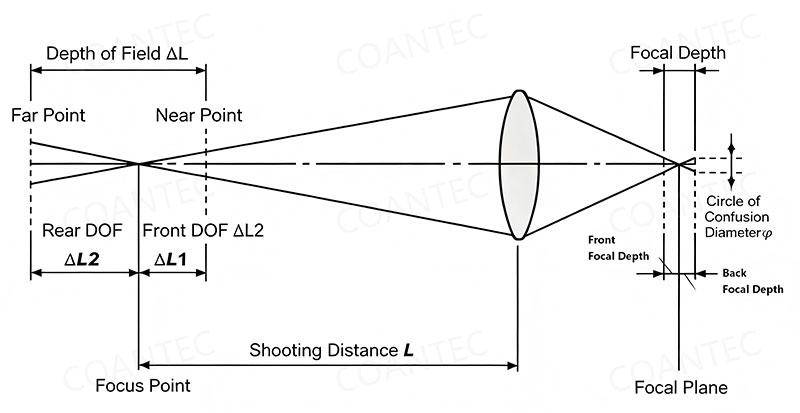
Imagine o espaço em frente à lente como uma zona de inspeção:
Lente → Região quase nítida → Região de melhor foco → Região distante e nítida
Desde que o alvo de inspeção permaneça dentro da profundidade de campo efetiva, a imagem pode manter um nível aceitável de clareza mesmo quando a distância de inspeção muda.
Em termos simples:
Profundidade de campo é a faixa de distâncias nas quais um alvo de inspeção pode permanecer aceitavelmente nítido.
Portanto, o DOF não indica simplesmente até onde um boroscópio industrial pode “ver”. Em vez disso, descreve quanta variação na distância do alvo pode ser acomodada enquanto se mantém uma clareza de imagem aceitável.
Para boroscópios industriais, a profundidade de campo também é um intervalo, e não uma única distância fixa. Seu valor prático é:
Mantenha uma clareza de imagem estável e utilizável à medida que a distância entre a lente e o alvo de inspeção muda dentro de um determinado intervalo.
É importante notar que a profundidade de campo não é um valor isolado ou universalmente fixo. É influenciado por fatores como design da lente, distância de trabalho, abertura e condições de imagem. Portanto, as especificações DOF devem sempre ser avaliadas em relação à aplicação de inspeção pretendida.
Uma das principais diferenças entre boroscópios industriais e câmeras convencionais é que o espaço de inspeção é restrito e a distância até o alvo muda frequentemente durante a inspeção.
Por exemplo, ao inspecionar as pás do motor, a lente pode precisar observar superfícies em distâncias diferentes. Ao inspecionar uma cavidade interna de fundição, o alvo pode se estender de uma superfície próxima até uma área mais profunda. Durante a inspeção da tubulação, a sonda pode mover-se continuamente através da tubulação.
Se a profundidade de campo efetiva for limitada, mesmo uma pequena alteração na distância entre a lente e o alvo pode afetar visivelmente a clareza da imagem. O operador pode então precisar reposicionar constantemente a sonda para encontrar a distância de visualização ideal.
Uma profundidade de campo adequada pode cobrir uma faixa de inspeção efetiva mais ampla, permitindo que a sonda se mova dentro dessa faixa enquanto mantém uma qualidade de imagem relativamente estável.
Do ponto de vista da inspeção industrial, portanto, o valor da profundidade de campo não é simplesmente “ver mais longe”. É a capacidade de manter a clareza da imagem utilizável à medida que a distância de inspeção muda.
Não necessariamente.
A profundidade de campo é um parâmetro importante de desempenho óptico, mas não deve ser usada sozinha para determinar se um boroscópio industrial é melhor que outro.
Diferentes tarefas de inspeção têm diferentes requisitos de imagem.
Por exemplo:
Grandes cavidades e interiores de equipamentos: Um alcance claro mais amplo pode facilitar a observação de estruturas em diferentes distâncias.
Soldas, trincas, corrosão e rebarbas de usinagem: A resolução de detalhes finos e a qualidade da imagem podem ser mais importantes do que simplesmente maximizar o DOF.
Buracos profundos e tubos estreitos: O diâmetro da sonda e a capacidade de inserção também são críticos.
Inspeção dimensional: As capacidades e a precisão da medição precisam ser consideradas além da clareza da imagem.
Portanto:
Um boroscópio industrial não tem necessariamente um desempenho melhor simplesmente porque possui uma profundidade de campo maior. O DOF ideal deve corresponder à distância real de inspeção e aos requisitos de identificação de defeitos.
A profundidade de campo está intimamente relacionada ao design óptico da lente e às condições sob as quais o boroscópio é usado.
A distância focal, a abertura e a configuração óptica da lente afetam a profundidade de campo. Como as sondas do boroscópio industrial normalmente têm diâmetro muito pequeno, a lente deve equilibrar profundidade de campo, resolução, campo de visão e qualidade geral da imagem dentro de um espaço altamente restrito.
À medida que a distância entre a lente e o alvo de inspeção muda, a condição da imagem também muda. Portanto, as especificações DOF fornecidas pelos fabricantes devem ser interpretadas em conjunto com as condições de teste correspondentes, em vez de comparadas de forma independente.
Os ambientes industriais internos costumam ser mal iluminados, tornando o sistema de iluminação uma parte importante do desempenho geral da imagem.
É importante distinguir entre os dois:
A profundidade de campo determina o quão ampla uma faixa de distância pode permanecer aceitavelmente nítida, enquanto a iluminação determina a clareza com que os detalhes podem ser vistos dentro dessa faixa.
Os dois fatores estão relacionados à qualidade geral da imagem, mas não devem ser confundidos.
Alvos diferentes têm requisitos de clareza diferentes.
Observar uma grande característica estrutural é diferente de identificar uma pequena trinca, ponto de corrosão, arranhão ou defeito de usinagem.
Por esta razão, a seleção do boroscópio industrial deve começar com o que precisa ser inspecionado e então determine as características ópticas apropriadas.
Para os profissionais de inspeção, entender como aplicar uma especificação DOF é mais útil do que simplesmente conhecer sua definição.
Uma avaliação prática pode ser feita em três etapas.
Primeiro, determine a distância típica entre a lente e a superfície de inspeção assim que a sonda for inserida no equipamento. Considere também o quanto essa distância provavelmente mudará durante a inspeção.
Se a distância entre a lente e o alvo variar significativamente, preste atenção especial se o DOF cobre adequadamente a faixa de inspeção necessária.
Se o objetivo for simplesmente observar estruturas internas, a qualidade geral da imagem e a cobertura de visualização podem ser as principais considerações.
Se a inspeção exigir a identificação rachaduras, corrosão, porosidade, arranhões, rebarbas ou outros pequenos defeitos, resolução, iluminação e detalhes da imagem também devem ser avaliados.
Ao inspecionar tubulações, motores, peças fundidas, caixas de engrenagens e outras estruturas internas complexas, a sonda normalmente precisa se mover continuamente.
Uma profundidade de campo adequada pode melhorar a estabilidade da imagem durante o movimento da sonda. A seleção do boroscópio industrial deve, portanto, considerar profundidade de campo, distância de trabalho, diâmetro da sonda, resolução de imagem, campo de visão, iluminação, articulação e classificação de proteção como um conjunto completo.
Somente quando essas especificações corresponderem ao objetivo da inspeção o boroscópio poderá fornecer uma solução eficaz de inspeção visual interna.
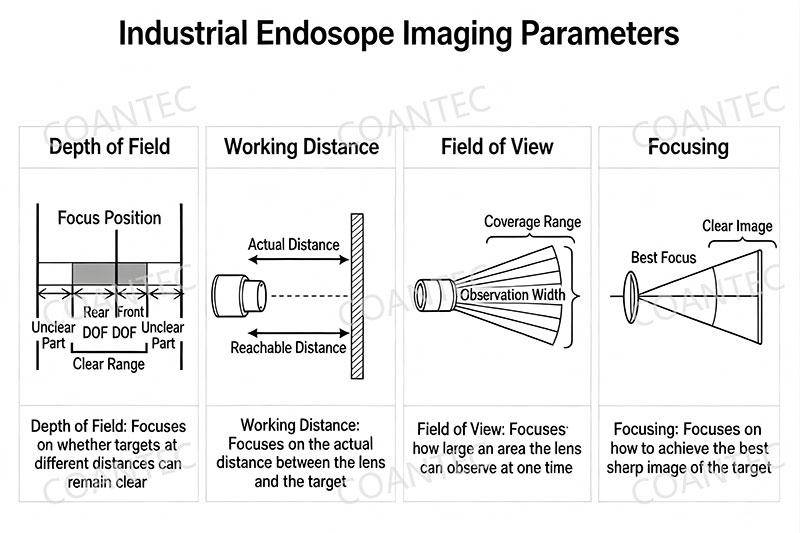
Ao revisar as especificações do boroscópio industrial, profundidade de campo, distância de trabalho, campo de visão e foco são frequentemente listados juntos. No entanto, eles descrevem diferentes aspectos do desempenho óptico.
Uma maneira simples de distingui-los é fazer quatro perguntas:
Distância de trabalho (WD): A que distância está a lente do alvo de inspeção?
Profundidade de campo (DOF): Em que faixa de distância em torno da posição focal o alvo pode permanecer aceitavelmente nítido?
Campo de visão (FOV): Quanto da área alvo a lente pode capturar de uma vez?
Foco: Como a lente é ajustada ou projetada para obter a imagem mais nítida a uma distância específica?
Em termos simples:
A distância de trabalho determina a que distância você inspeciona; a profundidade de campo determina quanta variação de distância pode permanecer nítida; o campo de visão determina o quanto você pode ver de uma vez; e o foco determina onde a imagem é mais nítida.
Durante a inspeção com boroscópio industrial, a sonda normalmente se move para frente, para trás e em diferentes direções dentro do equipamento. A distância de trabalho, portanto, não permanece constante.
É por isso que é importante considerar não apenas o distância mínima de foco ou uma única distância nominal de trabalho, mas também se a profundidade de campo efetiva cobre a faixa real de inspeção.
Muitas inspeções industriais não são fotografias estáticas. Em vez disso, os operadores mova a sonda enquanto observa continuamente o alvo.
Isso é comum ao inspecionar tubulações, motores, caixas de engrenagens, peças fundidas, moldes e outras estruturas internas.
Uma lente com profundidade de campo efetiva suficientemente ampla pode reduzir a necessidade de reposicionamento frequente causado por pequenas alterações na distância de inspeção, tornando a inspeção visual contínua mais conveniente e eficiente.
Portanto, o valor prático do DOF reside na melhoria da eficiência da inspeção e da estabilidade da imagem durante o movimento da sonda.
Em aplicações práticas, a profundidade de campo afeta, em última análise, estabilidade de imagem e eficiência de inspeção.
Quando uma sonda se move dentro de motores, componentes automotivos, peças fundidas de precisão, tubulações, moldes e outros espaços confinados, manter a clareza da imagem estável ao longo da distância real de trabalho facilita a observação contínua das estruturas internas. Isto fornece uma base visual confiável para identificação de defeitos, documentação de imagem e avaliação subsequente.
A profundidade de campo não deve, portanto, ser considerada uma especificação isolada. Precisa trabalhar junto com diâmetro da sonda, resolução, campo de visão, iluminação e articulação para atender aos requisitos de uma tarefa de inspeção específica.
A Coantec tem ampla experiência em tecnologias de boroscópio industrial e inspeção de visão industrial, avançando continuamente em soluções de imagem óptica para diferentes aplicações de inspeção. Por exemplo, o Série Coantec C40 possui tubos de inserção intercambiáveis, permitindo aos usuários selecionar diferentes diâmetros de sonda, comprimentos e configurações de profundidade de campo de acordo com o espaço de inspeção e a distância do alvo.
Portanto, ao projetar ou selecionar um boroscópio industrial, o objetivo não é simplesmente maximizar o valor DOF, mas combinar o alcance efetivo da imagem com os requisitos reais de inspeção.
A profundidade de campo é essencialmente a faixa de distâncias nas quais uma lente pode manter uma clareza de imagem aceitável sob condições específicas de imagem.
Não é simplesmente uma medida de até onde um boroscópio industrial pode “ver”. Em vez disso, está intimamente relacionado com o plano focal, círculo de confusão, abertura, distância focal, distância de trabalho e sistema de imagem.
Para a inspeção com boroscópio industrial, a questão principal não é se o valor DOF é o maior possível, mas se:
A profundidade de campo cobre a distância real de inspeção, ao mesmo tempo que fornece clareza de imagem suficiente para os defeitos que estão sendo inspecionados.
Ao compreender os princípios da profundidade de campo e avaliá-lo juntamente com diâmetro da sonda, resolução, iluminação, campo de visão e articulação, os usuários podem selecionar um boroscópio industrial mais adequado para ambientes de inspeção complexos, confinados e inacessíveis.
Não. A profundidade de campo depende do design óptico da lente, da abertura, da distância de trabalho e das condições específicas de imagem. As condições de teste do fabricante e o ambiente de inspeção real devem, portanto, ser considerados ao avaliar o DOF.
Diferentes fabricantes podem usar diferentes definições, condições de teste e critérios para nitidez de imagem aceitável. Ao comparar produtos, verifique o configuração da lente, distância de trabalho, condições de teste e critérios de imagem associado ao DOF declarado.
Alguns boroscópios industriais de foco fixo são projetados opticamente para que as distâncias de inspeção comuns caiam dentro de sua faixa efetiva de profundidade de campo. Isso permite que a sonda se mova sem ajustes frequentes de foco, tornando os sistemas de foco fixo adequados para inspeção interna contínua.
Uma lente possui uma posição específica de melhor foco. Quando o alvo se afasta desta posição, ocorre algum grau de desfocagem. Uma vez resultante círculo de confusão excede o limite aceitável, a imagem fica visivelmente desfocada.

Direitos autorais © 2025. Coantec Ltd. Todos os direitos reservados. mapa do site