
산업용 내시경에는 어떤 유형의 조명이 사용됩니까? LED, 광섬유 및 레이저 비교

2026-09-08

항공우주, 가스 터빈, 석유화학 가공, 자동차 제조 등의 산업에서는 많은 중요한 구성 요소가 좁거나 밀폐되어 있거나 접근할 수 없는 공간 내에 위치합니다.

산업용 내시경을 사용하면 검사관이 유연한 삽입 튜브를 통해 이러한 영역에 접근하고 내부 상태를 실시간으로 표시할 수 있으므로 비파괴 검사(NDT)에 필수적인 육안 검사 도구가 됩니다.
LED, Fiber-Optic and Laser Compared

그러나 명확하고 신뢰할 수 있는 검사 이미지를 얻는 것은 카메라와 광학 장치 그 이상에 달려 있습니다.

대부분의 산업 검사 환경에서 검사되는 영역에는 주변 조명이 거의 또는 전혀 없으며 완전히 어두울 수 있습니다. 따라서 이미징 시스템이 캡처한 유용한 이미지 정보의 양은 검사 지점에서 사용할 수 있는 조명에 따라 크게 달라집니다.

이러한 이유로 조명은 산업용 내시경 이미징 시스템의 중요한 부분이자 실제 검사 성능에 영향을 미치는 주요 요소 중 하나입니다.

그렇다면 산업용 내시경에는 어떤 유형의 조명이 일반적으로 사용됩니까? LED, 광섬유 및 레이저 조명의 차이점은 무엇입니까? 다양한 검사 응용 분야에 더 적합한 기술은 무엇입니까?

산업용 내시경에 조명이 필요한 이유는 무엇입니까?

조명의 역할을 이해하려면 먼저 산업용 내시경이 이미지를 형성하는 방식을 이해하는 것이 도움이 됩니다.

간단히 말해서 광원은 대상 표면을 비춥니다. 내시경 광학 장치는 반사된 빛을 수집하고, 이미지 센서는 해당 광학 정보를 전자 신호로 변환한 다음 처리하여 이미지로 표시합니다.

따라서 이미징 프로세스는 다음과 같이 요약될 수 있습니다.

빛이 대상을 비춥니다 → 반사된 빛이 광학 장치에 들어갑니다 → 이미지 센서가 정보를 캡처합니다 → 이미지 처리 → 디스플레이

조명이 충분하지 않으면 고해상도 이미지 센서라도 선명하고 사용 가능한 이미지를 생성하는 데 어려움을 겪을 수 있습니다.

이는 검사관이 매우 작은 표면 특징과 결함을 식별해야 하는 산업 검사에서 특히 중요합니다. 터빈이나 엔진 부품의 균열, 부식, 연소 손상, 침식 및 긁힘은 조명 부족, 그림자 영역 또는 이미지 노이즈로 인해 쉽게 가려질 수 있습니다.

따라서 산업용 내시경의 이미징 기능을 해상도나 디스플레이 크기만으로 평가해서는 안 됩니다. 조명 시스템, 광학, 이미지 센서, 이미지 처리 기술의 성능도 통합 시스템으로 고려해야 합니다.

LED 조명: 산업용 내시경의 가장 일반적인 조명 기술

LED 조명은 현재 산업용 내시경 및 비디오 내시경에서 가장 널리 사용되는 조명 솔루션입니다.

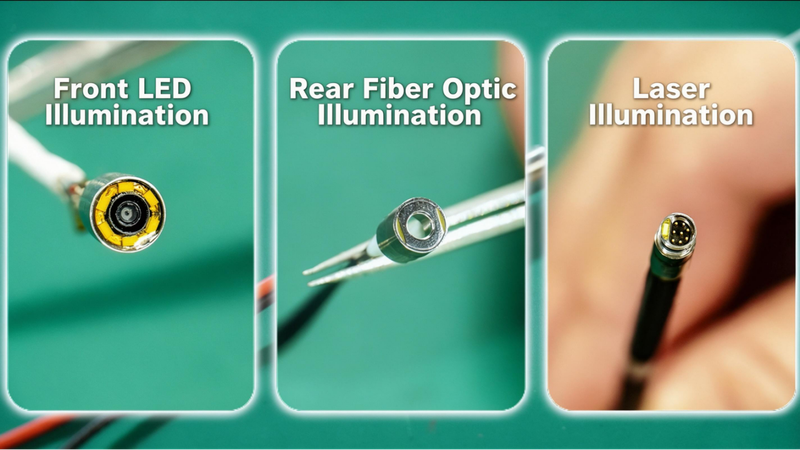
LED는 소형이고 에너지 효율적이며 오래 지속되고 상대적으로 제어하기 쉽기 때문에 내부 공간이 극도로 제한된 장비에 특히 적합합니다. 많은 산업용 내시경에서는 소형 LED가 삽입 튜브의 말단부에 있는 카메라 가까이에 통합되어 검사 영역을 직접 조명합니다.

자동차 엔진 검사, 기계 부품 검사, 내부 파이프 검사 및 일상적인 장비 유지 관리와 같은 응용 분야의 경우 일반적으로 검사 거리가 상대적으로 짧습니다. 이러한 조건에서 LED 조명은 대부분의 일상적인 육안 검사 요구 사항을 충족할 수 있습니다.

이러한 장점으로 인해 LED 기술은 산업용 내시경 시장에서 지배적인 조명 솔루션이 되었습니다.

그러나 LED는 모든 검사 환경에서 동일하게 성능을 발휘하는 것은 아닙니다.

검사 공간이 넓어지고 관찰 거리가 길어질수록 빛은 자연스럽게 더 넓은 영역으로 퍼집니다. 따라서 먼 목표물에 도달하는 유용한 조명의 양이 줄어듭니다. 검사자는 충분한 이미지 밝기와 세부 묘사를 얻기 위해 반복적으로 프로브 위치를 변경하고 말단부를 대상에 더 가깝게 이동해야 할 수도 있습니다.

따라서 크고 깊은 검사 환경에서는 효과적인 장거리 조명을 개선하는 것이 점점 더 중요한 과제가 되고 있습니다.

광섬유 조명: 말단부까지 빛 전달

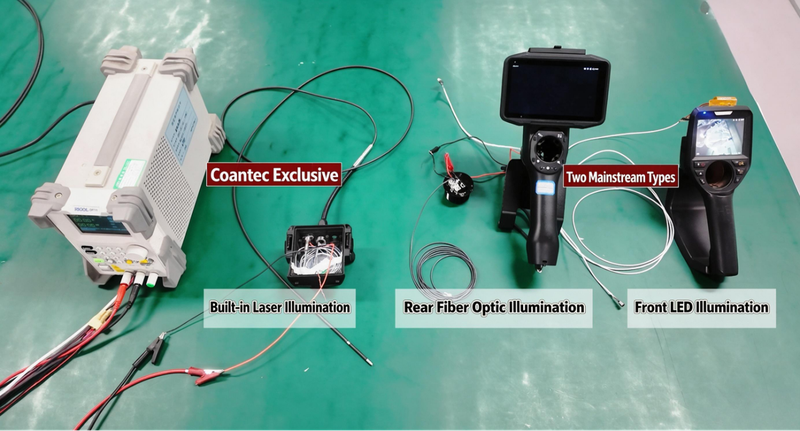
카메라 근처에 직접 장착된 LED와 달리 광섬유 조명은 내시경의 말단부에서 광원을 분리합니다.

조명 소스는 본체 또는 별도의 외부 광원에 위치할 수 있으며, 광섬유는 빛을 장비의 말단부로 전송합니다.

이 기술은 오랫동안 전문 산업용 내시경 검사 시스템에 사용되어 왔습니다.

프로브 팁에서 사용할 수 있는 극도로 제한된 공간으로 인해 광원이 제한되지 않기 때문에 시스템은 더 높은 출력 또는 더 특수화된 조명 소스를 선택할 때 더 큰 유연성을 제공할 수 있습니다.

따라서 조명 요구 사항이 더 높은 전문 검사 응용 분야의 경우 광섬유 시스템은 전체 광학 시스템 설계에 더 큰 유연성을 제공할 수 있습니다.

그러나 광섬유 조명은 시스템 복잡성을 증가시킬 수도 있습니다. 광원, 광섬유 번들 및 내시경 시스템은 적절하게 연결되고 일치해야 하며 현장 작업에는 추가 장비, 연결 및 광학 커플링 요구 사항이 포함될 수 있습니다.

기술적인 관점에서 보면, 광섬유 조명은 광원과 프로브의 분리를 강조합니다., 광원 구성에 더 많은 유연성을 허용합니다. 이에 비해 LED 조명은 컴팩트한 통합과 편의성에 더 중점을 둡니다.

레이저 조명: 산업 검사에서 주목받는 이유는 무엇입니까?

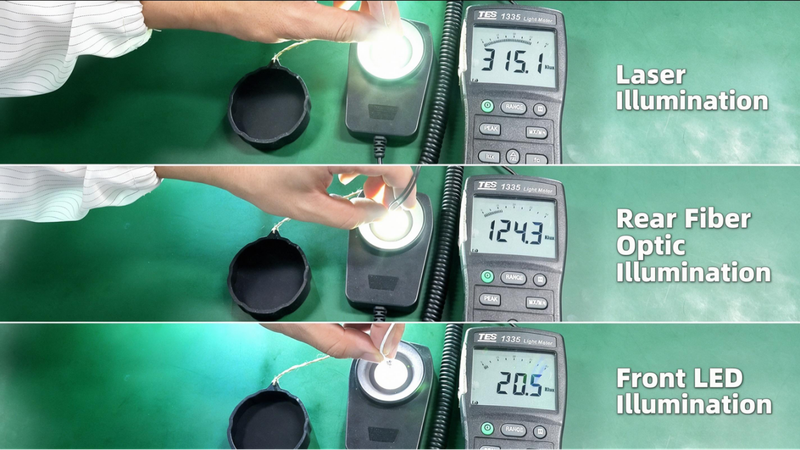
LED 및 기존 광섬유 조명과 비교하여 레이저 조명은 산업용 내시경 응용 분야에서 보다 전문적인 기술 방향을 나타냅니다.

레이저 빛의 주요 특징 중 하나는 강한 방향성과 높은 에너지 집중도입니다.

In industries such as aerospace, gas turbines, petrochemical processing and automotive manufacturing, many critical components are located inside narrow, enclosed, or otherwise inaccessible spaces. Industrial borescopes enable inspectors to access these areas through a flexible insertion tube and display internal conditions in real time, making them an essential visual inspection tool for non-destructive testing (NDT). However, achieving clear and reliable inspection images depends on more than just the camera and optics. In most industrial inspection environments, the area being inspected has little or no ambient light and may be completely dark. The amount of useful image information captured by the imaging system therefore depends heavily on the illumination available at the inspection point. For this reason, illumination is a critical part of an industrial borescope imaging system and one of the key factors affecting real-world inspection performance. So, what types of illumination are commonly used in industrial borescopes? What are the differences between LED, fiber-optic and laser illumination? And which technologies are better suited to different inspection applications? Why Do Industrial Borescopes Need Illumination? To understand the role of illumination, it is helpful to first understand how an industrial borescope forms an image. In simple terms, the light source illuminates the target surface. The borescope optics collect the reflected light, and the image sensor converts that optical information into electronic signals, which are then processed and displayed as an image. The imaging process can therefore be summarized as: Light illuminates the target → Reflected light enters the optics → The image sensor captures the information → Image processing → Display Without sufficient illumination, even a high-resolution image sensor may struggle to produce a clear and usable image. This is particularly important in industrial inspection, where inspectors often need to identify very small surface features and defects. Cracks, corrosion, burn damage, erosion and scratches on turbine or engine components can easily be obscured by insufficient illumination, shadowed areas or image noise. Therefore, the imaging capability of an industrial borescope should not be evaluated solely by resolution or display size. The performance of the illumination system, optics, image sensor and image-processing technology must also be considered as an integrated system. LED Illumination: The Most Common Lighting Technology in Industrial Borescopes LED illumination is currently the most widely used lighting solution in industrial borescopes and videoscopes. LEDs are compact, energy-efficient, long-lasting and relatively easy to control, making them particularly suitable for equipment with extremely limited internal space. In many industrial borescopes, miniature LEDs are integrated close to the camera at the distal end of the insertion tube, providing direct illumination of the inspection area. For applications such as automotive engine inspection, mechanical component inspection, internal pipe inspection and routine equipment maintenance, inspection distances are typically relatively short. Under these conditions, LED illumination can meet the requirements of most routine visual inspections. These advantages have made LED technology the dominant illumination solution in the industrial borescope market. However, LEDs do not perform equally well in every inspection environment. As the inspection space becomes larger and the viewing distance increases, light naturally spreads over a wider area. The amount of useful illumination reaching a distant target is therefore reduced. Inspectors may need to reposition the probe repeatedly and move the distal end closer to the target in order to obtain sufficient image brightness and detail. For large and deep inspection environments, improving effective long-distance illumination therefore becomes an increasingly important challenge. Fiber-Optic Illumination: Delivering Light to the Distal End Unlike LEDs mounted directly near the camera, fiber-optic illumination separates the light source from the distal end of the borescope. The illumination source can be located in the main unit or in a separate external light source, while optical fibers transmit the light to the distal end of the instrument. This technology has long been used in professional industrial endoscopic inspection systems. Because the light source is not constrained by the extremely limited space available at the probe tip, the system can provide greater flexibility in selecting higher-output or more specialized illumination sources. For professional inspection applications with higher illumination requirements, fiber-optic systems can therefore offer greater flexibility in overall optical system design. However, fiber-optic illumination can also increase system complexity. The light source, fiber bundle and borescope system must be properly connected and matched, while field operation may involve additional equipment, connections and optical coupling requirements. From a technical perspective, fiber-optic illumination emphasizes the separation of the light source and the probe, allowing more flexibility in light-source configuration. LED illumination, by comparison, focuses more on compact integration and convenience. Laser Illumination: Why Is It Attracting Attention in Industrial Inspection? Compared with LED and conventional fiber-optic illumination, laser illumination represents a more specialized technical direction in industrial borescope applications. One of the key characteristics of laser light is its strong directionality and high energy concentration. This does not simply mean that a laser is “brighter than an LED.” More importantly, with appropriate optical design, laser energy can be directed and distributed more effectively toward the inspection target, creating new possibilities for illuminating objects at longer distances and in deep inspection environments. This can be particularly valuable when inspecting large and complex industrial equipment. For example, during the inspection of large aero engines, gas turbines and other complex equipment, the inspector may not always be observing a small target located close to the distal end of the borescope. Instead, the inspection target may include turbine blades, combustion chambers or other structures located within a large and deep internal space. If illumination is effective only at close range, the inspector may need to repeatedly reposition the insertion tube or divide a large inspection area into multiple sections. More effective long-distance illumination can make it possible to observe larger target areas from a more suitable working distance, creating additional flexibility for inspection in large and deep spaces. Therefore, the value of laser illumination is not simply about achieving higher brightness. Its real significance lies in improving illumination efficiency for specific long-distance and large-volume inspection environments where conventional lighting technologies may face limitations. Of course, laser illumination also requires careful optical system design. Industrial equipment often contains highly reflective metallic surfaces. Strong reflections can produce localized highlights or overexposure. For this reason, the laser illumination system must be properly matched with the optical design, image sensor and image-processing algorithms in order to deliver useful inspection performance. LED vs. Fiber-Optic vs. Laser Illumination: What Is the Difference? In practical applications, these three illumination technologies should not simply be classified as “advanced” or “outdated.” Instead, each represents a different technical approach designed for different inspection requirements.  Illumination Technology Key Characteristics Typical Applications  LED Illumination Compact, easy to integrate, mature technology Routine industrial inspection at short distances  Fiber-Optic Illumination Separates the light source from the probe and supports more flexible light-source configurations Professional inspections with higher illumination requirements  Laser Illumination Strong directionality and concentrated optical energy, offering potential advantages for long-distance illumination Large, deep and long-distance industrial inspection environments  Therefore, when selecting an industrial borescope, it is not accurate to assume that laser illumination is automatically better than LED illumination. For routine close-range inspection of mechanical components, LED illumination can provide stable and reliable performance. For specialized applications requiring greater illumination capability or longer observation distances, fiber-optic or laser-based solutions may offer additional advantages. The most suitable illumination technology depends on the inspection object, working distance, internal space and the specific characteristics of the defects being inspected. Why Are Modern Industrial Borescopes Moving Toward Multi-Source Illumination? As industrial inspection targets become increasingly complex, a single white-light source may not be sufficient for every application. Different materials and surface conditions reflect light differently. The same defect may also appear differently under different illumination conditions. As a result, some next-generation industrial borescopes are beginning to offer a wider range of specialized illumination options, including different wavelengths and illumination methods. The purpose of multi-source illumination is not simply to add more lights to the system. Its real value is to provide inspectors with more suitable observation conditions for different inspection objects and tasks. In other words, the key question is changing. In the past, the focus was often: “Is the light bright enough?” Today, the more important question is becoming: “What type of illumination can help the inspector identify the target features more effectively?” Industrial Borescope Illumination Is Evolving from “Lighting” to “Effective Imaging” The development of industrial borescope illumination reflects the changing requirements of industrial inspection. In the early stages, illumination primarily needed to solve one problem: Making the invisible visible. As high-definition imaging technology developed, the focus shifted toward: Seeing more clearly. Today, as industrial inspection increasingly involves large-scale equipment and intelligent visual inspection technologies, illumination systems must also address new requirements: Seeing farther. Seeing more. And working more effectively with imaging algorithms. As a result, the illumination system is no longer simply an independent light source module. It is becoming increasingly integrated into the overall imaging system. The light source determines how the target is illuminated. The optical system determines how reflected light is collected. The image sensor records the information, while image-processing algorithms influence how the final image is presented and analyzed. Only when these elements work together effectively can an industrial borescope deliver meaningful visual inspection performance. The Next Step for Laser Illumination: From Specialized Light Sources to Integrated Systems As laser illumination enters industrial borescope applications, one important development direction is miniaturization and system integration. Traditional professional laser illumination systems often rely on separate light-source modules. While this approach may be acceptable for large stationary inspection systems, it can reduce convenience and operational efficiency for handheld industrial borescopes designed for field inspection. The more equipment and connections required, the greater the impact on portability and ease of use. This raises an important technical question: Can the laser emission system be integrated directly into the handheld industrial borescope itself? This is not simply a matter of adding a laser to the device. Integrating a laser emission module into a handheld borescope requires careful consideration of power supply, thermal management, optical coupling, internal space and overall system reliability. For this reason, integrated laser illumination is fundamentally a test of a manufacturer's system-level engineering and integration capabilities. The Coantec BLX Series AI Industrial Borescope represents one approach to this development direction by integrating the laser emission module directly into the handheld main unit, combining laser illumination with the overall borescope system in a more compact design. Currently, Coantec BLX is the only integrated handheld industrial borescope solution in China that incorporates the laser emission module directly into the main unit. This development reflects a broader trend in which laser illumination is gradually evolving from a separate professional light-source technology toward more compact and portable industrial visual inspection systems. Conclusion: Clear Industrial Inspection Starts with the Right Light The primary purpose of an industrial borescope is to inspect areas that cannot be directly observed. However, the ability to achieve a clear inspection image depends on far more than the camera alone. From LED illumination to fiber-optic light transmission and laser illumination, different technologies have emerged in response to changing industrial inspection requirements. LED illumination meets the needs of most routine close-range inspections. Fiber-optic illumination provides greater flexibility for professional light-source configurations. Laser illumination, meanwhile, is opening new possibilities for long-distance, large-space and deep-cavity inspection. As aerospace engines, gas turbines and other high-end industrial equipment place increasingly demanding requirements on visual inspection, illumination will continue to evolve from a simple supplementary lighting function into a critical component of the overall imaging system. Future competition in industrial borescope technology will therefore extend beyond specifications such as resolution, display size and probe diameter. It will increasingly focus on the integration and coordination of: Illumination · Optics · Imaging · Algorithms · System Engineering The transition of laser illumination from specialized external light sources toward integrated handheld systems may become an important part of this evolution. A high-performance industrial borescope does more than help inspectors see inside. With the right illumination, it helps them see the details that truly matter.

이는 단순히 레이저가 "LED보다 밝다"는 의미는 아닙니다.

더 중요한 것은 적절한 광학 설계를 통해 레이저 에너지를 검사 대상을 향해 보다 효과적으로 지향하고 분산시킬 수 있어 더 먼 거리와 심층 검사 환경에서 물체를 조명할 수 있는 새로운 가능성을 창출한다는 것입니다.

이는 크고 복잡한 산업 장비를 검사할 때 특히 유용할 수 있습니다.

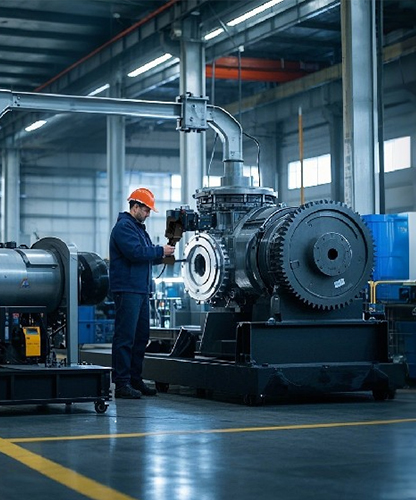
예를 들어, 대형 항공기 엔진, 가스 터빈 및 기타 복잡한 장비를 검사하는 동안 검사자는 내시경의 말단부 가까이에 위치한 작은 표적을 항상 관찰하지 못할 수도 있습니다. 대신에 검사 대상에는 크고 깊은 내부 공간에 위치한 터빈 블레이드, 연소실 또는 기타 구조물이 포함될 수 있습니다.

조명이 근거리에서만 효과적인 경우 검사자는 삽입 튜브의 위치를 ​​반복적으로 변경하거나 넓은 검사 영역을 여러 섹션으로 나누어야 할 수도 있습니다.

보다 효과적인 장거리 조명을 사용하면 보다 적합한 작업 거리에서 더 넓은 대상 영역을 관찰할 수 있으므로 넓고 깊은 공간에서 검사할 수 있는 유연성이 향상됩니다.

그러므로, 레이저 조명의 가치는 단순히 더 높은 밝기를 달성하는 데만 국한되지 않습니다. 그 진정한 의미는 기존 조명 기술이 한계에 직면할 수 있는 특정 장거리 및 대규모 검사 환경에서 조명 효율성을 향상시키는 데 있습니다.

물론 레이저 조명에는 세심한 광학 시스템 설계도 필요합니다.

산업용 장비에는 반사율이 높은 금속 표면이 포함되어 있는 경우가 많습니다. 반사가 강하면 국부적인 하이라이트나 노출 과다가 발생할 수 있습니다. 이러한 이유로 레이저 조명 시스템은 유용한 검사 성능을 제공하기 위해 광학 설계, 이미지 센서 및 이미지 처리 알고리즘과 적절하게 조화되어야 합니다.

LED, 광섬유, 레이저 조명: 차이점은 무엇입니까?

실제 응용 분야에서 이 세 가지 조명 기술은 단순히 "고급" 또는 "구식"으로 분류되어서는 안 됩니다.

대신, 각각은 다양한 검사 요구 사항에 맞게 설계된 서로 다른 기술적 접근 방식을 나타냅니다.

In industries such as aerospace, gas turbines, petrochemical processing and automotive manufacturing, many critical components are located inside narrow, enclosed, or otherwise inaccessible spaces. Industrial borescopes enable inspectors to access these areas through a flexible insertion tube and display internal conditions in real time, making them an essential visual inspection tool for non-destructive testing (NDT). However, achieving clear and reliable inspection images depends on more than just the camera and optics. In most industrial inspection environments, the area being inspected has little or no ambient light and may be completely dark. The amount of useful image information captured by the imaging system therefore depends heavily on the illumination available at the inspection point. For this reason, illumination is a critical part of an industrial borescope imaging system and one of the key factors affecting real-world inspection performance. So, what types of illumination are commonly used in industrial borescopes? What are the differences between LED, fiber-optic and laser illumination? And which technologies are better suited to different inspection applications? Why Do Industrial Borescopes Need Illumination? To understand the role of illumination, it is helpful to first understand how an industrial borescope forms an image. In simple terms, the light source illuminates the target surface. The borescope optics collect the reflected light, and the image sensor converts that optical information into electronic signals, which are then processed and displayed as an image. The imaging process can therefore be summarized as: Light illuminates the target → Reflected light enters the optics → The image sensor captures the information → Image processing → Display Without sufficient illumination, even a high-resolution image sensor may struggle to produce a clear and usable image. This is particularly important in industrial inspection, where inspectors often need to identify very small surface features and defects. Cracks, corrosion, burn damage, erosion and scratches on turbine or engine components can easily be obscured by insufficient illumination, shadowed areas or image noise. Therefore, the imaging capability of an industrial borescope should not be evaluated solely by resolution or display size. The performance of the illumination system, optics, image sensor and image-processing technology must also be considered as an integrated system. LED Illumination: The Most Common Lighting Technology in Industrial Borescopes LED illumination is currently the most widely used lighting solution in industrial borescopes and videoscopes. LEDs are compact, energy-efficient, long-lasting and relatively easy to control, making them particularly suitable for equipment with extremely limited internal space. In many industrial borescopes, miniature LEDs are integrated close to the camera at the distal end of the insertion tube, providing direct illumination of the inspection area. For applications such as automotive engine inspection, mechanical component inspection, internal pipe inspection and routine equipment maintenance, inspection distances are typically relatively short. Under these conditions, LED illumination can meet the requirements of most routine visual inspections. These advantages have made LED technology the dominant illumination solution in the industrial borescope market. However, LEDs do not perform equally well in every inspection environment. As the inspection space becomes larger and the viewing distance increases, light naturally spreads over a wider area. The amount of useful illumination reaching a distant target is therefore reduced. Inspectors may need to reposition the probe repeatedly and move the distal end closer to the target in order to obtain sufficient image brightness and detail. For large and deep inspection environments, improving effective long-distance illumination therefore becomes an increasingly important challenge. Fiber-Optic Illumination: Delivering Light to the Distal End Unlike LEDs mounted directly near the camera, fiber-optic illumination separates the light source from the distal end of the borescope. The illumination source can be located in the main unit or in a separate external light source, while optical fibers transmit the light to the distal end of the instrument. This technology has long been used in professional industrial endoscopic inspection systems. Because the light source is not constrained by the extremely limited space available at the probe tip, the system can provide greater flexibility in selecting higher-output or more specialized illumination sources. For professional inspection applications with higher illumination requirements, fiber-optic systems can therefore offer greater flexibility in overall optical system design. However, fiber-optic illumination can also increase system complexity. The light source, fiber bundle and borescope system must be properly connected and matched, while field operation may involve additional equipment, connections and optical coupling requirements. From a technical perspective, fiber-optic illumination emphasizes the separation of the light source and the probe, allowing more flexibility in light-source configuration. LED illumination, by comparison, focuses more on compact integration and convenience. Laser Illumination: Why Is It Attracting Attention in Industrial Inspection? Compared with LED and conventional fiber-optic illumination, laser illumination represents a more specialized technical direction in industrial borescope applications. One of the key characteristics of laser light is its strong directionality and high energy concentration. This does not simply mean that a laser is “brighter than an LED.” More importantly, with appropriate optical design, laser energy can be directed and distributed more effectively toward the inspection target, creating new possibilities for illuminating objects at longer distances and in deep inspection environments. This can be particularly valuable when inspecting large and complex industrial equipment. For example, during the inspection of large aero engines, gas turbines and other complex equipment, the inspector may not always be observing a small target located close to the distal end of the borescope. Instead, the inspection target may include turbine blades, combustion chambers or other structures located within a large and deep internal space. If illumination is effective only at close range, the inspector may need to repeatedly reposition the insertion tube or divide a large inspection area into multiple sections. More effective long-distance illumination can make it possible to observe larger target areas from a more suitable working distance, creating additional flexibility for inspection in large and deep spaces. Therefore, the value of laser illumination is not simply about achieving higher brightness. Its real significance lies in improving illumination efficiency for specific long-distance and large-volume inspection environments where conventional lighting technologies may face limitations. Of course, laser illumination also requires careful optical system design. Industrial equipment often contains highly reflective metallic surfaces. Strong reflections can produce localized highlights or overexposure. For this reason, the laser illumination system must be properly matched with the optical design, image sensor and image-processing algorithms in order to deliver useful inspection performance. LED vs. Fiber-Optic vs. Laser Illumination: What Is the Difference? In practical applications, these three illumination technologies should not simply be classified as “advanced” or “outdated.” Instead, each represents a different technical approach designed for different inspection requirements.  Illumination Technology Key Characteristics Typical Applications  LED Illumination Compact, easy to integrate, mature technology Routine industrial inspection at short distances  Fiber-Optic Illumination Separates the light source from the probe and supports more flexible light-source configurations Professional inspections with higher illumination requirements  Laser Illumination Strong directionality and concentrated optical energy, offering potential advantages for long-distance illumination Large, deep and long-distance industrial inspection environments  Therefore, when selecting an industrial borescope, it is not accurate to assume that laser illumination is automatically better than LED illumination. For routine close-range inspection of mechanical components, LED illumination can provide stable and reliable performance. For specialized applications requiring greater illumination capability or longer observation distances, fiber-optic or laser-based solutions may offer additional advantages. The most suitable illumination technology depends on the inspection object, working distance, internal space and the specific characteristics of the defects being inspected. Why Are Modern Industrial Borescopes Moving Toward Multi-Source Illumination? As industrial inspection targets become increasingly complex, a single white-light source may not be sufficient for every application. Different materials and surface conditions reflect light differently. The same defect may also appear differently under different illumination conditions. As a result, some next-generation industrial borescopes are beginning to offer a wider range of specialized illumination options, including different wavelengths and illumination methods. The purpose of multi-source illumination is not simply to add more lights to the system. Its real value is to provide inspectors with more suitable observation conditions for different inspection objects and tasks. In other words, the key question is changing. In the past, the focus was often: “Is the light bright enough?” Today, the more important question is becoming: “What type of illumination can help the inspector identify the target features more effectively?” Industrial Borescope Illumination Is Evolving from “Lighting” to “Effective Imaging” The development of industrial borescope illumination reflects the changing requirements of industrial inspection. In the early stages, illumination primarily needed to solve one problem: Making the invisible visible. As high-definition imaging technology developed, the focus shifted toward: Seeing more clearly. Today, as industrial inspection increasingly involves large-scale equipment and intelligent visual inspection technologies, illumination systems must also address new requirements: Seeing farther. Seeing more. And working more effectively with imaging algorithms. As a result, the illumination system is no longer simply an independent light source module. It is becoming increasingly integrated into the overall imaging system. The light source determines how the target is illuminated. The optical system determines how reflected light is collected. The image sensor records the information, while image-processing algorithms influence how the final image is presented and analyzed. Only when these elements work together effectively can an industrial borescope deliver meaningful visual inspection performance. The Next Step for Laser Illumination: From Specialized Light Sources to Integrated Systems As laser illumination enters industrial borescope applications, one important development direction is miniaturization and system integration. Traditional professional laser illumination systems often rely on separate light-source modules. While this approach may be acceptable for large stationary inspection systems, it can reduce convenience and operational efficiency for handheld industrial borescopes designed for field inspection. The more equipment and connections required, the greater the impact on portability and ease of use. This raises an important technical question: Can the laser emission system be integrated directly into the handheld industrial borescope itself? This is not simply a matter of adding a laser to the device. Integrating a laser emission module into a handheld borescope requires careful consideration of power supply, thermal management, optical coupling, internal space and overall system reliability. For this reason, integrated laser illumination is fundamentally a test of a manufacturer's system-level engineering and integration capabilities. The Coantec BLX Series AI Industrial Borescope represents one approach to this development direction by integrating the laser emission module directly into the handheld main unit, combining laser illumination with the overall borescope system in a more compact design. Currently, Coantec BLX is the only integrated handheld industrial borescope solution in China that incorporates the laser emission module directly into the main unit. This development reflects a broader trend in which laser illumination is gradually evolving from a separate professional light-source technology toward more compact and portable industrial visual inspection systems. Conclusion: Clear Industrial Inspection Starts with the Right Light The primary purpose of an industrial borescope is to inspect areas that cannot be directly observed. However, the ability to achieve a clear inspection image depends on far more than the camera alone. From LED illumination to fiber-optic light transmission and laser illumination, different technologies have emerged in response to changing industrial inspection requirements. LED illumination meets the needs of most routine close-range inspections. Fiber-optic illumination provides greater flexibility for professional light-source configurations. Laser illumination, meanwhile, is opening new possibilities for long-distance, large-space and deep-cavity inspection. As aerospace engines, gas turbines and other high-end industrial equipment place increasingly demanding requirements on visual inspection, illumination will continue to evolve from a simple supplementary lighting function into a critical component of the overall imaging system. Future competition in industrial borescope technology will therefore extend beyond specifications such as resolution, display size and probe diameter. It will increasingly focus on the integration and coordination of: Illumination · Optics · Imaging · Algorithms · System Engineering The transition of laser illumination from specialized external light sources toward integrated handheld systems may become an important part of this evolution. A high-performance industrial borescope does more than help inspectors see inside. With the right illumination, it helps them see the details that truly matter.


조명 기술

주요 특징

일반적인 응용 분야

LED 조명

컴팩트하고 통합이 용이하며 성숙한 기술

근거리에서의 일상적인 산업 검사

광섬유 조명

프로브에서 광원을 분리하고 보다 유연한 광원 구성을 지원합니다.

더 높은 조명 요구 사항을 갖춘 전문적인 검사

레이저 조명

강력한 방향성과 집중된 광학 에너지로 장거리 조명에 잠재적인 이점을 제공합니다.

크고 깊은 장거리 산업 검사 환경

따라서 산업용 내시경을 선택할 때 레이저 조명이 LED 조명보다 자동으로 더 좋다고 가정하는 것은 정확하지 않습니다.

기계 부품의 일상적인 근접 검사를 위해 LED 조명은 안정적이고 신뢰할 수 있는 성능을 제공할 수 있습니다. 더 큰 조명 기능이나 더 긴 관찰 거리가 필요한 특수 응용 분야의 경우 광섬유 또는 레이저 기반 솔루션이 추가적인 이점을 제공할 수 있습니다.

가장 적합한 조명 기술은 검사 대상, 작동 거리, 내부 공간 및 검사 대상 결함의 특정 특성에 따라 달라집니다.

현대 산업용 내시경이 다중 소스 조명으로 전환하는 이유는 무엇입니까?

산업 검사 대상이 점점 복잡해짐에 따라 단일 백색 광원만으로는 모든 응용 분야에 충분하지 않을 수 있습니다.

재료와 표면 상태에 따라 빛이 다르게 반사됩니다. 동일한 결함이 조명 조건에 따라 다르게 나타날 수도 있습니다.

결과적으로 일부 차세대 산업용 내시경은 다양한 파장과 조명 방법을 포함하여 더 넓은 범위의 특수 조명 옵션을 제공하기 시작했습니다.

다중 소스 조명의 목적은 단순히 시스템에 더 많은 조명을 추가하는 것이 아닙니다.

실제 가치는 검사관에게 다양한 검사 대상 및 작업에 더 적합한 관찰 조건을 제공하는 것입니다.

즉, 핵심 질문은 변화하고 있습니다.

과거에는 주로 다음 사항에 중점을 두었습니다.

“빛이 충분히 밝나요?”

오늘날 더욱 중요한 질문은 다음과 같습니다.

"검사자가 대상 특징을 보다 효과적으로 식별하는 데 도움이 되는 조명 유형은 무엇입니까?"

산업용 내시경 조명은 "조명"에서 "효과적인 이미징"으로 진화하고 있습니다.

산업용 내시경 조명의 개발은 산업 검사의 변화하는 요구 사항을 반영합니다.

초기 단계에서는 조명이 주로 한 가지 문제를 해결하는 데 필요했습니다.

보이지 않는 것을 보이게 만드는 것.

고화질 이미징 기술이 발전하면서 초점은 다음으로 옮겨졌습니다.

더 명확하게 보입니다.

오늘날 산업 검사에 대규모 장비와 지능형 시각 검사 기술이 점점 더 많이 포함됨에 따라 조명 시스템은 다음과 같은 새로운 요구 사항도 충족해야 합니다.

더 멀리 본다. 더 많은 것을 봅니다. 이미징 알고리즘을 사용하면 더욱 효율적으로 작업할 수 있습니다.

결과적으로 조명 시스템은 더 이상 단순히 독립된 광원 모듈이 아닙니다. 이는 전체 이미징 시스템에 점점 더 통합되고 있습니다.

광원은 대상이 조명되는 방식을 결정합니다. 광학 시스템은 반사광을 수집하는 방법을 결정합니다. 이미지 센서는 정보를 기록하는 반면 이미지 처리 알고리즘은 최종 이미지가 표시되고 분석되는 방식에 영향을 미칩니다.

이러한 요소들이 효과적으로 함께 작동할 때만 산업용 내시경이 의미 있는 육안 검사 성능을 제공할 수 있습니다.

레이저 조명의 다음 단계: 특수 광원에서 통합 시스템까지

레이저 조명이 산업용 내시경 응용 분야에 도입되면서 중요한 개발 방향 중 하나는 다음과 같습니다. 소형화 및 시스템 통합.

기존의 전문 레이저 조명 시스템은 별도의 광원 모듈에 의존하는 경우가 많습니다. 이 접근 방식은 대형 고정 검사 시스템에 적합할 수 있지만 현장 검사용으로 설계된 휴대용 산업용 내시경의 편의성과 운영 효율성을 감소시킬 수 있습니다.

필요한 장비와 연결이 많을수록 휴대성과 사용 편의성에 미치는 영향은 더욱 커집니다.

이는 중요한 기술적 질문을 제기합니다.

레이저 방출 시스템을 휴대용 산업용 내시경 자체에 직접 통합할 수 있습니까?

이는 단순히 장치에 레이저를 추가하는 문제가 아닙니다.

레이저 방출 모듈을 휴대용 내시경에 통합하려면 전원 공급 장치, 열 관리, 광학 커플링, 내부 공간 및 전반적인 시스템 신뢰성을 신중하게 고려해야 합니다.

이런 이유로, 통합 레이저 조명은 기본적으로 제조업체의 시스템 수준 엔지니어링 및 통합 기능을 테스트합니다.

Coantec BLX 시리즈 AI 산업용 내시경은 레이저 방출 모듈을 휴대용 본체에 직접 통합하고 레이저 조명을 전체 내시경 시스템과 보다 컴팩트한 디자인으로 결합함으로써 이러한 개발 방향에 대한 한 가지 접근 방식을 나타냅니다.

현재 Coantec BLX는 레이저 방출 모듈을 본체에 직접 통합하는 중국 유일의 통합 휴대용 산업용 내시경 솔루션입니다.

이러한 개발은 레이저 조명이 별도의 전문 광원 기술에서 보다 작고 휴대 가능한 산업용 시각 검사 시스템으로 점차 진화하고 있는 광범위한 추세를 반영합니다.

결론: 명확한 산업 검사는 올바른 조명에서 시작됩니다

산업용 내시경의 주요 목적은 직접 관찰할 수 없는 영역을 검사하는 것입니다. 그러나 선명한 검사 이미지를 얻는 능력은 카메라에만 의존하는 것보다 훨씬 더 중요합니다.

LED 조명에서 광섬유 광 전송 및 레이저 조명에 이르기까지 변화하는 산업 검사 요구 사항에 대응하여 다양한 기술이 등장했습니다.

LED 조명은 대부분의 일상적인 근거리 검사 요구 사항을 충족합니다. 광섬유 조명은 전문적인 광원 구성에 더 큰 유연성을 제공합니다. 한편, 레이저 조명은 장거리, 넓은 공간 및 깊은 공동 검사에 대한 새로운 가능성을 열어줍니다.

항공우주 엔진, 가스 터빈 및 기타 고급 산업용 장비의 육안 검사에 대한 요구 사항이 점점 더 까다로워짐에 따라 조명은 단순한 보조 조명 기능에서 전체 이미징 시스템의 중요한 구성 요소로 계속 발전할 것입니다.

따라서 산업용 내시경 기술의 미래 경쟁은 해상도, 디스플레이 크기, 프로브 직경과 같은 사양을 넘어 확장될 것입니다.

다음 사항의 통합과 조정에 점점 더 중점을 둘 것입니다.

조명·광학·이미징·알고리즘·시스템공학

특수 외부 광원에서 통합형 휴대용 시스템으로 레이저 조명을 전환하는 것이 이러한 발전의 중요한 부분이 될 수 있습니다.

고성능 산업용 내시경은 검사자가 내부를 볼 수 있도록 돕는 것 이상의 역할을 합니다. 적절한 조명을 사용하면 정말로 중요한 세부 사항을 볼 수 있습니다.
flora@chinavideoscope.com

+86-755-89728626

+86 13714520051