

Many users seeking an industrial videoscope for the pharmaceutical industry have requirements that go beyond those for standard industrial models. The unique requirements that distinguish this sector are summarized below:
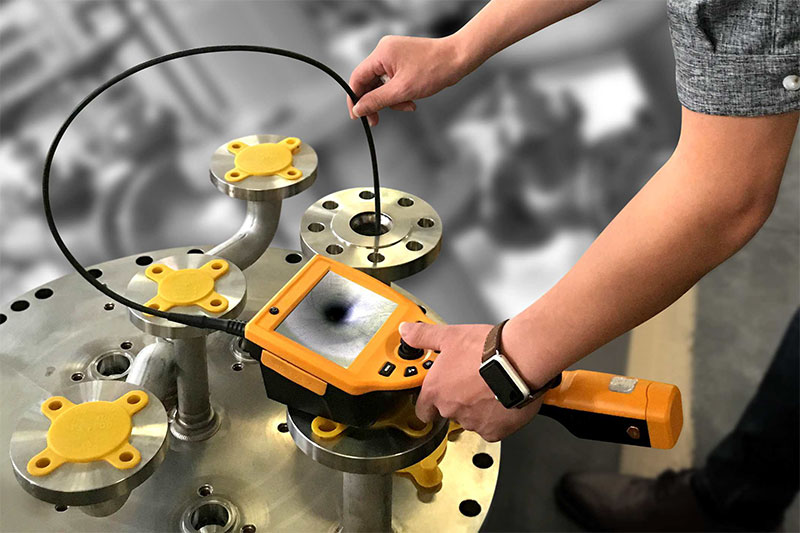
1. Core Mission: Contamination Prevention and Control
The primary goal in the pharmaceutical industry is to prevent drug contamination, and every feature of an industrial videoscope serves this purpose.
Micro-Defect Detection: The videoscope must offer high resolution to inspect sanitary stainless steel pipe welds for tiny cracks, incomplete penetration, porosity, or slag inclusions. These defects can become breeding grounds for bacteria.
Cleanliness Verification: The videoscope is used to verify that after a Clean-in-Place (CIP) cycle, areas such as pipe interiors, elbows, and valves—which are difficult to disassemble—are free from residual powder or soiling.
Fluorescence Inspection Capability: The videoscope must be equipped with an ultraviolet (UV) light source. Under UV light, trace organic residues (such as active pharmaceutical ingredients or biofilms) fluoresce, allowing the videoscope to perform a more thorough cleanliness verification than is possible with white light alone.
2. Physical Accessibility: Navigating Narrow, Sanitary Piping
Pharmaceutical facility piping systems are complex with confined spaces, imposing stringent demands on the videoscope’s physical dimensions and maneuverability.
Slender Insertion Tube: The videoscope’s insertion tube is typically 4mm to 6mm in diameter and can range from several meters to tens of meters in length, enabling it to enter very narrow sanitary pipes.
Precise Articulation: The videoscope must feature a wide articulation range with highly responsive steering, allowing it to navigate through bends and tees and remain stable at the target location for observation.
Durable Construction: The insertion tube must be abrasion-resistant and corrosion-resistant, often featuring a four-layer tungsten braid protective sheath to withstand friction against stainless steel pipe walls and exposure to chemical cleaning agents.
3. Image Quality: Overcoming High Glare Reflection
Pharmaceutical equipment is often made of polished stainless steel, which can cause glare and overexposed images with standard videoscopes.
High Dynamic Range Imaging: The videoscope utilizes specialized image processing technologies (such as PulsarPic, WiDER) to dynamically suppress intense glare from stainless steel surfaces while preserving shadow details, such as the weld root, ensuring critical areas are clearly visible.
4. Specialized Adapters and Accessories
To address the specific geometries found in pharmaceutical applications, the videoscope must be compatible with dedicated accessories.
Optical Adapters: The videoscope supports interchangeable optical tips, such as side-viewing and 120° wide-angle lenses, to facilitate capturing a complete image of the weld interior.
Auxiliary Tools: The videoscope can be equipped with centering guides to keep the lens aligned, and heat-shrink tubing or push-rod adapters can be used to protect the insertion tube when navigating through flange connections.
5. Data Management and Regulatory Compliance
The pharmaceutical industry is subject to stringent regulations, including GMP and FDA standards, requiring that all inspection records be traceable. The videoscope’s data management functionality is critical.
Systematic Recording: The videoscope should feature built-in inspection software that supports naming and organizing images and videos, facilitating easy data traceability.
One-Click Reporting: The videoscope should be capable of using built-in templates to quickly generate inspection reports, simplifying the creation of compliance documentation and ensuring audit requirements are met.
6. Hygiene and Cross-Contamination Control
The videoscope itself must not become a source of contamination.
Easy-to-Clean Design: The insertion tube and lens assembly should be easy to clean and disinfect. For example, wiping them with isopropyl alcohol (IPA) helps prevent the videoscope from causing cross-contamination when used to inspect different areas or equipment.
7. Explosion-Proof Safety Requirements
Some pharmaceutical equipment—such as that found in areas where volatile organic solvents like ethanol or acetone are handled (e.g., dispensing or production zones)—is located in potentially explosive atmospheres. For use in such areas, the videoscope must have the appropriate explosion-proof certification to ensure safe operation in hazardous environments.
Copyright © 2025. Coantec Ltd. All rights reserved. sitemap