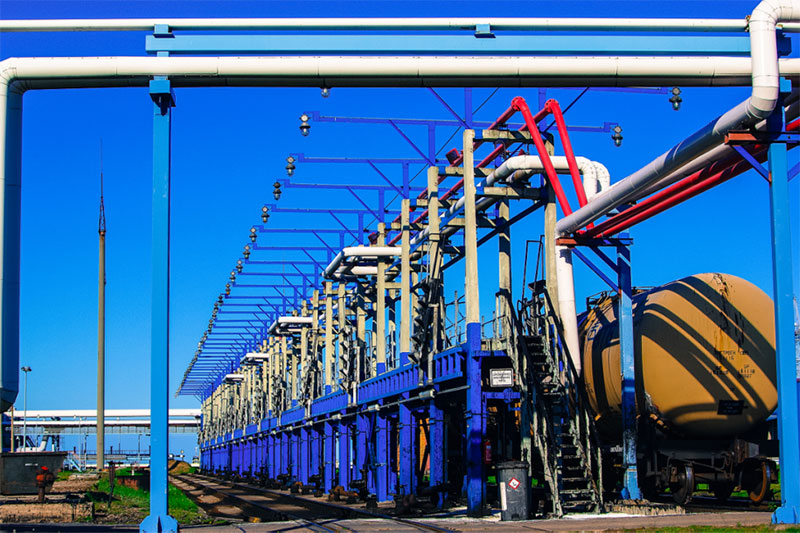

As global energy demand continues to grow, long-distance oil and gas pipelines remain critical infrastructure connecting energy resources with consumer markets. Pipeline construction, maintenance, and asset management are expanding accordingly. With increasing investment in pipeline networks across North America, the Middle East, and Asia-Pacific, energy transportation systems are becoming more extensive and complex. At the same time, many aging pipelines that have been in service for more than 20 years require rehabilitation, replacement, or service-life assessment.
Against this backdrop, pipeline integrity and lifecycle quality management have become critical to maintaining energy infrastructure safety and reducing operational risks. From welding and installation during new pipeline construction to routine inspection, maintenance, and emergency repair of in-service pipelines, efficiently and accurately understanding internal pipeline conditions has become an important challenge for oil and gas operators and maintenance teams worldwide.
For enclosed pipeline spaces that are difficult or impossible for personnel to access directly, an industrial borescope uses a flexible probe to reach internal areas and capture real-time, high-resolution images. This provides a direct and efficient visual inspection solution for industrial pipelines, complementing conventional non-destructive testing (NDT) methods.
Oil and gas pipelines transport crude oil, natural gas, and other energy products. As long-distance pipeline networks continue to expand, more efficient and precise inspection methods are needed throughout pipeline construction, operation, and maintenance.
Internal pipeline inspection may be required at multiple stages of the asset lifecycle.
For newly installed or repaired pipelines, inspectors may need to check for foreign objects, residual materials, contamination, and visible abnormalities. During routine maintenance, visual inspection can help identify visible conditions such as corrosion, rust, deposits, and other abnormalities on internal surfaces. Valves, elbows, tees, and other complex components may also require inspection in areas that are difficult to observe directly.
However, pipeline interiors are typically enclosed, narrow, and difficult to access.
Extensive disassembly can make inspection more complicated and may increase equipment downtime and maintenance costs. This creates a need for inspection methods that can reach internal areas and provide a clear view with minimal disassembly.
An industrial borescope is a visual inspection device designed to examine internal structures that are difficult to access directly. A typical system consists of a control unit, camera probe, insertion tube, and illumination system.
During an inspection, a flexible probe can be inserted into a pipeline through an access port, inspection opening, process connection, or other suitable entry point. The camera at the probe tip captures real-time images and displays the internal condition of the pipeline on the monitor.
Compared with relying solely on direct visual observation, an industrial borescope converts inaccessible internal spaces into real-time visual information. Images and videos can also be captured and stored to document inspection results.
Depending on the pipeline structure and inspection requirements, industrial borescopes can assist with visual inspection of:
Pipeline inner walls: Visible corrosion, rust, deposits, and other abnormalities
Welds and connection areas: Close-up inspection of critical joints and connections
Elbows and tees: Internal areas that are difficult to observe manually
Valves, pumps, and other equipment: Internal structures and visible abnormalities
Post-maintenance equipment: Foreign objects, residual materials, or visible damage
It is important to note that industrial borescopes are primarily used for internal visual inspection and visual assessment. Applications such as wall-thickness measurement and quantitative crack evaluation may require dedicated NDT methods, including ultrasonic testing (UT), radiographic testing (RT), magnetic particle testing (MT), or liquid penetrant testing (PT), depending on the inspection target and applicable requirements.
Oil and gas and petrochemical environments can present demanding inspection conditions. A pipeline inspection borescope must offer more than basic accessibility. Probe diameter, imaging performance, articulation, protection, and environmental suitability should all be considered according to the application.
Different pipelines, valves, and equipment require different probe sizes.
Small-diameter probes can access narrow passages and confined spaces, while a flexible insertion tube helps the probe navigate curved pipelines and complex internal structures, improving inspection coverage.
Pipeline interiors may involve low-light conditions, reflective metal surfaces, oil contamination, rust, or deposits. High-quality imaging combined with appropriate illumination provides an important foundation for evaluating internal conditions.
For inspectors, clear visualization of the target area is essential for identifying visible abnormalities.
Pipelines are not always straight. Elbows, valves, tees, and complex connections require flexible probe articulation so inspectors can adjust the viewing direction and examine targets from different angles.
Probe articulation and directional control are therefore important capabilities for industrial borescope inspection in complex piping systems.
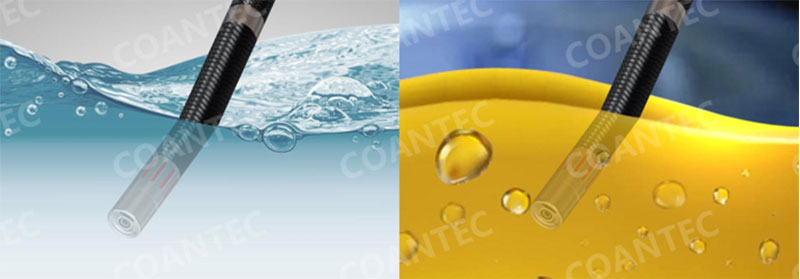
Oil and gas and petrochemical equipment may contain oil, process residues, moisture, or other contaminants. These conditions place higher demands on probe materials, sealing, and overall protection.
For inspection tasks involving oil contamination, users should select probes with appropriate oil resistance and protection ratings based on the actual operating environment.
Specific oil-resistance performance should always be evaluated according to the product's materials, construction, and technical specifications. For potentially explosive environments, equipment selection must also take into account the hazardous area classification, applicable explosion-protection requirements, and site safety procedures.
An industrial borescope should not only provide real-time viewing but also support inspection documentation.
Captured images and videos can preserve visible abnormalities for subsequent review, maintenance decisions, quality analysis, and inspection records, improving the traceability of visual inspection results.
With more than a decade of experience in industrial vision inspection, Coantec continues to develop industrial borescope technologies covering imaging, probes, illumination, articulation, and modular configurations.
Coantec provides internal visual inspection solutions for industries including energy, oil & gas, petrochemical, power, aerospace, automotive manufacturing, and industrial equipment manufacturing.
For different pipe diameters, inspection spaces, and operating environments, Coantec industrial borescopes can be configured with different probe and lens options according to specific inspection requirements.
During pipeline and equipment inspection, flexible probes can reach target areas and combine HD imaging, auxiliary illumination, and precise directional control to inspect pipeline inner walls, welds, connection areas, and complex internal structures. Images and videos can also be recorded to preserve inspection results for subsequent review.
For challenging environments involving oil contamination or moisture, suitable probe configurations with oil resistance and high protection against water and dust can be selected according to specific application requirements, helping improve field adaptability.
From access to imaging, and from observation to documentation, Coantec industrial borescopes make previously inaccessible internal spaces easier to inspect and understand.
As oil and gas pipeline networks continue to expand and infrastructure maintenance requirements become more demanding, pipeline inspection is moving toward greater efficiency, precision, and visualization.
For complex, narrow, and enclosed industrial spaces, the ability to quickly obtain reliable visual information from inside a pipeline or piece of equipment is an important part of efficient inspection and reliable operation.
Coantec continues to focus on industrial vision inspection technologies and develops industrial borescope solutions tailored to different pipeline structures, operating environments, and inspection requirements. By supporting visual inspection across oil & gas, petrochemical, energy, and other industrial applications, Coantec helps inspection teams obtain clearer visual information and conduct internal inspections more efficiently.
See inside. Identify problems more effectively. Make inspection more reliable.
Copyright © 2025. Coantec Ltd. All rights reserved. sitemap