

In nondestructive testing, the borescope articulating head is the critical component that determines whether an electronic video borescope can truly inspect complex geometries. A well-designed borescope articulating head lets you maneuver inside engines, pipe elbows, and confined cavities with precision, while a probe without this mechanism forces you to accept a rigid, fixed viewing direction. This article explores the definition of a borescope articulating head, its steering methods, advantages, applications, and a real‑world case study, helping you fully understand this essential technology.
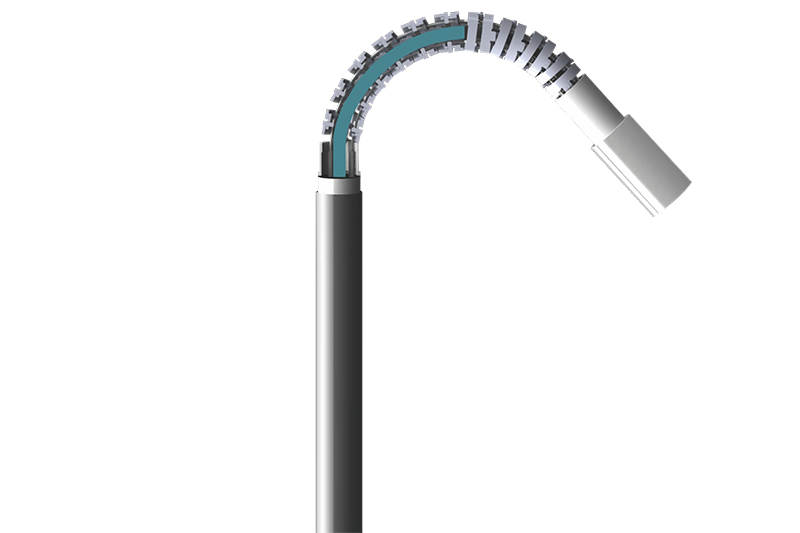
1. What Is a Borescope Articulating Head? – Focusing on Electronic Video Borescopes
A borescope articulating head is the actively controllable mechanical steering section at the distal tip of an electronic borescope (based on a CMOS image sensor). It is not merely a flexible tube; it is a controlled bending segment composed of precision vertebrae and pull wires, or an electrically driven steering unit. When you move the handset control, the wires inside the borescope articulating head are tensioned, making the camera tip swing up, down, left, and right, thereby altering the probe’s viewing direction. This is fundamentally different from a passive flexible tube that simply follows a path—the borescope articulating head gives you active control over the field of view.
It is important to note that rigid borescopes also offer probe tip steering, but the principle is different. In the context of electronic video borescopes, borescope articulating head specifically refers to the bendable steering mechanism at the end of a flexible insertion tube.
2. Steering Methods – Rigid and Flexible Borescope Articulating Head Explained
Steering methods can be divided into two categories based on scope construction.
Rigid Borescope Probe Steering (X and Y Axis)
Rigid borescopes have a stiff, non‑bendable shaft, yet their probe tip often provides two axes of view steering. X‑axis rotation: the optical tip rotates 360° around the insertion tube axis, scanning the full circumference of a pipe. Y‑axis deflection: by adjusting a prism or a mirror, different viewing angles (0°, 30°, 70°, 90°, etc.) are achieved, switching the view from straight ahead to a side‑looking direction. Although such a rigid scope lacks a flexible borescope articulating head, this X/Y axis optical steering mechanism can be regarded as a static form of probe articulation. It enables forward and side viewing in straight passages but typically requires a larger insertion tube diameter to house the steerable camera assembly—for example, the Coantec CPT series borescopes.
Flexible Borescope Borescope Articulating Head (2‑Way, 4‑Way, and 360° Steering)
This is the true borescope articulating head technology commonly used in industrial inspection. Based on a flexible bending section, the handset control enables:
2‑Way Steering: The borescope articulating head deflects only up and down. Combined with manually rotating the probe, you can inspect most internal sidewalls.
4‑Way Steering: The borescope articulating head moves independently up, down, left, and right, locking onto defects with precision—the mainstream configuration for industrial use.
360° All‑Around Steering: When a borescope articulating head has four‑way capability and sufficient bending angle, the operator can combine motions to steer the tip in any circumferential direction, achieving complete spherical coverage. Some advanced borescope articulating head models can bend more than 180° in one direction, looking backward toward the entry point without any blind spot.
Choosing the right borescope articulating head depends on the application and the geometry of the object being inspected: straight tubes suit rigid X/Y steering, whereas complex curved passages require a four‑way or even 360° borescope articulating head.
3. Advantages of the Borescope Articulating Head
Compared to fixed‑view flexible scopes or rigid scopes with purely rotating optics, a video borescope equipped with a borescope articulating head delivers these core advantages:
Active Exploration: The borescope articulating head gives you complete control over the viewing angle. You can steer the borescope articulating head to look up at a weld root, tilt down to examine liquid accumulation, turn left to bypass a baffle, or swivel right to inspect the back of a fin—no longer passively seeing only where the tube happens to slide.
Complete Coverage in a Single Insertion: Thanks to the 360° steering capability of the borescope articulating head, you can scan all internal surfaces with a single insertion, eliminating the need to repeatedly withdraw the probe, swap lenses, or use guide tools.
Mechanical Lock‑in for Stability: A borescope articulating head can hold itself at any bending angle without drift or wobble, enabling precise measurement and photography even in high‑vibration environments.
Non‑Destructive and Time‑Saving: Without disassembling equipment, the borescope articulating head enters through a small access port and reaches the target directly, greatly reducing downtime and maintenance costs.
Refined Control: High‑end motorized borescope articulating head systems provide force feedback and slow micro‑movements, approaching cracks with sub‑millimeter precision while supporting one‑touch return‑to‑center for maximum efficiency.
4. Application Fields Suited for the Borescope Articulating Head
Any scenario that requires directional visual inspection inside complex or inaccessible cavities is an area where the borescope articulating head excels.
Aerospace: Inserted through access ports into turbine engines, the borescope articulating head drives the camera to inspect blades, combustion chambers, and fuel nozzles without engine teardown.
Automotive Powertrain: Through a spark plug hole, the borescope articulating head rotates and turns to check valve seats, piston crowns, and cylinder wall crosshatching, enabling engine diagnosis without disassembly.
Oil and Petrochemical: Inside pressure vessels and heat exchanger tube bundles, the borescope articulating head sweeps around to scan weld root cracks and corrosion pits.
Power Generation: Inspecting generator stator end windings and steam pipe elbows, the borescope articulating head navigates narrow gaps with ease.
Precision Casting and Manufacturing: For 360° defect inspection of internal passages and cross‑holes in castings, the borescope articulating head carries the light source deep into blind holes.
Security and Emergency Response: The borescope articulating head is used to probe into crevices or debris to actively search for targets.
5. Real‑World Example: Coantec M40 Borescope Articulating Head in Action
Take the Coantec M40 electronic video borescope as an example. Its mechanical borescope articulating head is a precision transmission unit. The probe diameter can be as small as 0.95 mm, yet it achieves 180° articulation. In a case involving emergency diesel generator inspection, an engineer inserted the M40 probe through a cylinder head opening and used the borescope articulating head to tilt upward approximately 160°. Within the narrow gap between the piston crown and the cylinder head, it clearly captured a fatigue crack on the exhaust valve seat. Thanks to the precise self‑locking of the borescope articulating head, the lens steadily acquired high‑resolution inspection images and allowed immediate measurement and positioning, eliminating the need for a complete engine teardown and saving over 48 hours of downtime.
When purchasing an electronic borescope, be sure to verify that you are getting a true borescope articulating head—not merely a flexible tube. Only a borescope articulating head with active steering capability can elevate visual inspection from passive observation to proactive exploration. When you need to pinpoint a critical defect inside an equipment cavity, an outstanding borescope articulating head is the irreplaceable, decision‑making instrument.
Copyright © 2025. Coantec Ltd. All rights reserved. sitemap