

In pipe inspection, equipment maintenance, and industrial non-destructive testing, the lighting capability of an industrial endoscope probe directly determines inspection quality. Industrial endoscope probes are essential tools for inspecting inner pipe walls. Defects such as corrosion, cracks, and foreign object blockages require clear images for accurate judgment. Insufficient brightness leads to dark, noisy images that obscure critical details. Illuminated industrial endoscope probes, with their independent and controllable lighting, have become the core configuration for inspecting complex dark cavities, deep holes, and confined spaces. The structural differences, usage advantages, brightness selection, and adjustment methods of industrial endoscope probes are key to ensuring clear, efficient, and reliable inspections. Every technician should understand how industrial endoscope probes work.
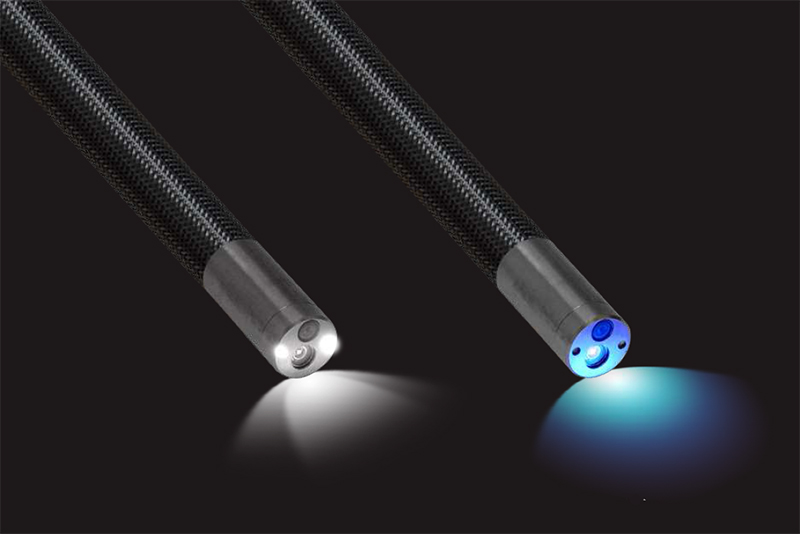
1. Two Types of Industrial Endoscope Probes
Industrial endoscope probes are mainly divided into two types based on lighting configuration:
(1) Non-illuminated industrial endoscope probes
These industrial endoscope probes rely on ambient light or external lighting. They are only suitable for simple observation in open, bright, and shallow areas. Industrial endoscope probes need light for photoelectric conversion, so non-illuminated industrial endoscope probes have very limited application in actual industrial inspections and cannot meet the basic requirements of confined spaces or deep cavities. In mainstream fields such as petrochemical and aerospace, this type of industrial endoscope probe has largely been eliminated. Choosing the right industrial endoscope probe is critical.
(2) Illuminated industrial endoscope probes
These industrial endoscope probes integrate LED or fiber‑optic light guide modules and have their own light source. Illuminated industrial endoscope probes can work in complete darkness, deep cavities, and long-distance pipes, making them the mainstream configuration for industrial inspection. Industrial endoscope probes generally integrate the light source inside the handheld unit or embed it at the probe tip. The lighting system of industrial endoscope probes should be powerful, use durable and energy‑efficient LEDs, and include brightness adjustment functions to adapt to different inspection distances and material characteristics. High-quality industrial endoscope probes offer better performance.
2. Structural Differences of Illuminated Industrial Endoscope Probes
Illuminated industrial endoscope probes differ structurally mainly in two lighting technology approaches:
(1) Industrial endoscope probes with front LED lighting
LED chips are directly packaged at the front end of the industrial endoscope probe, arranged around the camera. Depending on the industrial endoscope probe diameter, 2 to 6 SMD LED chips are used. Front-lit industrial endoscope probes are low‑cost and simple to manufacture, but the number and intensity of LEDs are limited by the industrial endoscope probe diameter – the smaller the probe, the lower the brightness. In addition, the industrial endoscope probe tip tends to heat up during operation. Currently, the maximum brightness of front-lit industrial endoscope probes is about 18,000 lux, which is sufficient for most routine inspections but slightly inadequate for high‑precision tasks. When selecting industrial endoscope probes, consider this limitation.
(2) Industrial endoscope probes with rear fiber‑optic lighting
A high‑power LED light source is installed inside the main unit, and light is transmitted to the industrial endoscope probe tip via a fiber‑optic light guide. The LED size in this type of industrial endoscope probe is not limited, allowing brightness up to 100,000 lux – an order of magnitude higher than front-lit industrial endoscope probes. Because the light source is in the main unit with a heat dissipation module, the industrial endoscope probe tip remains at near‑ambient temperature, making this industrial endoscope probe particularly suitable for temperature‑sensitive applications. The drawback is higher cost; most domestic industrial endoscope probes still use front lighting. Nevertheless, rear-fiber industrial endoscope probes deliver superior image quality.
(3) Other structural differences of industrial endoscope probes
Illuminated industrial endoscope probes also include a brightness control module, with a dimming circuit built into the handle, supporting multi‑level brightness adjustment. In front-lit designs, the LEDs and camera of the industrial endoscope probe are encapsulated together, achieving an IP67 protection rating. In rear-lit designs, the fiber bundle of the industrial endoscope probe is protected inside a tungsten‑alloy wear‑resistant tube. Every part of an industrial endoscope probe is designed for durability.
3. Key Advantages of Illuminated Industrial Endoscope Probes
(1) Visibility in complete darkness
Illuminated industrial endoscope probes need no external lighting to produce clear images in pipes, vessels, and other lightless spaces. Insufficient industrial endoscope probe brightness can cause missed detections and false judgments, posing risks to equipment safety. Good lighting is a prerequisite for clear imaging with industrial endoscope probes. That’s why professional industrial endoscope probes always include illumination.
(2) Eliminates shadows and blind spots, improving defect detection
The ring‑shaped light of an illuminated industrial endoscope probe provides uniform illumination, reducing reflections and dark corners, preventing defects like cracks and corrosion from being missed. At higher illumination levels, the contrast between defects and the surrounding area is better, making defects easier to identify. Using a high-quality industrial endoscope probe significantly improves detection rates.
(3) Enhances image clarity and detail rendition
Adequate and controllable light greatly improves the contrast and detail resolution of the industrial endoscope probe’s image. The approximately 18,000 lux of a front-lit industrial endoscope probe meets most needs, while the 100,000 lux of a rear-fiber industrial endoscope probe is suitable for high‑precision detection of micro‑cracks and pinholes. The lighting system of industrial endoscope probes should also focus on color rendition, with a color temperature no lower than 5600K. Advanced industrial endoscope probes offer superior color accuracy.
(4) Extends inspection range, adapts to long distances and complex pipes
Rear-fiber industrial endoscope probes have a long lighting distance and can handle long, curved pipes. Front-lit industrial endoscope probes are only suitable for shallow straight pipes or cavities, while rear-fiber industrial endoscope probes maintain sufficient illumination even at depths of several meters to tens of meters. For challenging environments, rear-fiber industrial endoscope probes are the best choice.
(5) Improves inspection efficiency
Illuminated industrial endoscope probes turn on instantly and allow real‑time dimming, reducing time spent on auxiliary lighting. The Coantec X1 series industrial endoscope probes use “+” and “–” buttons for brightness adjustment, making operation convenient. Illuminated industrial endoscope probes can also capture photos and videos on the spot to generate inspection reports. Efficient industrial endoscope probes save time and money.
(6) Ensures operator safety
Illuminated industrial endoscope probes enable non‑destructive testing without disassembling equipment or stopping operations, reducing personnel exposure to high temperatures, toxic substances, and radiation. Using industrial endoscope probes keeps workers safe while maintaining productivity. That’s a key benefit of modern industrial endoscope probes.
4. Principles for Selecting Industrial Endoscope Probe Brightness
Brightness selection for an industrial endoscope probe should be based on the inspection scenario, material, and distance, following the principle of “avoid too dark or too bright with glare”. The lighting system of an industrial endoscope probe should have brightness adjustment capability. Every user of industrial endoscope probes needs to understand these principles.
(1) Based on inspection distance
The distance from the industrial endoscope probe’s objective lens determines the required illumination – the greater the distance, the more severe the light attenuation, and the higher the brightness requirement. For short, shallow pipes (5‑25 mm), low to medium brightness is sufficient for your industrial endoscope probe. For long, deep pipes, high brightness (industrial endoscope probes require at least 2,600 lux) is needed to compensate for light loss. Always match your industrial endoscope probe brightness to the task.
(2) Based on surface material
- Highly reflective metal, polished inner walls: Reduce brightness on your industrial endoscope probe and use diffuse lighting to avoid glare.
- Light‑absorbing materials (oil, carbon deposits, rubber, rust): Increase brightness on your industrial endoscope probe to reveal details in dark areas.
(3) Based on inspection precision
High‑precision defect detection (micro‑cracks, pinholes) requires moderate to high brightness to ensure sharp edges in the industrial endoscope probe’s image. Routine inspections can use medium brightness on the industrial endoscope probe. Precision tasks demand better industrial endoscope probes.
(4) Based on environmental interference
Wet, dusty, or oily environments accelerate light attenuation. When using an industrial endoscope probe in such conditions, increase brightness appropriately. Durable industrial endoscope probes perform well even in harsh conditions.
5. Brightness Adjustment Methods for Coantec Industrial Endoscope Probes
Taking Coantec brand industrial endoscope probes as an example, their products offer mature solutions for brightness adjustment. Coantec industrial endoscope probes are known for reliability.
Multi‑level brightness adjustment with clear steps
Coantec’s industrial endoscope probes generally feature multi‑level brightness adjustment. The C50 series industrial endoscope probes can be configured with either front LED or rear fiber‑optic lighting, offering 8 brightness levels; the rear-fiber version reaches up to 100,000 lux. Handheld industrial endoscope probes use a 7‑level cyclic adjustment. The MN62 series supports manual 7‑level brightness adjustment. With multi‑level linear dimming, users of Coantec industrial endoscope probes can smoothly transition from low to high brightness. This makes Coantec industrial endoscope probes user‑friendly.
Conclusion
By properly selecting and precisely adjusting the light brightness, illuminated industrial endoscope probes maximize their inspection performance, providing reliable visual evidence for the safe operation of industrial pipelines. An illuminated industrial endoscope probe is not just the “infrastructure” of industrial inspection – it is a key factor determining inspection quality, efficiency, and safety. Investing in good industrial endoscope probes pays off in the long run. Always choose industrial endoscope probes that meet your specific needs.

Copyright © 2025. Coantec Ltd. All rights reserved. sitemap