

Most importantly: When using or placing the borescope, please hold the probe tightly with one hand to avoid the camera being hit, stepped on, or squeezed by the instrument box cover.
1. During use, if the front-end probe gets stuck and cannot be pulled out, you can try pushing the probe forward a bit, then pulling it out, or slightly turning the directional joystick before pulling it out. Do not pull forcefully to avoid detaching the probe.
2. When using the device in a relatively small or narrow space within the object being inspected, avoid rotating the host unit while the probe is at a bent angle, as this can cause the tubing to twist or even detach.
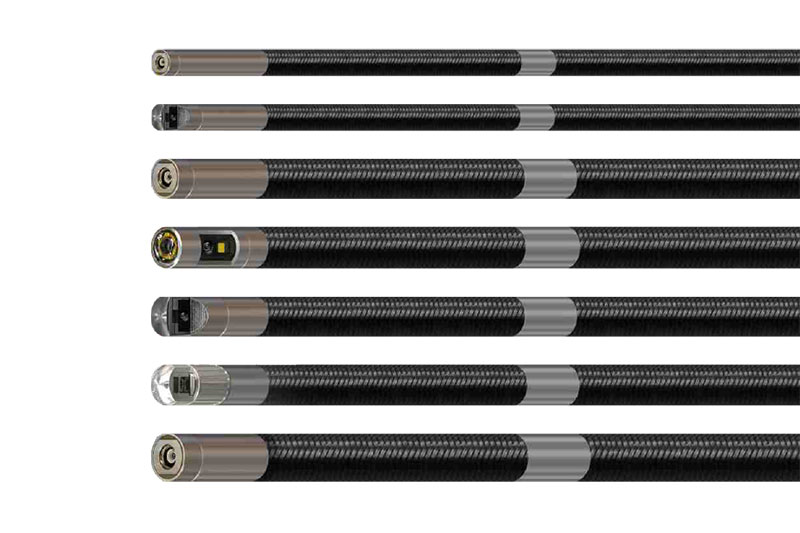
3. If the operating environment contains liquids such as oil or water, after use, please wipe the front lens area clean with a clean paper towel or lint-free cloth. Certain oils may be corrosive; prolonged contact can affect the sealing at the product's front end. Once compromised, oil ingress can occur, leading to blurred camera imaging.
4. After using the endoscope, carefully place it back into the dedicated instrument case or a designated storage area to prevent the camera or steering mechanism from being crushed or damaged.
5. When the endoscope tubing is coiled inside the instrument case, do not forcibly operate the joystick/steering lever or test the steering angle. Also, do not coil the tubing (probe) in your hand and forcibly operate the joystick, as this may cause steering malfunction or damage.
6. Do not pull on the probe or the spring-sheath tubing, to avoid breaking the internal signal wires or steel cables.
7. When returning the endoscope to its case after use, coil the probe tubing clockwise into the corresponding grooves in the instrument case. Do not coil it counterclockwise, as this may cause deformation of the wear-resistant tube, reduced steering angle, or steering deviation.
8. When using a small-diameter endoscope to inspect small holes, and when other auxiliary tools need to enter the cavity simultaneously, take care not to interfere with the normal operation of the articulation rings.
9. When using a 2.0mm or 2.8mm camera to inspect small holes (especially when the inner surface is unfinished/rough), do not insert into or withdraw from the hole too rapidly, to avoid damaging the front lens or causing probe detachment. Given their compact size and delicate construction, extra care should be taken to avoid abrupt insertion or withdrawal.
10. When cleaning a probe equipped with a protective cover, it is recommended to wrap the tip of a pair of forceps with a lint-free cloth, moisten it with a suitable amount of medical alcohol, and gently wipe the front lens.
Note: Do not expose the sharp tip of the forceps to avoid damaging the camera.
11. When operating the endoscope, do not forcefully bend the junction between the wear-resistant tube and the host unit, as this may cause deformation or breakage of the wear-resistant tube.
12. For long-tube borescopes, two-person operation is typically recommended: one person holds the probe by hand, while the other operates the joystick and watches the display.
When operating the tip steering, ensure the tubing is in a flat and straight state. Otherwise, you may only achieve a very small bending angle or risk breaking the steering wire rope. Do not operate the joystick when the tubing is coiled or inside the instrument case, as this will damage the internal steel wires.
Over prolonged storage, the tubing may develop a natural curvature and should be straightened before use. Prior to operation, firmly hold the probe and gently flex the tubing up, down, left, and right to restore it to a straight and relaxed state, ensuring optimal bending performance.
Copyright © 2025. Coantec Ltd. All rights reserved. sitemap