

Depth of field is a critical parameter when evaluating the imaging performance of industrial endoscopes. In simple terms, the depth of field of an industrial endoscope probe refers to the range of distances over which it can capture clear images without requiring focusing. For industrial endoscopes, this range is typically expressed in distance units—for example, "3mm to 50mm" or "15mm to infinity (∞)". As long as the object being inspected falls within this distance range, the image captured by the endoscope will remain sharp.
Depth of field is one of the most important factors to consider when selecting an industrial endoscope. The right choice depends largely on your specific application. The golden rule is to ensure that the depth of field of the probe fully covers the area you need to inspect. Since most industrial endoscopes are equipped with fixedfocus lenses and cannot be adjusted like a camera lens, choosing the appropriate depth of field is essential. This is also one of the key differences between industrial endoscopes and standard cameras.
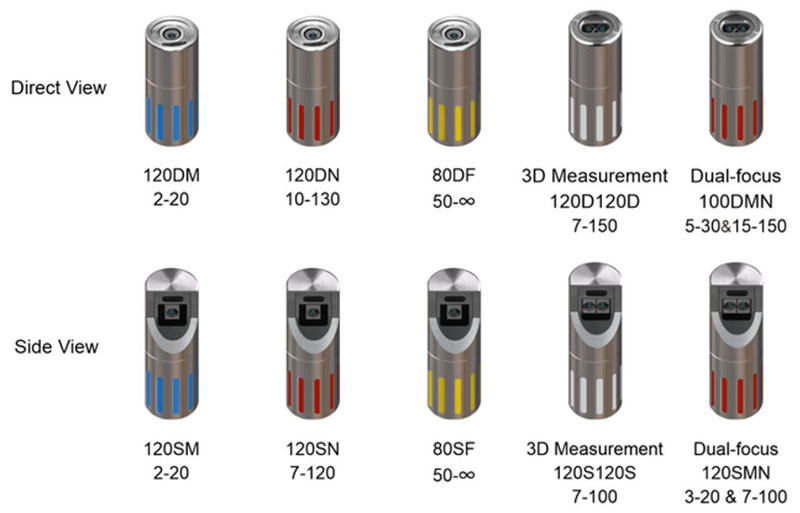
The strategy for selecting depth of field varies based on the inspection task at hand. Below is a breakdown of how to match depth of field to your specific scenario.
1. CloseUp Precision Inspection
For inspections that focus on narrow cavities or small defects—such as scratches on engine cylinder walls or burrs inside precision castings—a shallow depth of field (shortfocus) probe is recommended.
Shortfocus probes are designed to focus clearly at very close distances, making them ideal for revealing fine details. These probes excel in applications where high magnification and close proximity to the target are required.
Examples of Use:
Inspecting burrs in smalldiameter holes (e.g., 4mm holes in machined parts) or detecting micronlevel wear on turbine blades.
Recommended Depth of Field:
Probes with a depth of field of 3mm–50mm or 5mm–50mm are often used in these scenarios. These ranges allow the probe to get extremely close to the target, ensuring highprecision observation. In fact, measurementgrade industrial endoscopes frequently utilize a 3mm–50mm depth of field, as this range is optimized for detailed, highaccuracy inspections.
2. General or LongDistance Inspection
For inspections in varying environments or when observing deep inside pipes or cavities, a large depth of field (longfocus or ultrawide depth of field) probe is recommended.
A wide depth of field ensures that both nearby surfaces (e.g., the inner wall of a pipe) and distant areas (e.g., the far end of a cavity) remain in focus. This eliminates the need to constantly adjust the probe's position, saving time and improving inspection efficiency.
Examples of Use:
Inspecting pipes of varying diameters or examining the interior of engine cylinder blocks.
Recommended Depth of Field:
Probes with a depth of field of 8mm–250mm or 15mm to infinity (∞) are ideal for these tasks. These ranges effectively provide a "universal focus" capability, ensuring clarity across a wide variety of distances. For routine inspections, opting for a probe with a large depth of field is often the most practical and reliable choice.
3. Fixed Working Distance Inspections
If you know the approximate distance between the probe and the object being inspected (e.g., the probe is consistently positioned about 10 centimeters away), you can select a depth of field that specifically covers that working distance.
This approach ensures that the probe's imaging range is perfectly aligned with your inspection needs, minimizing unnecessary adjustments and maximizing efficiency.
Examples of Use:
Inspections where the probetoobject distance is consistent, such as in jigbased or automated setups.
Recommended Depth of Field:
For a working distance of around 10 cm, probes with a depth of field of 8mm–80mm or 10mm–100mm are suitable. If you need to accommodate occasional longdistance observations, a broader range like 8mm–250mm is a versatile option.
Key Factors Affecting Depth of Field
Understanding the optical principles that influence depth of field can help you make a more informed decision. The depth of field of an industrial endoscope is determined by several interrelated factors:
Focal Length:
Shorter focal lengths generally result in a greater depth of field, while longer focal lengths produce a shallower depth of field. This is a fundamental optical rule that applies to industrial endoscopes as well.
Object Distance (Focusing Distance):
The farther the object is from the probe, the greater the depth of field. Conversely, the closer the object, the shallower the depth of field.
Field of View (FOV):
A wider field of view often compresses the depth of field, while a narrower FOV tends to enhance it. Balancing these two parameters is a key consideration in endoscope design.
Summary of Recommendations
To summarize, here are the recommended depth of field specifications based on common application scenarios:
For closeup precision inspections, such as identifying fine defects or burrs, prioritize shortfocus probes with a depth of field like 3mm–50mm or 5mm–50mm to capture maximum detail.
For general or longdistance inspections, such as examining pipes or engine interiors, choose widedepthoffield probes like 8mm–250mm or 15mm to infinity (∞) for maximum versatility.
For fixed working distance inspections, where the probetoobject distance is consistent, match the depth of field to that specific distance—for example, 8mm–80mm or 10mm–100mm for a 10 cm working distance.
Final Thoughts
Selecting the right depth of field for your industrial endoscope is essential for achieving clear, accurate inspections. By aligning the depth of field with your specific application—whether it's closeup precision work, generalpurpose inspections, or fixeddistance tasks—you can ensure optimal performance and efficiency. Always consider the tradeoffs between focal length, object distance, and field of view when making your choice, and don't hesitate to consult with manufacturers or suppliers for additional guidance tailored to your needs.

Copyright © 2025. Coantec Ltd. All rights reserved. sitemap