

An industrial endoscope enables internal inspection of equipment without disassembly. However, market prices range from hundreds to tens of thousands of dollars. How should an average user make the right choice? By understanding the following four key points, you can select the endoscope that truly meets your needs.
I. Image Quality: The Goal is "Seeing Clearly"—Don’t Just Focus on Megapixels
Many assume that a higher megapixel count automatically means better image quality—for example, that 10MP is always superior to 5MP. This is an oversimplification. Clarity depends on three core factors:
1. Image Sensor Size: A larger sensor captures more light, similar to how a larger window brightens a room. In lowlight environments such as dark pipes, a 2MP sensor with a 1/1.8inch size will typically deliver clearer, less noisy images than a 5MP sensor with a smaller 1/3inch size.
2. Lens Quality: A highquality lens is like precision eyewear—it provides sharp, distortionfree images across the entire field of view. A poor lens may show blurriness or distortion, especially around the edges, compromising inspection accuracy.
3. Lighting System: Builtin LEDs are critical. The lighting should be even and adjustable. For instance, when inspecting a rusty surface, overly bright light can cause glare, while dim light may hide details. A good endoscope allows brightness adjustment to reveal defects clearly.
II. Water and Oil Resistance: Built for Harsh Environments
Durability is essential in demanding industrial settings.
1. IP Protection Ratings:
IP67: Dusttight and can withstand temporary immersion in 1 meter of water for up to 30 minutes. Suitable for most factory environments, including wet conditions and exposure to oil splashes.
IP68: Can operate continuously underwater. Ideal for underwater inspections in fields such as marine or water engineering. For most indoor industrial applications, IP67 is sufficient—avoid unnecessary cost on higher ratings unless specifically required.
2. Specialized Coatings: Many probes feature a nanooleophobic coating, which causes oil and water to bead up and roll off rather than stick to the lens. This is especially useful for inspecting oily components like engines and gearboxes, keeping the view unobstructed.
III. Probe Selection: Match the Tool to the Task
The probe is the part that enters the equipment—selecting the right type, size, and length is crucial for access and maneuverability.
Probe Type:
Rigid Probe: Straight and nonbendable. Best for straight pipes or open spaces, offering maximum durability and stable images.
Flexible/Semirigid Probe: Manually bendable to navigate simple curves. The most versatile and widely used type.
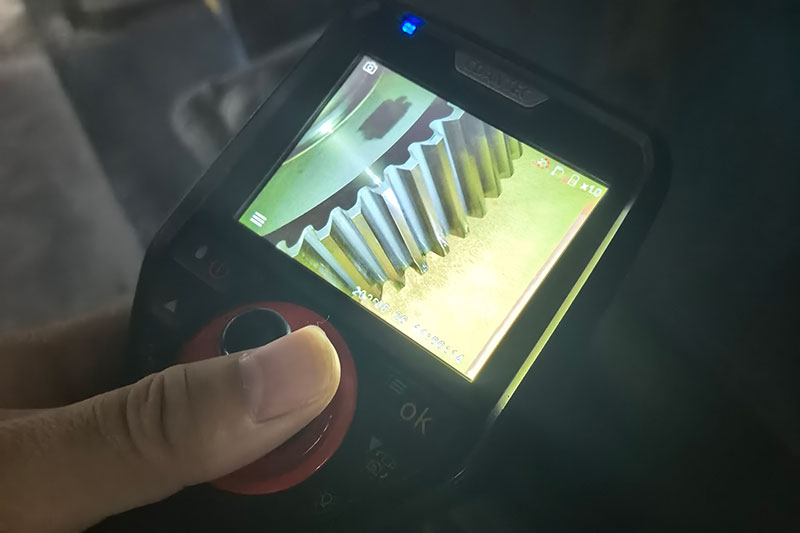
Articulating Motorized Probe: The tip can be remotely steered with a joystick for precise positioning. Ideal for complex paths, such as inspecting turbine blades or intricate assemblies.
Size and Length:
Diameter: Measure the smallest opening you need to pass through. Standard diameters include 4mm, 6mm, and 8mm—choose one smaller than the access point.
Length: Estimate the distance from the entry point to the inspection area. Select a probe longer than this distance.
Viewing Angle: Options include forward (0°) and sideview (90°) lenses. If uncertain, choose a system with interchangeable lenses for greater flexibility.
IV. Practical Features and LongTerm Value: Beyond the Initial Purchase
1. UserFriendly Design:
Ergonomics: The main unit should be lightweight with intuitively placed controls for onehanded operation. Whenever possible, test the device before purchasing.
Measurement Capabilities: If you need to measure crack lengths or corrosion depth, ensure the endoscope has measurement functions. Basic 2D measurement requires the probe to be perpendicular and at a fixed distance, while advanced 3D measurement allows sizing from any angle, offering greater practicality at a higher cost.
Reporting Software: Efficient models allow onscreen annotation and measurement, with oneclick report generation that includes all images and data—significantly boosting productivity.
2. Consider Total Cost of Ownership:
Consumables: Probes wear out over time. Inquire about replacement probe costs.
Maintenance & Warranty: Check the warranty period, repair turnaround time, and service costs.
Software Updates: Confirm whether future software upgrades are included.
Training and Support: Does the supplier offer operator training and responsive technical support?
By keeping these points in mind, you can make an informed decision. A suitable industrial endoscope isn’t necessarily the most expensive one—it’s the one best matched to your specific application. Invest in solving real problems, not in unnecessary specifications.

Copyright © 2025. Coantec Ltd. All rights reserved. sitemap