

On busy flight routes, even a routine flight delay can stem from a landing gear issue. For workhorse narrow-body aircraft like the Boeing 737NG, the landing gear system serves as the critical interface between the aircraft and the ground. Its condition directly impacts the safety and smoothness of every takeoff and landing. Proactive inspection using advanced tools like Industrial Endoscopes is essential for maintaining this vital system.
I. The Importance of Landing Gear Maintenance and Regular Inspection
As aircraft fleets age, fluid leakage from landing gear shock struts has become a common challenge during line maintenance and scheduled checks. The landing gear system is far more than a simple support structure. Taking the Boeing 737NG as an example, its hydraulic shock struts are filled with a specific ratio of oil and nitrogen, creating a sophisticated energy-absorbing system. Upon touchdown, it converts substantial impact kinetic energy into heat, protecting the airframe structure. The reliability of this system, however, hinges on internal components such as dynamic seals, static seals, wiper rings, and bearing carriers. These precision parts operate under high pressure, with frequent extension/compression cycles, and across varying temperatures. Therefore, landing gear maintenance—particularly seal replacement—is not merely about "fixing a leak." It requires proactive inspection tools, primarily Industrial Endoscopes, to identify and eliminate potential failures, ensuring long-term operational safety.
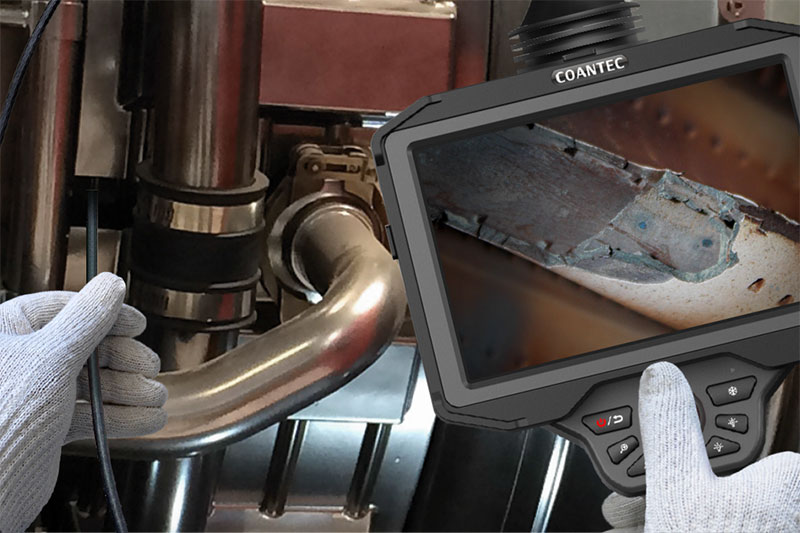
II. The Role of Industrial Endoscopes in Landing Gear Maintenance
Prior to the widespread adoption of Industrial Endoscopes, maintenance crews had limited means to assess the internal condition of enclosed cavities like shock struts. Evaluating seal integrity largely depended on external signs of leakage, pressure tests, and inspections only possible after complete disassembly. This approach was inherently time-consuming and uncertain. The introduction of Industrial Endoscopes has equipped maintenance engineers with a flexible set of "eyes." Using a slender, flexible, or rigid probe equipped with a high-definition camera and lighting system, these Industrial Endoscopes allow inspectors to navigate through existing inspection ports or service holes to directly view a component's interior. Personnel can observe—in real-time on a monitor—critical conditions such as scratches, cracks, corrosion, foreign object debris (FOD), and the assembly status of parts, all without extensive teardown. This "minimally invasive" inspection method, powered by Industrial Endoscopes, has revolutionized maintenance decision-making. It enables preventative checks, shifting fault diagnosis from inference to empirical evidence. In aviation maintenance, from engine turbine and combustor borescope inspections to examining complex internal structures, Industrial Endoscopes have become an indispensable standard diagnostic tool.
III. Advantages of Industrial Endoscopes Over Other Inspection Methods
A comparison with common alternatives highlights the unique value of Industrial Endoscopes:
1. Vs. Complete Disassembly: While thorough, full disassembly has major drawbacks: long downtime and high cost. Industrial Endoscopes offer "targeted access with minimal intervention," drastically reducing aircraft downtime and lowering maintenance costs.
2. Vs. External/Indirect Measurement: Inferring internal condition from external parameters is convenient but relies on indirect evidence. Industrial Endoscopes provide a direct visual answer, definitively pinpointing the location or morphology of internal damage.
3. Vs. Other NDT Methods: Ultrasonic testing and X-ray imaging have limitations in assessing surface conditions or identifying foreign objects. The core advantage of Industrial Endoscopes is direct visual confirmation, which is unparalleled for inspecting non-metallic components and fine surface details.
In a typical Boeing 737NG landing gear shock strut seal replacement, key concerns are whether the seal was nicked during handling or is correctly seated. This is where Industrial Endoscopes excel: the high-definition camera can clearly reveal the surface texture and assembly of the seal. This "seeing is believing" verification offered by Industrial Endoscopes provides the most direct assurance of maintenance quality.
IV. Coantec Industrial Endoscopes: Suited for Diverse Aircraft Maintenance Tasks
Coantec Industrial Endoscopes are engineered to meet the practical demands of aircraft maintenance. The X5 series, for instance, demonstrates the critical features required for this work:
Superior Imaging & Illumination: Aircraft interiors are often dark. Coantec Industrial Endoscopes utilize high-resolution CMOS sensors and adaptive LED lighting to deliver bright, uniform, and color-accurate images.
Flexible Maneuverability & Adequate Length: The complex internal geometry of landing gear requires navigation through narrow gaps. Coantec's flexible Industrial Endoscopes offer excellent articulation with precise 360-degree tip control.
Durability & Environmental Resistance: Probes may contact aviation grease and hydraulic fluid. Coantec Industrial Endoscopes feature oil and water resistance with a robust tungsten-steel reinforced sheath.
Portability & User-Friendly Design: Maintenance work requires mobility. Coantec Industrial Endoscopes are compact and lightweight with an intuitive interface, allowing easy capture of media and quick report generation for record-keeping.
In conclusion, the integration of Industrial Endoscopes into landing gear maintenance protocols represents a best practice in modern aviation. For aircraft like the Boeing 737NG, these tools are not just convenient; they are fundamental for efficient, accurate, and cost-effective upkeep of critical safety systems.
Copyright © 2025. Coantec Ltd. All rights reserved. sitemap