
Quels types d’éclairage sont utilisés dans les endoscopes industriels ? LED, fibre optique et laser comparés

2026-09-08

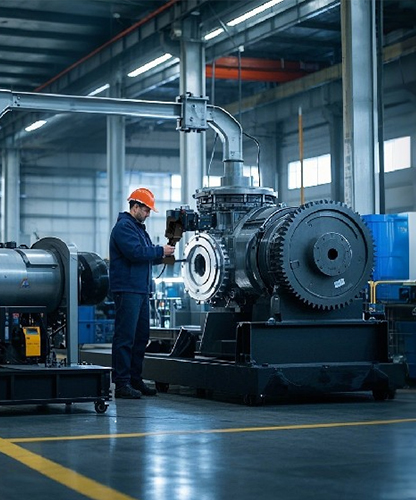
Dans des secteurs tels que l’aérospatiale, les turbines à gaz, la pétrochimie et la construction automobile, de nombreux composants critiques sont situés dans des espaces étroits, clos ou autrement inaccessibles.

Les endoscopes industriels permettent aux inspecteurs d'accéder à ces zones via un tube d'insertion flexible et d'afficher les conditions internes en temps réel, ce qui en fait un outil d'inspection visuelle essentiel pour les tests non destructifs (CND).
LED, Fiber-Optic and Laser Compared

Cependant, l’obtention d’images d’inspection claires et fiables ne dépend pas uniquement de la caméra et de l’optique.

Dans la plupart des environnements d’inspection industrielle, la zone inspectée a peu ou pas de lumière ambiante et peut être complètement sombre. La quantité d’informations d’image utiles capturées par le système d’imagerie dépend donc fortement de l’éclairage disponible au point d’inspection.

Pour cette raison, l’éclairage est un élément essentiel d’un système d’imagerie d’endoscope industriel et l’un des facteurs clés affectant les performances d’inspection réelles.

Alors, quels types d’éclairage sont couramment utilisés dans les endoscopes industriels ? Quelles sont les différences entre l’éclairage LED, fibre optique et laser ? Et quelles technologies sont les mieux adaptées aux différentes applications d’inspection ?

Pourquoi les endoscopes industriels ont-ils besoin d'un éclairage ?

Pour comprendre le rôle de l’éclairage, il est utile de comprendre d’abord comment un endoscope industriel forme une image.

En termes simples, la source lumineuse éclaire la surface cible. L'optique de l'endoscope collecte la lumière réfléchie et le capteur d'image convertit ces informations optiques en signaux électroniques, qui sont ensuite traités et affichés sous forme d'image.

Le processus d’imagerie peut donc être résumé comme suit :

La lumière éclaire la cible → La lumière réfléchie pénètre dans l'optique → Le capteur d'image capture les informations → Traitement de l'image → Affichage

Sans éclairage suffisant, même un capteur d’image haute résolution peut avoir du mal à produire une image claire et utilisable.

Ceci est particulièrement important dans l’inspection industrielle, où les inspecteurs doivent souvent identifier de très petites caractéristiques et défauts de surface. Les fissures, la corrosion, les brûlures, l'érosion et les rayures sur les composants de la turbine ou du moteur peuvent facilement être masquées par un éclairage insuffisant, des zones d'ombre ou un bruit d'image.

Par conséquent, la capacité d’imagerie d’un endoscope industriel ne doit pas être évaluée uniquement par la résolution ou la taille de l’écran. Les performances du système d'éclairage, de l'optique, du capteur d'image et de la technologie de traitement d'image doivent également être considérées comme un système intégré.

Éclairage LED : la technologie d'éclairage la plus courante dans les endoscopes industriels

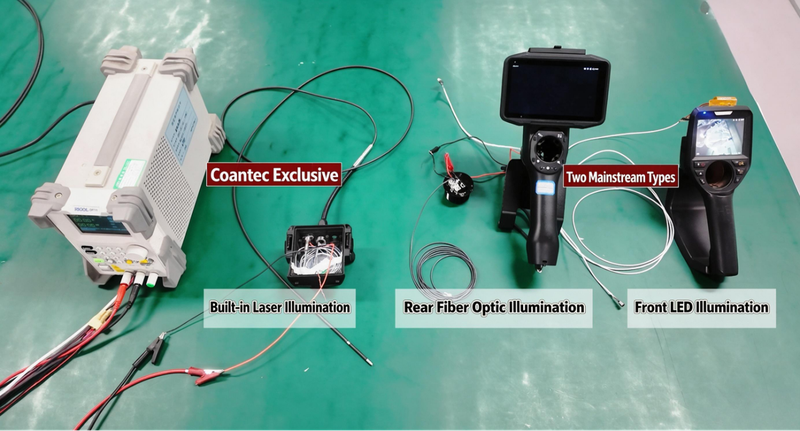
L’éclairage LED est actuellement la solution d’éclairage la plus utilisée dans les endoscopes et vidéoscopes industriels.

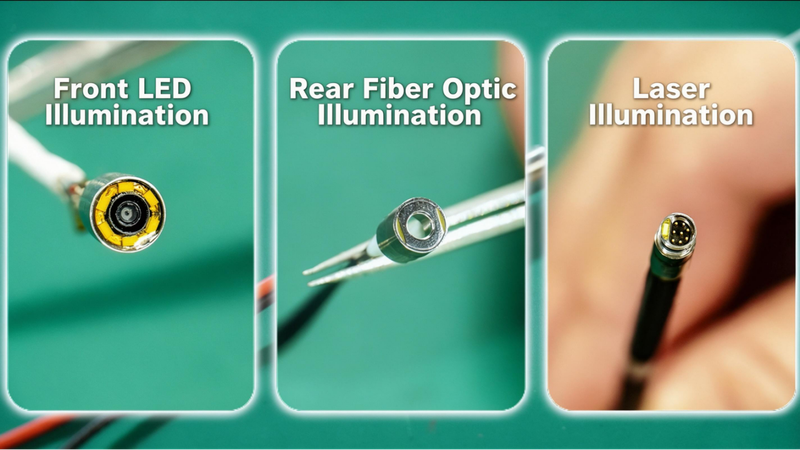
Les LED sont compactes, économes en énergie, durables et relativement faciles à contrôler, ce qui les rend particulièrement adaptées aux équipements dont l'espace interne est extrêmement limité. Dans de nombreux endoscopes industriels, des LED miniatures sont intégrées à proximité de la caméra, à l'extrémité distale du tube d'insertion, fournissant un éclairage direct de la zone d'inspection.

Pour des applications telles que l’inspection de moteurs automobiles, l’inspection de composants mécaniques, l’inspection de tuyaux internes et l’entretien de routine d’équipements, les distances d’inspection sont généralement relativement courtes. Dans ces conditions, l’éclairage LED peut répondre aux exigences de la plupart des inspections visuelles de routine.

Ces avantages ont fait de la technologie LED la solution d’éclairage dominante sur le marché des endoscopes industriels.

Cependant, les LED ne fonctionnent pas aussi bien dans tous les environnements d’inspection.

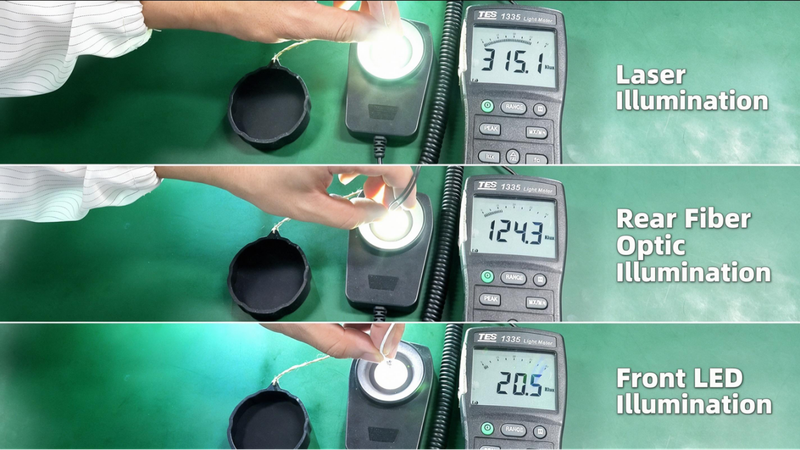
À mesure que l’espace d’inspection s’agrandit et que la distance de visualisation augmente, la lumière se propage naturellement sur une zone plus large. La quantité d'éclairage utile atteignant une cible distante est donc réduite. Les inspecteurs devront peut-être repositionner la sonde à plusieurs reprises et rapprocher l’extrémité distale de la cible afin d’obtenir une luminosité et des détails d’image suffisants.

Pour les environnements d’inspection vastes et profonds, améliorer l’éclairage efficace à longue distance devient donc un défi de plus en plus important.

Éclairage par fibre optique : fournir de la lumière à l'extrémité distale

Contrairement aux LED montées directement à proximité de la caméra, l'éclairage par fibre optique sépare la source lumineuse de l'extrémité distale de l'endoscope.

La source d'éclairage peut être située dans l'unité principale ou dans une source de lumière externe séparée, tandis que les fibres optiques transmettent la lumière jusqu'à l'extrémité distale de l'instrument.

Cette technologie est utilisée depuis longtemps dans les systèmes d’inspection endoscopique industriels professionnels.

Étant donné que la source lumineuse n'est pas limitée par l'espace extrêmement limité disponible au niveau de la pointe de la sonde, le système peut offrir une plus grande flexibilité dans la sélection de sources d'éclairage à plus haut rendement ou plus spécialisées.

Pour les applications d'inspection professionnelle avec des exigences d'éclairage plus élevées, les systèmes à fibre optique peuvent donc offrir une plus grande flexibilité dans la conception globale du système optique.

Cependant, l’éclairage par fibre optique peut également accroître la complexité du système. La source lumineuse, le faisceau de fibres et le système d'endoscope doivent être correctement connectés et adaptés, tandis que l'opération sur le terrain peut impliquer des équipements, des connexions et des exigences de couplage optique supplémentaires.

D'un point de vue technique, l'éclairage par fibre optique souligne la séparation de la source lumineuse et de la sonde, permettant plus de flexibilité dans la configuration de la source lumineuse. L’éclairage LED, en comparaison, se concentre davantage sur l’intégration compacte et la commodité.

Éclairage laser : pourquoi attire-t-il l’attention dans l’inspection industrielle ?

Comparé à l'éclairage LED et à fibre optique conventionnel, l'éclairage laser représente une direction technique plus spécialisée dans les applications d'endoscopes industriels.

L’une des principales caractéristiques de la lumière laser est sa forte directionnalité et sa forte concentration d’énergie.

In industries such as aerospace, gas turbines, petrochemical processing and automotive manufacturing, many critical components are located inside narrow, enclosed, or otherwise inaccessible spaces. Industrial borescopes enable inspectors to access these areas through a flexible insertion tube and display internal conditions in real time, making them an essential visual inspection tool for non-destructive testing (NDT). However, achieving clear and reliable inspection images depends on more than just the camera and optics. In most industrial inspection environments, the area being inspected has little or no ambient light and may be completely dark. The amount of useful image information captured by the imaging system therefore depends heavily on the illumination available at the inspection point. For this reason, illumination is a critical part of an industrial borescope imaging system and one of the key factors affecting real-world inspection performance. So, what types of illumination are commonly used in industrial borescopes? What are the differences between LED, fiber-optic and laser illumination? And which technologies are better suited to different inspection applications? Why Do Industrial Borescopes Need Illumination? To understand the role of illumination, it is helpful to first understand how an industrial borescope forms an image. In simple terms, the light source illuminates the target surface. The borescope optics collect the reflected light, and the image sensor converts that optical information into electronic signals, which are then processed and displayed as an image. The imaging process can therefore be summarized as: Light illuminates the target → Reflected light enters the optics → The image sensor captures the information → Image processing → Display Without sufficient illumination, even a high-resolution image sensor may struggle to produce a clear and usable image. This is particularly important in industrial inspection, where inspectors often need to identify very small surface features and defects. Cracks, corrosion, burn damage, erosion and scratches on turbine or engine components can easily be obscured by insufficient illumination, shadowed areas or image noise. Therefore, the imaging capability of an industrial borescope should not be evaluated solely by resolution or display size. The performance of the illumination system, optics, image sensor and image-processing technology must also be considered as an integrated system. LED Illumination: The Most Common Lighting Technology in Industrial Borescopes LED illumination is currently the most widely used lighting solution in industrial borescopes and videoscopes. LEDs are compact, energy-efficient, long-lasting and relatively easy to control, making them particularly suitable for equipment with extremely limited internal space. In many industrial borescopes, miniature LEDs are integrated close to the camera at the distal end of the insertion tube, providing direct illumination of the inspection area. For applications such as automotive engine inspection, mechanical component inspection, internal pipe inspection and routine equipment maintenance, inspection distances are typically relatively short. Under these conditions, LED illumination can meet the requirements of most routine visual inspections. These advantages have made LED technology the dominant illumination solution in the industrial borescope market. However, LEDs do not perform equally well in every inspection environment. As the inspection space becomes larger and the viewing distance increases, light naturally spreads over a wider area. The amount of useful illumination reaching a distant target is therefore reduced. Inspectors may need to reposition the probe repeatedly and move the distal end closer to the target in order to obtain sufficient image brightness and detail. For large and deep inspection environments, improving effective long-distance illumination therefore becomes an increasingly important challenge. Fiber-Optic Illumination: Delivering Light to the Distal End Unlike LEDs mounted directly near the camera, fiber-optic illumination separates the light source from the distal end of the borescope. The illumination source can be located in the main unit or in a separate external light source, while optical fibers transmit the light to the distal end of the instrument. This technology has long been used in professional industrial endoscopic inspection systems. Because the light source is not constrained by the extremely limited space available at the probe tip, the system can provide greater flexibility in selecting higher-output or more specialized illumination sources. For professional inspection applications with higher illumination requirements, fiber-optic systems can therefore offer greater flexibility in overall optical system design. However, fiber-optic illumination can also increase system complexity. The light source, fiber bundle and borescope system must be properly connected and matched, while field operation may involve additional equipment, connections and optical coupling requirements. From a technical perspective, fiber-optic illumination emphasizes the separation of the light source and the probe, allowing more flexibility in light-source configuration. LED illumination, by comparison, focuses more on compact integration and convenience. Laser Illumination: Why Is It Attracting Attention in Industrial Inspection? Compared with LED and conventional fiber-optic illumination, laser illumination represents a more specialized technical direction in industrial borescope applications. One of the key characteristics of laser light is its strong directionality and high energy concentration. This does not simply mean that a laser is “brighter than an LED.” More importantly, with appropriate optical design, laser energy can be directed and distributed more effectively toward the inspection target, creating new possibilities for illuminating objects at longer distances and in deep inspection environments. This can be particularly valuable when inspecting large and complex industrial equipment. For example, during the inspection of large aero engines, gas turbines and other complex equipment, the inspector may not always be observing a small target located close to the distal end of the borescope. Instead, the inspection target may include turbine blades, combustion chambers or other structures located within a large and deep internal space. If illumination is effective only at close range, the inspector may need to repeatedly reposition the insertion tube or divide a large inspection area into multiple sections. More effective long-distance illumination can make it possible to observe larger target areas from a more suitable working distance, creating additional flexibility for inspection in large and deep spaces. Therefore, the value of laser illumination is not simply about achieving higher brightness. Its real significance lies in improving illumination efficiency for specific long-distance and large-volume inspection environments where conventional lighting technologies may face limitations. Of course, laser illumination also requires careful optical system design. Industrial equipment often contains highly reflective metallic surfaces. Strong reflections can produce localized highlights or overexposure. For this reason, the laser illumination system must be properly matched with the optical design, image sensor and image-processing algorithms in order to deliver useful inspection performance. LED vs. Fiber-Optic vs. Laser Illumination: What Is the Difference? In practical applications, these three illumination technologies should not simply be classified as “advanced” or “outdated.” Instead, each represents a different technical approach designed for different inspection requirements.  Illumination Technology Key Characteristics Typical Applications  LED Illumination Compact, easy to integrate, mature technology Routine industrial inspection at short distances  Fiber-Optic Illumination Separates the light source from the probe and supports more flexible light-source configurations Professional inspections with higher illumination requirements  Laser Illumination Strong directionality and concentrated optical energy, offering potential advantages for long-distance illumination Large, deep and long-distance industrial inspection environments  Therefore, when selecting an industrial borescope, it is not accurate to assume that laser illumination is automatically better than LED illumination. For routine close-range inspection of mechanical components, LED illumination can provide stable and reliable performance. For specialized applications requiring greater illumination capability or longer observation distances, fiber-optic or laser-based solutions may offer additional advantages. The most suitable illumination technology depends on the inspection object, working distance, internal space and the specific characteristics of the defects being inspected. Why Are Modern Industrial Borescopes Moving Toward Multi-Source Illumination? As industrial inspection targets become increasingly complex, a single white-light source may not be sufficient for every application. Different materials and surface conditions reflect light differently. The same defect may also appear differently under different illumination conditions. As a result, some next-generation industrial borescopes are beginning to offer a wider range of specialized illumination options, including different wavelengths and illumination methods. The purpose of multi-source illumination is not simply to add more lights to the system. Its real value is to provide inspectors with more suitable observation conditions for different inspection objects and tasks. In other words, the key question is changing. In the past, the focus was often: “Is the light bright enough?” Today, the more important question is becoming: “What type of illumination can help the inspector identify the target features more effectively?” Industrial Borescope Illumination Is Evolving from “Lighting” to “Effective Imaging” The development of industrial borescope illumination reflects the changing requirements of industrial inspection. In the early stages, illumination primarily needed to solve one problem: Making the invisible visible. As high-definition imaging technology developed, the focus shifted toward: Seeing more clearly. Today, as industrial inspection increasingly involves large-scale equipment and intelligent visual inspection technologies, illumination systems must also address new requirements: Seeing farther. Seeing more. And working more effectively with imaging algorithms. As a result, the illumination system is no longer simply an independent light source module. It is becoming increasingly integrated into the overall imaging system. The light source determines how the target is illuminated. The optical system determines how reflected light is collected. The image sensor records the information, while image-processing algorithms influence how the final image is presented and analyzed. Only when these elements work together effectively can an industrial borescope deliver meaningful visual inspection performance. The Next Step for Laser Illumination: From Specialized Light Sources to Integrated Systems As laser illumination enters industrial borescope applications, one important development direction is miniaturization and system integration. Traditional professional laser illumination systems often rely on separate light-source modules. While this approach may be acceptable for large stationary inspection systems, it can reduce convenience and operational efficiency for handheld industrial borescopes designed for field inspection. The more equipment and connections required, the greater the impact on portability and ease of use. This raises an important technical question: Can the laser emission system be integrated directly into the handheld industrial borescope itself? This is not simply a matter of adding a laser to the device. Integrating a laser emission module into a handheld borescope requires careful consideration of power supply, thermal management, optical coupling, internal space and overall system reliability. For this reason, integrated laser illumination is fundamentally a test of a manufacturer's system-level engineering and integration capabilities. The Coantec BLX Series AI Industrial Borescope represents one approach to this development direction by integrating the laser emission module directly into the handheld main unit, combining laser illumination with the overall borescope system in a more compact design. Currently, Coantec BLX is the only integrated handheld industrial borescope solution in China that incorporates the laser emission module directly into the main unit. This development reflects a broader trend in which laser illumination is gradually evolving from a separate professional light-source technology toward more compact and portable industrial visual inspection systems. Conclusion: Clear Industrial Inspection Starts with the Right Light The primary purpose of an industrial borescope is to inspect areas that cannot be directly observed. However, the ability to achieve a clear inspection image depends on far more than the camera alone. From LED illumination to fiber-optic light transmission and laser illumination, different technologies have emerged in response to changing industrial inspection requirements. LED illumination meets the needs of most routine close-range inspections. Fiber-optic illumination provides greater flexibility for professional light-source configurations. Laser illumination, meanwhile, is opening new possibilities for long-distance, large-space and deep-cavity inspection. As aerospace engines, gas turbines and other high-end industrial equipment place increasingly demanding requirements on visual inspection, illumination will continue to evolve from a simple supplementary lighting function into a critical component of the overall imaging system. Future competition in industrial borescope technology will therefore extend beyond specifications such as resolution, display size and probe diameter. It will increasingly focus on the integration and coordination of: Illumination · Optics · Imaging · Algorithms · System Engineering The transition of laser illumination from specialized external light sources toward integrated handheld systems may become an important part of this evolution. A high-performance industrial borescope does more than help inspectors see inside. With the right illumination, it helps them see the details that truly matter.

Cela ne signifie pas simplement qu’un laser est « plus lumineux qu’une LED ».

Plus important encore, avec une conception optique appropriée, l’énergie laser peut être dirigée et distribuée plus efficacement vers la cible d’inspection, créant ainsi de nouvelles possibilités d’éclairage d’objets à de plus longues distances et dans des environnements d’inspection profonds.

Cela peut s’avérer particulièrement utile lors de l’inspection d’équipements industriels volumineux et complexes.

Par exemple, lors de l’inspection de gros moteurs d’avion, de turbines à gaz et d’autres équipements complexes, l’inspecteur n’observe pas toujours une petite cible située à proximité de l’extrémité distale de l’endoscope. Au lieu de cela, la cible de l'inspection peut inclure des aubes de turbine, des chambres de combustion ou d'autres structures situées dans un espace interne vaste et profond.

Si l'éclairage n'est efficace qu'à courte distance, l'inspecteur devra peut-être repositionner à plusieurs reprises le tube d'insertion ou diviser une grande zone d'inspection en plusieurs sections.

Un éclairage longue distance plus efficace peut permettre d'observer des zones cibles plus vastes à partir d'une distance de travail plus appropriée, créant ainsi une flexibilité supplémentaire pour l'inspection dans des espaces vastes et profonds.

Donc, la valeur de l’éclairage laser ne réside pas simplement dans l’obtention d’une luminosité plus élevée. Sa véritable importance réside dans l’amélioration de l’efficacité de l’éclairage pour les environnements d’inspection spécifiques à longue distance et à grand volume où les technologies d’éclairage conventionnelles peuvent rencontrer des limites.

Bien entendu, l’éclairage laser nécessite également une conception minutieuse du système optique.

Les équipements industriels contiennent souvent des surfaces métalliques hautement réfléchissantes. De fortes réflexions peuvent produire des reflets localisés ou une surexposition. Pour cette raison, le système d'éclairage laser doit être correctement adapté à la conception optique, au capteur d'image et aux algorithmes de traitement d'image afin de fournir des performances d'inspection utiles.

Éclairage LED, fibre optique ou laser : quelle est la différence ?

Dans les applications pratiques, ces trois technologies d’éclairage ne doivent pas simplement être classées comme « avancées » ou « dépassées ».

Au lieu de cela, chacun représente une approche technique différente conçue pour différentes exigences d’inspection.

In industries such as aerospace, gas turbines, petrochemical processing and automotive manufacturing, many critical components are located inside narrow, enclosed, or otherwise inaccessible spaces. Industrial borescopes enable inspectors to access these areas through a flexible insertion tube and display internal conditions in real time, making them an essential visual inspection tool for non-destructive testing (NDT). However, achieving clear and reliable inspection images depends on more than just the camera and optics. In most industrial inspection environments, the area being inspected has little or no ambient light and may be completely dark. The amount of useful image information captured by the imaging system therefore depends heavily on the illumination available at the inspection point. For this reason, illumination is a critical part of an industrial borescope imaging system and one of the key factors affecting real-world inspection performance. So, what types of illumination are commonly used in industrial borescopes? What are the differences between LED, fiber-optic and laser illumination? And which technologies are better suited to different inspection applications? Why Do Industrial Borescopes Need Illumination? To understand the role of illumination, it is helpful to first understand how an industrial borescope forms an image. In simple terms, the light source illuminates the target surface. The borescope optics collect the reflected light, and the image sensor converts that optical information into electronic signals, which are then processed and displayed as an image. The imaging process can therefore be summarized as: Light illuminates the target → Reflected light enters the optics → The image sensor captures the information → Image processing → Display Without sufficient illumination, even a high-resolution image sensor may struggle to produce a clear and usable image. This is particularly important in industrial inspection, where inspectors often need to identify very small surface features and defects. Cracks, corrosion, burn damage, erosion and scratches on turbine or engine components can easily be obscured by insufficient illumination, shadowed areas or image noise. Therefore, the imaging capability of an industrial borescope should not be evaluated solely by resolution or display size. The performance of the illumination system, optics, image sensor and image-processing technology must also be considered as an integrated system. LED Illumination: The Most Common Lighting Technology in Industrial Borescopes LED illumination is currently the most widely used lighting solution in industrial borescopes and videoscopes. LEDs are compact, energy-efficient, long-lasting and relatively easy to control, making them particularly suitable for equipment with extremely limited internal space. In many industrial borescopes, miniature LEDs are integrated close to the camera at the distal end of the insertion tube, providing direct illumination of the inspection area. For applications such as automotive engine inspection, mechanical component inspection, internal pipe inspection and routine equipment maintenance, inspection distances are typically relatively short. Under these conditions, LED illumination can meet the requirements of most routine visual inspections. These advantages have made LED technology the dominant illumination solution in the industrial borescope market. However, LEDs do not perform equally well in every inspection environment. As the inspection space becomes larger and the viewing distance increases, light naturally spreads over a wider area. The amount of useful illumination reaching a distant target is therefore reduced. Inspectors may need to reposition the probe repeatedly and move the distal end closer to the target in order to obtain sufficient image brightness and detail. For large and deep inspection environments, improving effective long-distance illumination therefore becomes an increasingly important challenge. Fiber-Optic Illumination: Delivering Light to the Distal End Unlike LEDs mounted directly near the camera, fiber-optic illumination separates the light source from the distal end of the borescope. The illumination source can be located in the main unit or in a separate external light source, while optical fibers transmit the light to the distal end of the instrument. This technology has long been used in professional industrial endoscopic inspection systems. Because the light source is not constrained by the extremely limited space available at the probe tip, the system can provide greater flexibility in selecting higher-output or more specialized illumination sources. For professional inspection applications with higher illumination requirements, fiber-optic systems can therefore offer greater flexibility in overall optical system design. However, fiber-optic illumination can also increase system complexity. The light source, fiber bundle and borescope system must be properly connected and matched, while field operation may involve additional equipment, connections and optical coupling requirements. From a technical perspective, fiber-optic illumination emphasizes the separation of the light source and the probe, allowing more flexibility in light-source configuration. LED illumination, by comparison, focuses more on compact integration and convenience. Laser Illumination: Why Is It Attracting Attention in Industrial Inspection? Compared with LED and conventional fiber-optic illumination, laser illumination represents a more specialized technical direction in industrial borescope applications. One of the key characteristics of laser light is its strong directionality and high energy concentration. This does not simply mean that a laser is “brighter than an LED.” More importantly, with appropriate optical design, laser energy can be directed and distributed more effectively toward the inspection target, creating new possibilities for illuminating objects at longer distances and in deep inspection environments. This can be particularly valuable when inspecting large and complex industrial equipment. For example, during the inspection of large aero engines, gas turbines and other complex equipment, the inspector may not always be observing a small target located close to the distal end of the borescope. Instead, the inspection target may include turbine blades, combustion chambers or other structures located within a large and deep internal space. If illumination is effective only at close range, the inspector may need to repeatedly reposition the insertion tube or divide a large inspection area into multiple sections. More effective long-distance illumination can make it possible to observe larger target areas from a more suitable working distance, creating additional flexibility for inspection in large and deep spaces. Therefore, the value of laser illumination is not simply about achieving higher brightness. Its real significance lies in improving illumination efficiency for specific long-distance and large-volume inspection environments where conventional lighting technologies may face limitations. Of course, laser illumination also requires careful optical system design. Industrial equipment often contains highly reflective metallic surfaces. Strong reflections can produce localized highlights or overexposure. For this reason, the laser illumination system must be properly matched with the optical design, image sensor and image-processing algorithms in order to deliver useful inspection performance. LED vs. Fiber-Optic vs. Laser Illumination: What Is the Difference? In practical applications, these three illumination technologies should not simply be classified as “advanced” or “outdated.” Instead, each represents a different technical approach designed for different inspection requirements.  Illumination Technology Key Characteristics Typical Applications  LED Illumination Compact, easy to integrate, mature technology Routine industrial inspection at short distances  Fiber-Optic Illumination Separates the light source from the probe and supports more flexible light-source configurations Professional inspections with higher illumination requirements  Laser Illumination Strong directionality and concentrated optical energy, offering potential advantages for long-distance illumination Large, deep and long-distance industrial inspection environments  Therefore, when selecting an industrial borescope, it is not accurate to assume that laser illumination is automatically better than LED illumination. For routine close-range inspection of mechanical components, LED illumination can provide stable and reliable performance. For specialized applications requiring greater illumination capability or longer observation distances, fiber-optic or laser-based solutions may offer additional advantages. The most suitable illumination technology depends on the inspection object, working distance, internal space and the specific characteristics of the defects being inspected. Why Are Modern Industrial Borescopes Moving Toward Multi-Source Illumination? As industrial inspection targets become increasingly complex, a single white-light source may not be sufficient for every application. Different materials and surface conditions reflect light differently. The same defect may also appear differently under different illumination conditions. As a result, some next-generation industrial borescopes are beginning to offer a wider range of specialized illumination options, including different wavelengths and illumination methods. The purpose of multi-source illumination is not simply to add more lights to the system. Its real value is to provide inspectors with more suitable observation conditions for different inspection objects and tasks. In other words, the key question is changing. In the past, the focus was often: “Is the light bright enough?” Today, the more important question is becoming: “What type of illumination can help the inspector identify the target features more effectively?” Industrial Borescope Illumination Is Evolving from “Lighting” to “Effective Imaging” The development of industrial borescope illumination reflects the changing requirements of industrial inspection. In the early stages, illumination primarily needed to solve one problem: Making the invisible visible. As high-definition imaging technology developed, the focus shifted toward: Seeing more clearly. Today, as industrial inspection increasingly involves large-scale equipment and intelligent visual inspection technologies, illumination systems must also address new requirements: Seeing farther. Seeing more. And working more effectively with imaging algorithms. As a result, the illumination system is no longer simply an independent light source module. It is becoming increasingly integrated into the overall imaging system. The light source determines how the target is illuminated. The optical system determines how reflected light is collected. The image sensor records the information, while image-processing algorithms influence how the final image is presented and analyzed. Only when these elements work together effectively can an industrial borescope deliver meaningful visual inspection performance. The Next Step for Laser Illumination: From Specialized Light Sources to Integrated Systems As laser illumination enters industrial borescope applications, one important development direction is miniaturization and system integration. Traditional professional laser illumination systems often rely on separate light-source modules. While this approach may be acceptable for large stationary inspection systems, it can reduce convenience and operational efficiency for handheld industrial borescopes designed for field inspection. The more equipment and connections required, the greater the impact on portability and ease of use. This raises an important technical question: Can the laser emission system be integrated directly into the handheld industrial borescope itself? This is not simply a matter of adding a laser to the device. Integrating a laser emission module into a handheld borescope requires careful consideration of power supply, thermal management, optical coupling, internal space and overall system reliability. For this reason, integrated laser illumination is fundamentally a test of a manufacturer's system-level engineering and integration capabilities. The Coantec BLX Series AI Industrial Borescope represents one approach to this development direction by integrating the laser emission module directly into the handheld main unit, combining laser illumination with the overall borescope system in a more compact design. Currently, Coantec BLX is the only integrated handheld industrial borescope solution in China that incorporates the laser emission module directly into the main unit. This development reflects a broader trend in which laser illumination is gradually evolving from a separate professional light-source technology toward more compact and portable industrial visual inspection systems. Conclusion: Clear Industrial Inspection Starts with the Right Light The primary purpose of an industrial borescope is to inspect areas that cannot be directly observed. However, the ability to achieve a clear inspection image depends on far more than the camera alone. From LED illumination to fiber-optic light transmission and laser illumination, different technologies have emerged in response to changing industrial inspection requirements. LED illumination meets the needs of most routine close-range inspections. Fiber-optic illumination provides greater flexibility for professional light-source configurations. Laser illumination, meanwhile, is opening new possibilities for long-distance, large-space and deep-cavity inspection. As aerospace engines, gas turbines and other high-end industrial equipment place increasingly demanding requirements on visual inspection, illumination will continue to evolve from a simple supplementary lighting function into a critical component of the overall imaging system. Future competition in industrial borescope technology will therefore extend beyond specifications such as resolution, display size and probe diameter. It will increasingly focus on the integration and coordination of: Illumination · Optics · Imaging · Algorithms · System Engineering The transition of laser illumination from specialized external light sources toward integrated handheld systems may become an important part of this evolution. A high-performance industrial borescope does more than help inspectors see inside. With the right illumination, it helps them see the details that truly matter.


Technologie d'éclairage

Caractéristiques clés

Applications typiques

Éclairage LED

Technologie compacte, facile à intégrer et mature

Inspection industrielle de routine à courte distance

Éclairage à fibre optique

Sépare la source lumineuse de la sonde et prend en charge des configurations de source lumineuse plus flexibles

Inspections professionnelles avec des exigences d'éclairage plus élevées

Éclairage laser

Forte directivité et énergie optique concentrée, offrant des avantages potentiels pour l'éclairage longue distance

Environnements d'inspection industrielle vastes, profonds et longue distance

Par conséquent, lors de la sélection d’un endoscope industriel, il n’est pas exact de supposer que l’éclairage laser est automatiquement meilleur que l’éclairage LED.

Pour l'inspection de routine à courte distance des composants mécaniques, l'éclairage LED peut fournir des performances stables et fiables. Pour les applications spécialisées nécessitant une plus grande capacité d’éclairage ou des distances d’observation plus longues, les solutions à fibre optique ou laser peuvent offrir des avantages supplémentaires.

La technologie d'éclairage la plus adaptée dépend de l'objet à inspecter, de la distance de travail, de l'espace interne et des caractéristiques spécifiques des défauts inspectés.

Pourquoi les endoscopes industriels modernes s’orientent-ils vers un éclairage multi-sources ?

À mesure que les objectifs de l’inspection industrielle deviennent de plus en plus complexes, une seule source de lumière blanche peut ne pas suffire pour chaque application.

Différents matériaux et états de surface reflètent la lumière différemment. Le même défaut peut également apparaître différemment dans différentes conditions d’éclairage.

En conséquence, certains endoscopes industriels de nouvelle génération commencent à offrir une gamme plus large d’options d’éclairage spécialisées, notamment différentes longueurs d’onde et méthodes d’éclairage.

Le but de l’éclairage multi-sources n’est pas simplement d’ajouter plus de lumières au système.

Sa véritable valeur est de fournir aux inspecteurs des conditions d’observation plus adaptées aux différents objets et tâches d’inspection.

En d’autres termes, la question clé est en train de changer.

Dans le passé, l’accent était souvent mis sur :

« La lumière est-elle suffisamment brillante ? »

Aujourd’hui, la question la plus importante devient :

« Quel type d'éclairage peut aider l'inspecteur à identifier plus efficacement les éléments cibles ? »

L’éclairage des endoscopes industriels évolue de « l’éclairage » à une « imagerie efficace »

Le développement de l’éclairage des endoscopes industriels reflète les exigences changeantes de l’inspection industrielle.

Au début, l’éclairage devait principalement résoudre un problème :

Rendre visible l’invisible.

À mesure que la technologie d’imagerie haute définition se développait, l’accent s’est déplacé vers :

Voir plus clairement.

Aujourd’hui, alors que l’inspection industrielle implique de plus en plus d’équipements à grande échelle et de technologies d’inspection visuelle intelligente, les systèmes d’éclairage doivent également répondre à de nouvelles exigences :

Voir plus loin. Voir plus. Et travailler plus efficacement avec les algorithmes d’imagerie.

Le système d’éclairage n’est donc plus simplement un module de source lumineuse indépendant. Il est de plus en plus intégré dans le système d’imagerie global.

La source lumineuse détermine la manière dont la cible est éclairée. Le système optique détermine la manière dont la lumière réfléchie est collectée. Le capteur d'image enregistre les informations, tandis que les algorithmes de traitement d'image influencent la façon dont l'image finale est présentée et analysée.

Ce n'est que lorsque ces éléments fonctionnent ensemble efficacement qu'un endoscope industriel peut offrir des performances d'inspection visuelle significatives.

La prochaine étape pour l’éclairage laser : des sources lumineuses spécialisées aux systèmes intégrés

Alors que l’éclairage laser entre dans les applications industrielles des endoscopes, une direction de développement importante est miniaturisation et intégration de systèmes.

Les systèmes d'éclairage laser professionnels traditionnels reposent souvent sur des modules de source lumineuse séparés. Bien que cette approche puisse être acceptable pour les grands systèmes d'inspection fixes, elle peut réduire la commodité et l'efficacité opérationnelle des endoscopes industriels portatifs conçus pour l'inspection sur le terrain.

Plus il faut d’équipements et de connexions, plus l’impact sur la portabilité et la facilité d’utilisation est grand.

Cela soulève une question technique importante :

Le système d’émission laser peut-il être intégré directement dans l’endoscope industriel portatif lui-même ?

Il ne s’agit pas simplement d’ajouter un laser à l’appareil.

L'intégration d'un module d'émission laser dans un endoscope portatif nécessite une prise en compte minutieuse de l'alimentation électrique, de la gestion thermique, du couplage optique, de l'espace interne et de la fiabilité globale du système.

Pour cette raison, L'éclairage laser intégré est fondamentalement un test des capacités d'ingénierie et d'intégration au niveau système d'un fabricant.

L'endoscope industriel Coantec BLX série AI représente une approche de cette direction de développement en intégrant le module d'émission laser directement dans l'unité principale portative, combinant l'éclairage laser avec le système global d'endoscope dans une conception plus compacte.

Actuellement, Coantec BLX est la seule solution d'endoscope industriel portable intégrée en Chine qui intègre le module d'émission laser directement dans l'unité principale.

Ce développement reflète une tendance plus large dans laquelle l'éclairage laser évolue progressivement d'une technologie de source lumineuse professionnelle distincte vers des systèmes d'inspection visuelle industrielle plus compacts et portables.

Conclusion : une inspection industrielle claire commence par le bon éclairage

L'objectif principal d'un endoscope industriel est d'inspecter les zones qui ne peuvent pas être observées directement. Cependant, la capacité à obtenir une image d’inspection claire ne dépend pas uniquement de la caméra seule.

De l'éclairage LED à la transmission de la lumière par fibre optique et à l'éclairage laser, différentes technologies ont émergé en réponse à l'évolution des exigences d'inspection industrielle.

L'éclairage LED répond aux besoins de la plupart des inspections rapprochées de routine. L'éclairage à fibre optique offre une plus grande flexibilité pour les configurations de sources lumineuses professionnelles. L’éclairage laser, quant à lui, ouvre de nouvelles possibilités pour l’inspection à longue distance, dans de grands espaces et dans des cavités profondes.

Alors que les moteurs aérospatiaux, les turbines à gaz et autres équipements industriels haut de gamme imposent des exigences de plus en plus strictes en matière d’inspection visuelle, l’éclairage continuera d’évoluer d’une simple fonction d’éclairage supplémentaire à un composant essentiel du système d’imagerie global.

La concurrence future dans la technologie des endoscopes industriels s'étendra donc au-delà des spécifications telles que la résolution, la taille de l'écran et le diamètre de la sonde.

Il se concentrera de plus en plus sur l’intégration et la coordination de :

Éclairage · Optique · Imagerie · Algorithmes · Ingénierie Système

La transition de l’éclairage laser de sources lumineuses externes spécialisées vers des systèmes portables intégrés pourrait devenir une partie importante de cette évolution.

Un endoscope industriel haute performance fait bien plus qu’aider les inspecteurs à voir à l’intérieur. Avec le bon éclairage, cela les aide à voir les détails qui comptent vraiment.
flora@chinavideoscope.com

+86-755-89728626

+86 13714520051