

Lors de l'inspection des surfaces internes des moteurs, des pipelines, des turbines et des machines industrielles, les techniciens doivent souvent examiner des zones difficiles, voire impossibles, d'accès direct. Un endoscope ou fibroscope industriel constitue un moyen pratique d'effectuer des inspections visuelles sans démontage inutile.
Bien que ces instruments partagent un objectif similaire, ils peuvent différer considérablement en termes de transmission d’images, de qualité d’image, de flexibilité de la sonde, de fonctionnalités de fonctionnement et de capacités d’inspection. Comprendre ces différences est essentiel lors de la sélection du bon équipement d'inspection pour la maintenance industrielle, le contrôle qualité et les tests non destructifs (CND).
Alors, quelle est la différence entre un endoscope industriel et un fibroscope ? Quel instrument est le meilleur pour inspecter des passages étroits, des structures internes complexes ou des composants mécaniques critiques ?
Ce guide explique leurs principes de fonctionnement, leurs principales différences, leurs applications typiques et les facteurs à prendre en compte lors du choix d'une portée d'inspection industrielle.
Un endoscope industriel est un instrument d'inspection visuelle conçu pour examiner les zones internes qui ne peuvent pas être visualisées directement. Il se compose généralement d'un tube ou d'une sonde d'insertion, d'un système optique, d'un système d'éclairage et d'un oculaire ou d'un affichage électronique.
Les endoscopes industriels sont largement utilisés dans l'aérospatiale, la fabrication automobile, la production d'électricité, le traitement pétrochimique, le travail des métaux et la maintenance industrielle.
Selon leur conception, les endoscopes industriels peuvent être divisés en plusieurs catégories :
Endoscopes rigides : Utilisez un tube d'insertion droit et rigide et conviennent à l'inspection des chemins d'accès relativement droits.
Endoscopes flexibles : Utilisez un tube d'insertion flexible pour accéder aux espaces incurvés ou obstrués.
Endoscopes vidéo : Capturez des images électroniquement et affichez-les sur un moniteur ou un écran de poche.
Endoscopes à fibre optique : Utilisez des faisceaux de fibres optiques pour transmettre des images de la zone d'inspection à l'extrémité de visualisation.
Les endoscopes vidéo industriels modernes peuvent également inclure des sondes articulées, un éclairage LED réglable, un enregistrement d'images et vidéo et des fonctions de mesure spécialisées.
Ces fonctionnalités aident les inspecteurs à examiner les composants internes, à documenter les défauts et à comparer les résultats de l'inspection au fil du temps.
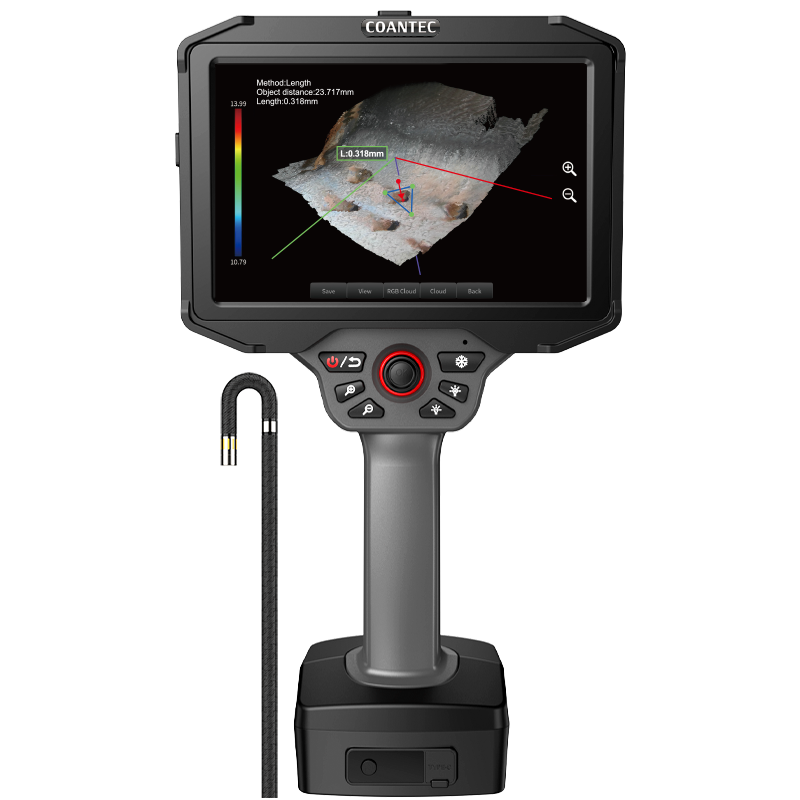
Un fibroscope est un instrument d'inspection optique qui utilise un faisceau de fibres optiques pour transmettre une image de l'extrémité distale de la sonde à l'extrémité de visualisation.
Dans un fibroscope traditionnel de transmission d'images, le faisceau de fibres contient de nombreuses fibres optiques individuelles disposées pour préserver les informations spatiales de l'image. Chaque fibre transporte une partie de l'image, permettant à l'opérateur de visualiser la cible à travers un oculaire.
Un fibroscope se compose généralement de :
Un tube d'insertion flexible
Une lentille d'objectif à l'extrémité distale
Un faisceau de fibres transmettant des images
Un oculaire ou un système de visualisation
Un système d'éclairage, utilisant souvent une source de lumière et des fibres d'éclairage séparées
Un mécanisme de commande sur certains modèles pour piloter l'extrémité distale
La sonde flexible rend le fibroscope utile pour inspecter les passages étroits, les canaux incurvés et les structures internes à accès limité.
Les fibroscopes traditionnels sont appréciés pour leur flexibilité et leur conception optique compacte. Cependant, la qualité de l'image peut être affectée par le nombre, la densité et l'état des fibres de l'image. Les fibres cassées peuvent apparaître sous forme de points sombres ou d'imperfections sur l'image visualisée.
Il est important de noter que tous les instruments contenant des fibres optiques ne sont pas des fibroscopes. Certains endoscopes vidéo électroniques utilisent des fibres optiques uniquement pour fournir un éclairage, tandis qu'un capteur de caméra miniature capture l'image.
La distinction la plus importante réside dans la manière dont l’image est transmise et affichée. Cependant, la construction de la sonde, la maniabilité, la documentation des images et les exigences d'inspection influencent également l'instrument le plus adapté.
| Fonctionnalité | Endoscope vidéo industriel | Fibroscope traditionnel |
|---|---|---|
| Transmission d'images | Capture d'images électroniques et transmission numérique | Transmission d'images optiques à travers un faisceau de fibres |
| Affichage des images | Moniteur électronique ou écran portable | Généralement un oculaire ou une visionneuse optique |
| Qualité des images | Dépend de la résolution du capteur, de l'optique, de l'éclairage et du traitement | Dépend de la qualité du faisceau de fibres, de l'optique, de l'éclairage et du système de visualisation |
| Enregistrement d'images | Prend généralement en charge les photos et vidéos numériques | Dépend du système de visualisation et des accessoires disponibles |
| Flexibilité de la sonde | Disponible en modèles rigides, flexibles et articulés | Généralement flexible |
| Pilotage de la sonde | Disponible sur les modèles articulés | Disponible sur certains modèles |
| Fonctions de mesure | Disponible sur certains modèles | Nécessite généralement des systèmes supplémentaires ou des conceptions spécialisées |
| Transmission d'images | Électronique | Optique dans les fibroscopes traditionnels à transmission d'images |
| Applications typiques | Inspection du moteur, inspection de la turbine, maintenance de l'équipement et documentation des défauts | Passages étroits, canaux incurvés et tâches d'inspection optique spécialisées |
Il s’agit là de caractéristiques générales plutôt que de règles universelles. Certains fibroscopes avancés peuvent se connecter à des systèmes d'imagerie numérique, tandis que certains endoscopes vidéo industriels sont conçus pour des applications très spécialisées.
La meilleure comparaison doit donc être basée sur la configuration réelle de l'instrument, plutôt que sur le seul nom du produit.
La qualité de l'image est l'une des considérations les plus importantes lors de l'inspection industrielle, en particulier lorsque les inspecteurs doivent identifier de petites fissures, de la corrosion, une usure de surface ou des dommages causés par des corps étrangers.
Un endoscope vidéo utilise un capteur d'image électronique, généralement situé près de l'extrémité distale de la sonde, pour capturer la cible d'inspection. L'image est ensuite traitée et affichée électroniquement.
Selon le modèle, cette architecture peut prendre en charge :
Images fixes haute résolution
Inspection vidéo en temps réel
Zoom numérique et réglage de l'image
Stockage de photos et de vidéos
Dossiers d’inspection pour la maintenance et le contrôle qualité
Fonctionnalités de mesure dimensionnelle spécialisées
Les performances réelles dépendent du capteur d'image, de la conception optique, de l'éclairage, de la distance de travail et des capacités de traitement d'image.
Un écran haute résolution ne garantit pas à lui seul qu’un instrument puisse détecter chaque petit défaut. Les inspecteurs doivent également tenir compte de la clarté de l'image optique et des conditions dans lesquelles la cible est observée.
A traditional fiberscope transmits the image through a coherent optical fiber bundle. Its image quality depends on the number and density of fibers, the optical design, the condition of the bundle, and the quality of the illumination.
Fiberscopes can provide useful visual information in confined spaces, particularly where their flexible construction is advantageous. However, the fiber structure can limit image detail compared with some modern electronic imaging systems.
If individual fibers become damaged, dark spots may appear in the image. These artifacts can make it more difficult to distinguish small surface defects.
For applications requiring digital image storage, repeatable inspection records, and integration with modern inspection workflows, a video borescope is often the more practical option.
For specialized inspections where a very flexible optical probe is the priority, a fiberscope may remain suitable.
The correct choice depends on the smallest defect that must be identified, the working distance, the available access path, and the required inspection documentation.
Probe flexibility is another important factor when inspecting complex internal structures.
A traditional fiberscope generally uses a flexible insertion tube that can follow curved access paths. This makes it useful for inspecting narrow channels and internal passages that cannot be reached with a straight probe.
Flexible industrial video borescopes offer similar access advantages. Some models also feature articulating probe tips that allow the operator to steer the camera toward a target without repeatedly withdrawing and repositioning the insertion tube.
For example, a four-way articulating video borescope may allow the inspector to direct the probe tip in multiple directions, making it easier to examine different surfaces within a confined component.
When selecting an instrument for a restricted access point, consider the following factors:
Probe diameter: The insertion tube must fit through the available opening.
Working length: The probe must reach the target without excessive unused length.
Bend radius: The insertion tube must accommodate the access path without exceeding its operating limits.
Articulation: Tip steering may be important when the inspection target is not directly in front of the probe.
Distal-end design: The camera, lens, and illumination must suit the geometry of the inspection area.
Neither a fiberscope nor a video borescope is automatically better in every confined space. The required probe dimensions and steering capabilities should determine the final selection.
Both instruments can be used for visual inspection of internal structures, but their strengths may differ according to the inspection task.
Aircraft engines contain components such as turbine blades, compressor stages, combustion chambers, and other internal surfaces that require careful inspection.
A video borescope can be advantageous when inspectors need to capture images, document findings, and compare conditions during subsequent maintenance inspections.
A suitable articulating probe can help inspectors examine surfaces from different viewing angles.
The instrument must be selected according to the engine manufacturer's inspection procedures, access-port dimensions, required viewing direction, and applicable maintenance requirements.
In automotive maintenance, inspection scopes can help examine cylinder walls, piston crowns, valves, and other internal engine components.
A compact video borescope may provide a convenient way to observe internal conditions and record images for troubleshooting.
A fiberscope can also be suitable for certain restricted passages, particularly when its probe construction matches the access requirements.
Gas turbines and other power-generation equipment contain internal components that can be expensive or time-consuming to disassemble.
Video borescopes can help maintenance teams examine accessible internal surfaces and create visual inspection records.
For these applications, probe length, articulation, image clarity, illumination, and operating temperature limits are important selection criteria.
Industrial inspection scopes can help examine internal surfaces in castings, pipework, gearboxes, hydraulic systems, and other mechanical assemblies.
The appropriate instrument depends on the geometry of the component, the available opening, the inspection distance, and whether the target requires only visual observation or more detailed documentation.
For long pipelines or large industrial structures, a dedicated pipe inspection camera or robotic inspection system may be more appropriate than a conventional handheld borescope.
The purchase price of an industrial borescope or fiberscope depends on more than the basic imaging technology.
Important factors include probe diameter, insertion length, articulation, optical performance, illumination, durability, accessories, and measurement capabilities.
Traditional fiberscopes may be attractive for certain specialized inspection requirements, but the condition of the image fiber bundle is important. Damaged fibers can degrade the viewing image and may require professional repair or replacement.
Video borescopes can offer convenient digital recording and image management, but more advanced systems may involve higher initial costs, electronic components, batteries, displays, and software-related considerations.
Before purchasing, evaluate the total cost of ownership, including:
Initial purchase price
Expected service life
Probe repair or replacement costs
Cleaning and maintenance requirements
Calibration or verification requirements, where applicable
Accessories and software
Operator training
Inspection time and documentation requirements
For industrial applications, the most economical solution is not necessarily the instrument with the lowest purchase price. A tool that matches the inspection task and reduces repeated inspections or unnecessary equipment disassembly may provide greater long-term value.
Choosing between an industrial video borescope and a fiberscope starts with the inspection requirements rather than the product category.
Determine whether the task involves general visual observation, defect identification, digital documentation, or dimensional measurement.
For applications requiring repeatable digital inspection records, a video borescope is often a strong candidate.
Identify the maximum permissible probe diameter and the available insertion length.
Do not select an instrument based on diameter alone. The probe must also accommodate the access path and reach the inspection target.
Determine whether the target can be viewed through a straight access path or whether the operator must steer the probe around bends or obstructions.
A flexible probe may be sufficient for some applications, while an articulating tip may be necessary for others.
Consider the smallest defect that must be identified, the target's surface characteristics, the working distance, and the available illumination.
For critical inspections, evaluate actual sample images or perform a practical demonstration using representative inspection targets.
Confirm whether the probe must withstand moisture, oil, cleaning agents, elevated temperatures, or other environmental conditions.
Verify the manufacturer's specified operating limits and ingress-protection rating. Do not assume that every inspection scope is suitable for hazardous atmospheres or high-temperature environments.
If inspection results must be shared with customers, maintenance teams, or quality departments, check whether the instrument supports image storage, video recording, annotations, reporting, or specialized measurement.
Dimensional measurement requires appropriate instrument capabilities and operating procedures; a clear image alone does not establish measurement accuracy.
Consider product availability, technical support, accessories, repair services, and the availability of replacement probes.
Matching these factors to your inspection requirements helps ensure that the selected equipment remains practical throughout its service life.
Not exactly. Borescope is a broad term for instruments used to visually inspect inaccessible areas. A traditional fiberscope is a type of borescope that uses an optical fiber bundle to transmit the image. Industrial video borescopes instead capture images electronically using an image sensor.
Neither is universally better. A fiberscope may be suitable for specialized applications requiring a flexible optical probe. A video borescope is often more convenient when digital imaging, video recording, image sharing, and inspection documentation are important.
Yes, depending on its configuration. Some fiberscopes can be connected to camera systems or digital viewing accessories. However, digital recording is generally more straightforward with an electronic video borescope designed with built-in imaging and storage features.
An industrial video borescope is often a practical choice for aircraft engine inspections that require digital image documentation and articulating probe control. However, the appropriate instrument must meet the specific engine manufacturer's inspection requirements and applicable maintenance procedures.
The correct diameter depends on the access opening, the internal geometry, the required working distance, and the available probe design. Always confirm the actual dimensions and clearance requirements before selecting an instrument.
Some advanced industrial video borescopes offer specialized measurement functions. Their suitability depends on the measurement technology, calibration or verification procedures, target conditions, and required accuracy. Ordinary visual inspection should not be treated as equivalent to a validated dimensional measurement.
Follow the manufacturer's instructions for cleaning, handling, storage, and inspection. Clean the probe and distal-end optics using approved methods, avoid exceeding the specified bending limits, and inspect the insertion tube for signs of damage before and after use.
Industrial borescopes and fiberscopes both provide access to internal areas that are difficult to inspect directly, but their image-transmission technologies and operating features can differ considerably.
A traditional fiberscope uses a coherent optical fiber bundle to transmit images and can be suitable for specialized inspections requiring a flexible optical probe. An industrial video borescope captures images electronically and often provides advantages in digital recording, image management, and inspection documentation.
When choosing between the two, consider the inspection objective, probe diameter, working length, articulation, image quality, illumination, environmental requirements, and total cost of ownership.
Copyright © 2025. Coantec Ltd. Tous droits réservés. carte du site