
Welche Beleuchtungsarten werden in industriellen Endoskopen verwendet? LED, Glasfaser und Laser im Vergleich

2026-09-08

In Branchen wie der Luft- und Raumfahrt, Gasturbinen, der petrochemischen Verarbeitung und der Automobilherstellung befinden sich viele kritische Komponenten in engen, geschlossenen oder anderweitig unzugänglichen Räumen.

Industrielle Endoskope ermöglichen Prüfern den Zugang zu diesen Bereichen über ein flexibles Einführrohr und zeigen interne Zustände in Echtzeit an, was sie zu einem unverzichtbaren visuellen Inspektionsinstrument für die zerstörungsfreie Prüfung (NDT) macht.
LED, Fiber-Optic and Laser Compared

Die Erzielung klarer und zuverlässiger Inspektionsbilder hängt jedoch von mehr als nur der Kamera und der Optik ab.

In den meisten industriellen Inspektionsumgebungen verfügt der zu inspizierende Bereich über wenig oder gar kein Umgebungslicht und kann völlig dunkel sein. Die Menge der vom Bildsystem erfassten nützlichen Bildinformationen hängt daher stark von der am Inspektionspunkt verfügbaren Beleuchtung ab.

Aus diesem Grund ist die Beleuchtung ein entscheidender Bestandteil eines industriellen Endoskop-Bildgebungssystems und einer der Schlüsselfaktoren, die die Inspektionsleistung in der Praxis beeinflussen.

Welche Beleuchtungsarten werden also üblicherweise in industriellen Endoskopen verwendet? Was sind die Unterschiede zwischen LED-, Glasfaser- und Laserbeleuchtung? Und welche Technologien eignen sich besser für unterschiedliche Inspektionsanwendungen?

Warum benötigen industrielle Endoskope eine Beleuchtung?

Um die Rolle der Beleuchtung zu verstehen, ist es hilfreich, zunächst zu verstehen, wie ein industrielles Endoskop ein Bild erzeugt.

Vereinfacht ausgedrückt beleuchtet die Lichtquelle die Zieloberfläche. Die Endoskopoptik sammelt das reflektierte Licht und der Bildsensor wandelt diese optischen Informationen in elektronische Signale um, die dann verarbeitet und als Bild angezeigt werden.

Der Bildgebungsprozess kann daher wie folgt zusammengefasst werden:

Licht beleuchtet das Ziel → Reflektiertes Licht gelangt in die Optik → Der Bildsensor erfasst die Informationen → Bildverarbeitung → Anzeige

Ohne ausreichende Beleuchtung kann es sogar für einen hochauflösenden Bildsensor schwierig sein, ein klares und brauchbares Bild zu erzeugen.

Dies ist besonders wichtig bei der industriellen Inspektion, wo Inspektoren häufig sehr kleine Oberflächenmerkmale und -fehler identifizieren müssen. Risse, Korrosion, Brandschäden, Erosion und Kratzer an Turbinen- oder Triebwerkskomponenten können durch unzureichende Beleuchtung, Schattenbereiche oder Bildrauschen leicht verdeckt werden.

Daher sollte die Abbildungsfähigkeit eines industriellen Endoskops nicht allein anhand der Auflösung oder der Anzeigegröße beurteilt werden. Auch die Leistung des Beleuchtungssystems, der Optik, des Bildsensors und der Bildverarbeitungstechnik muss als integriertes System betrachtet werden.

LED-Beleuchtung: Die gebräuchlichste Beleuchtungstechnologie in industriellen Endoskopen

LED-Beleuchtung ist derzeit die am weitesten verbreitete Beleuchtungslösung in industriellen Endoskopen und Videoskopen.

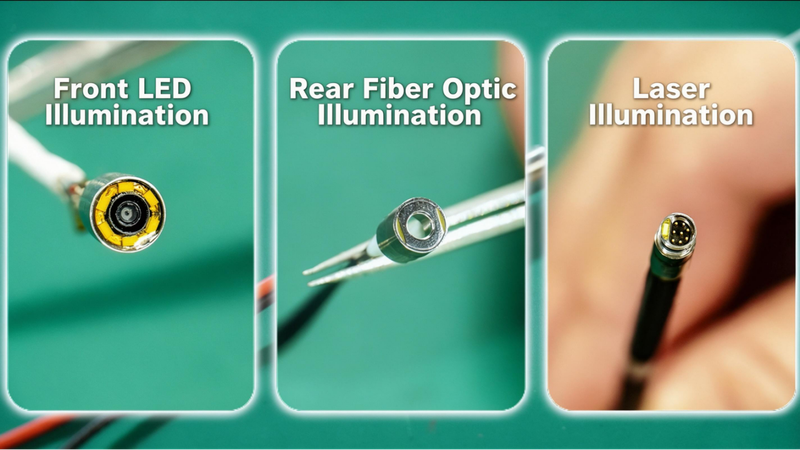
LEDs sind kompakt, energieeffizient, langlebig und relativ einfach zu steuern, wodurch sie sich besonders für Geräte mit extrem begrenztem Innenraum eignen. Bei vielen industriellen Endoskopen sind Miniatur-LEDs nahe der Kamera am distalen Ende des Einführrohrs integriert und sorgen für eine direkte Ausleuchtung des Inspektionsbereichs.

Bei Anwendungen wie der Inspektion von Kraftfahrzeugmotoren, der Inspektion mechanischer Komponenten, der Inspektion interner Rohre und der routinemäßigen Wartung von Geräten sind die Inspektionsabstände in der Regel relativ kurz. Unter diesen Bedingungen kann die LED-Beleuchtung die Anforderungen der meisten routinemäßigen Sichtprüfungen erfüllen.

Diese Vorteile haben die LED-Technologie zur dominierenden Beleuchtungslösung auf dem Markt für industrielle Endoskope gemacht.

Allerdings funktionieren LEDs nicht in jeder Inspektionsumgebung gleich gut.

Wenn der Inspektionsraum größer wird und der Betrachtungsabstand zunimmt, breitet sich das Licht auf natürliche Weise über einen größeren Bereich aus. Die Menge an nutzbarer Beleuchtung, die ein entferntes Ziel erreicht, wird daher reduziert. Prüfer müssen die Sonde möglicherweise wiederholt neu positionieren und das distale Ende näher an das Ziel heranführen, um eine ausreichende Bildhelligkeit und -details zu erhalten.

Für große und tiefe Inspektionsumgebungen wird die Verbesserung einer effektiven Fernbeleuchtung daher zu einer immer wichtigeren Herausforderung.

Faseroptische Beleuchtung: Lieferung von Licht an das distale Ende

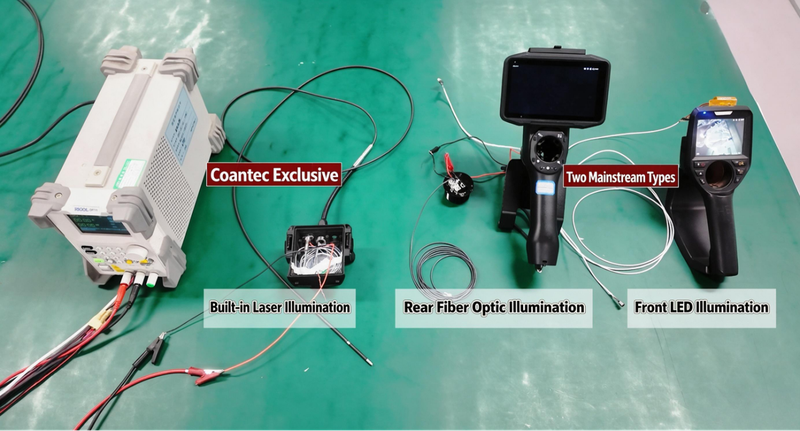
Im Gegensatz zu LEDs, die direkt in der Nähe der Kamera angebracht sind, trennt die faseroptische Beleuchtung die Lichtquelle vom distalen Ende des Endoskops.

Die Beleuchtungsquelle kann sich im Hauptgerät oder in einer separaten externen Lichtquelle befinden, während optische Fasern das Licht zum distalen Ende des Instruments übertragen.

Diese Technologie wird seit langem in professionellen industriellen endoskopischen Inspektionssystemen eingesetzt.

Da die Lichtquelle nicht durch den extrem begrenzten Platz an der Sondenspitze eingeschränkt wird, kann das System eine größere Flexibilität bei der Auswahl von Beleuchtungsquellen mit höherer Leistung oder spezielleren Beleuchtungsquellen bieten.

Für professionelle Inspektionsanwendungen mit höheren Beleuchtungsanforderungen können faseroptische Systeme daher eine größere Flexibilität beim gesamten optischen Systemdesign bieten.

Allerdings kann die faseroptische Beleuchtung auch die Systemkomplexität erhöhen. Die Lichtquelle, das Faserbündel und das Endoskopsystem müssen ordnungsgemäß angeschlossen und aufeinander abgestimmt sein, während der Feldeinsatz möglicherweise zusätzliche Geräte, Anschlüsse und optische Kopplungsanforderungen erfordert.

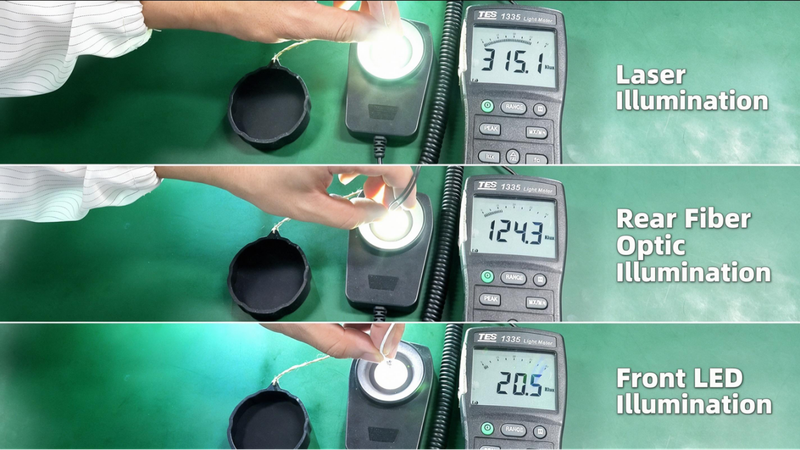
Aus technischer Sicht ist Bei der faseroptischen Beleuchtung wird die Trennung von Lichtquelle und Sonde betontDies ermöglicht mehr Flexibilität bei der Konfiguration der Lichtquelle. Bei der LED-Beleuchtung stehen dagegen eher kompakte Integration und Komfort im Vordergrund.

Laserbeleuchtung: Warum erregt sie in der industriellen Inspektion Aufmerksamkeit?

Im Vergleich zu LED- und herkömmlicher faseroptischer Beleuchtung stellt die Laserbeleuchtung eine speziellere technische Richtung in industriellen Endoskopanwendungen dar.

Eines der Hauptmerkmale von Laserlicht ist seine starke Ausrichtung und hohe Energiekonzentration.

In industries such as aerospace, gas turbines, petrochemical processing and automotive manufacturing, many critical components are located inside narrow, enclosed, or otherwise inaccessible spaces. Industrial borescopes enable inspectors to access these areas through a flexible insertion tube and display internal conditions in real time, making them an essential visual inspection tool for non-destructive testing (NDT). However, achieving clear and reliable inspection images depends on more than just the camera and optics. In most industrial inspection environments, the area being inspected has little or no ambient light and may be completely dark. The amount of useful image information captured by the imaging system therefore depends heavily on the illumination available at the inspection point. For this reason, illumination is a critical part of an industrial borescope imaging system and one of the key factors affecting real-world inspection performance. So, what types of illumination are commonly used in industrial borescopes? What are the differences between LED, fiber-optic and laser illumination? And which technologies are better suited to different inspection applications? Why Do Industrial Borescopes Need Illumination? To understand the role of illumination, it is helpful to first understand how an industrial borescope forms an image. In simple terms, the light source illuminates the target surface. The borescope optics collect the reflected light, and the image sensor converts that optical information into electronic signals, which are then processed and displayed as an image. The imaging process can therefore be summarized as: Light illuminates the target → Reflected light enters the optics → The image sensor captures the information → Image processing → Display Without sufficient illumination, even a high-resolution image sensor may struggle to produce a clear and usable image. This is particularly important in industrial inspection, where inspectors often need to identify very small surface features and defects. Cracks, corrosion, burn damage, erosion and scratches on turbine or engine components can easily be obscured by insufficient illumination, shadowed areas or image noise. Therefore, the imaging capability of an industrial borescope should not be evaluated solely by resolution or display size. The performance of the illumination system, optics, image sensor and image-processing technology must also be considered as an integrated system. LED Illumination: The Most Common Lighting Technology in Industrial Borescopes LED illumination is currently the most widely used lighting solution in industrial borescopes and videoscopes. LEDs are compact, energy-efficient, long-lasting and relatively easy to control, making them particularly suitable for equipment with extremely limited internal space. In many industrial borescopes, miniature LEDs are integrated close to the camera at the distal end of the insertion tube, providing direct illumination of the inspection area. For applications such as automotive engine inspection, mechanical component inspection, internal pipe inspection and routine equipment maintenance, inspection distances are typically relatively short. Under these conditions, LED illumination can meet the requirements of most routine visual inspections. These advantages have made LED technology the dominant illumination solution in the industrial borescope market. However, LEDs do not perform equally well in every inspection environment. As the inspection space becomes larger and the viewing distance increases, light naturally spreads over a wider area. The amount of useful illumination reaching a distant target is therefore reduced. Inspectors may need to reposition the probe repeatedly and move the distal end closer to the target in order to obtain sufficient image brightness and detail. For large and deep inspection environments, improving effective long-distance illumination therefore becomes an increasingly important challenge. Fiber-Optic Illumination: Delivering Light to the Distal End Unlike LEDs mounted directly near the camera, fiber-optic illumination separates the light source from the distal end of the borescope. The illumination source can be located in the main unit or in a separate external light source, while optical fibers transmit the light to the distal end of the instrument. This technology has long been used in professional industrial endoscopic inspection systems. Because the light source is not constrained by the extremely limited space available at the probe tip, the system can provide greater flexibility in selecting higher-output or more specialized illumination sources. For professional inspection applications with higher illumination requirements, fiber-optic systems can therefore offer greater flexibility in overall optical system design. However, fiber-optic illumination can also increase system complexity. The light source, fiber bundle and borescope system must be properly connected and matched, while field operation may involve additional equipment, connections and optical coupling requirements. From a technical perspective, fiber-optic illumination emphasizes the separation of the light source and the probe, allowing more flexibility in light-source configuration. LED illumination, by comparison, focuses more on compact integration and convenience. Laser Illumination: Why Is It Attracting Attention in Industrial Inspection? Compared with LED and conventional fiber-optic illumination, laser illumination represents a more specialized technical direction in industrial borescope applications. One of the key characteristics of laser light is its strong directionality and high energy concentration. This does not simply mean that a laser is “brighter than an LED.” More importantly, with appropriate optical design, laser energy can be directed and distributed more effectively toward the inspection target, creating new possibilities for illuminating objects at longer distances and in deep inspection environments. This can be particularly valuable when inspecting large and complex industrial equipment. For example, during the inspection of large aero engines, gas turbines and other complex equipment, the inspector may not always be observing a small target located close to the distal end of the borescope. Instead, the inspection target may include turbine blades, combustion chambers or other structures located within a large and deep internal space. If illumination is effective only at close range, the inspector may need to repeatedly reposition the insertion tube or divide a large inspection area into multiple sections. More effective long-distance illumination can make it possible to observe larger target areas from a more suitable working distance, creating additional flexibility for inspection in large and deep spaces. Therefore, the value of laser illumination is not simply about achieving higher brightness. Its real significance lies in improving illumination efficiency for specific long-distance and large-volume inspection environments where conventional lighting technologies may face limitations. Of course, laser illumination also requires careful optical system design. Industrial equipment often contains highly reflective metallic surfaces. Strong reflections can produce localized highlights or overexposure. For this reason, the laser illumination system must be properly matched with the optical design, image sensor and image-processing algorithms in order to deliver useful inspection performance. LED vs. Fiber-Optic vs. Laser Illumination: What Is the Difference? In practical applications, these three illumination technologies should not simply be classified as “advanced” or “outdated.” Instead, each represents a different technical approach designed for different inspection requirements.  Illumination Technology Key Characteristics Typical Applications  LED Illumination Compact, easy to integrate, mature technology Routine industrial inspection at short distances  Fiber-Optic Illumination Separates the light source from the probe and supports more flexible light-source configurations Professional inspections with higher illumination requirements  Laser Illumination Strong directionality and concentrated optical energy, offering potential advantages for long-distance illumination Large, deep and long-distance industrial inspection environments  Therefore, when selecting an industrial borescope, it is not accurate to assume that laser illumination is automatically better than LED illumination. For routine close-range inspection of mechanical components, LED illumination can provide stable and reliable performance. For specialized applications requiring greater illumination capability or longer observation distances, fiber-optic or laser-based solutions may offer additional advantages. The most suitable illumination technology depends on the inspection object, working distance, internal space and the specific characteristics of the defects being inspected. Why Are Modern Industrial Borescopes Moving Toward Multi-Source Illumination? As industrial inspection targets become increasingly complex, a single white-light source may not be sufficient for every application. Different materials and surface conditions reflect light differently. The same defect may also appear differently under different illumination conditions. As a result, some next-generation industrial borescopes are beginning to offer a wider range of specialized illumination options, including different wavelengths and illumination methods. The purpose of multi-source illumination is not simply to add more lights to the system. Its real value is to provide inspectors with more suitable observation conditions for different inspection objects and tasks. In other words, the key question is changing. In the past, the focus was often: “Is the light bright enough?” Today, the more important question is becoming: “What type of illumination can help the inspector identify the target features more effectively?” Industrial Borescope Illumination Is Evolving from “Lighting” to “Effective Imaging” The development of industrial borescope illumination reflects the changing requirements of industrial inspection. In the early stages, illumination primarily needed to solve one problem: Making the invisible visible. As high-definition imaging technology developed, the focus shifted toward: Seeing more clearly. Today, as industrial inspection increasingly involves large-scale equipment and intelligent visual inspection technologies, illumination systems must also address new requirements: Seeing farther. Seeing more. And working more effectively with imaging algorithms. As a result, the illumination system is no longer simply an independent light source module. It is becoming increasingly integrated into the overall imaging system. The light source determines how the target is illuminated. The optical system determines how reflected light is collected. The image sensor records the information, while image-processing algorithms influence how the final image is presented and analyzed. Only when these elements work together effectively can an industrial borescope deliver meaningful visual inspection performance. The Next Step for Laser Illumination: From Specialized Light Sources to Integrated Systems As laser illumination enters industrial borescope applications, one important development direction is miniaturization and system integration. Traditional professional laser illumination systems often rely on separate light-source modules. While this approach may be acceptable for large stationary inspection systems, it can reduce convenience and operational efficiency for handheld industrial borescopes designed for field inspection. The more equipment and connections required, the greater the impact on portability and ease of use. This raises an important technical question: Can the laser emission system be integrated directly into the handheld industrial borescope itself? This is not simply a matter of adding a laser to the device. Integrating a laser emission module into a handheld borescope requires careful consideration of power supply, thermal management, optical coupling, internal space and overall system reliability. For this reason, integrated laser illumination is fundamentally a test of a manufacturer's system-level engineering and integration capabilities. The Coantec BLX Series AI Industrial Borescope represents one approach to this development direction by integrating the laser emission module directly into the handheld main unit, combining laser illumination with the overall borescope system in a more compact design. Currently, Coantec BLX is the only integrated handheld industrial borescope solution in China that incorporates the laser emission module directly into the main unit. This development reflects a broader trend in which laser illumination is gradually evolving from a separate professional light-source technology toward more compact and portable industrial visual inspection systems. Conclusion: Clear Industrial Inspection Starts with the Right Light The primary purpose of an industrial borescope is to inspect areas that cannot be directly observed. However, the ability to achieve a clear inspection image depends on far more than the camera alone. From LED illumination to fiber-optic light transmission and laser illumination, different technologies have emerged in response to changing industrial inspection requirements. LED illumination meets the needs of most routine close-range inspections. Fiber-optic illumination provides greater flexibility for professional light-source configurations. Laser illumination, meanwhile, is opening new possibilities for long-distance, large-space and deep-cavity inspection. As aerospace engines, gas turbines and other high-end industrial equipment place increasingly demanding requirements on visual inspection, illumination will continue to evolve from a simple supplementary lighting function into a critical component of the overall imaging system. Future competition in industrial borescope technology will therefore extend beyond specifications such as resolution, display size and probe diameter. It will increasingly focus on the integration and coordination of: Illumination · Optics · Imaging · Algorithms · System Engineering The transition of laser illumination from specialized external light sources toward integrated handheld systems may become an important part of this evolution. A high-performance industrial borescope does more than help inspectors see inside. With the right illumination, it helps them see the details that truly matter.

Dies bedeutet nicht einfach, dass ein Laser „heller als eine LED“ ist.

Noch wichtiger ist, dass die Laserenergie bei geeignetem optischen Design effektiver auf das Inspektionsziel gerichtet und verteilt werden kann, wodurch neue Möglichkeiten für die Beleuchtung von Objekten über größere Entfernungen und in tiefen Inspektionsumgebungen entstehen.

Dies kann besonders bei der Inspektion großer und komplexer Industrieanlagen von Nutzen sein.

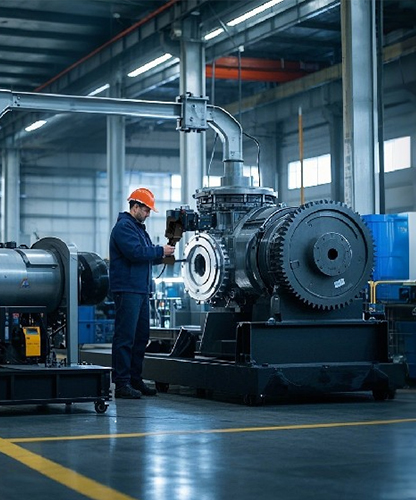
Beispielsweise beobachtet der Prüfer bei der Inspektion großer Flugzeugtriebwerke, Gasturbinen und anderer komplexer Geräte nicht immer ein kleines Ziel, das sich in der Nähe des distalen Endes des Endoskops befindet. Stattdessen kann das Inspektionsziel Turbinenschaufeln, Brennkammern oder andere Strukturen umfassen, die sich in einem großen und tiefen Innenraum befinden.

Wenn die Beleuchtung nur im Nahbereich wirksam ist, muss der Prüfer möglicherweise das Einführrohr wiederholt neu positionieren oder einen großen Prüfbereich in mehrere Abschnitte unterteilen.

Eine effektivere Fernbeleuchtung ermöglicht die Beobachtung größerer Zielbereiche aus einem geeigneteren Arbeitsabstand und schafft so zusätzliche Flexibilität für die Inspektion in großen und tiefen Räumen.

Daher, Der Wert der Laserbeleuchtung liegt nicht nur darin, eine höhere Helligkeit zu erreichen. Ihre eigentliche Bedeutung liegt in der Verbesserung der Beleuchtungseffizienz für bestimmte Inspektionsumgebungen mit großen Entfernungen und großen Volumina, in denen herkömmliche Beleuchtungstechnologien möglicherweise an ihre Grenzen stoßen.

Natürlich erfordert die Laserbeleuchtung auch eine sorgfältige Gestaltung des optischen Systems.

Industrieanlagen enthalten häufig stark reflektierende metallische Oberflächen. Starke Reflexionen können zu lokalen Glanzlichtern oder Überbelichtungen führen. Aus diesem Grund muss das Laserbeleuchtungssystem richtig auf das optische Design, den Bildsensor und die Bildverarbeitungsalgorithmen abgestimmt sein, um eine nützliche Inspektionsleistung zu liefern.

LED vs. Glasfaser vs. Laserbeleuchtung: Was ist der Unterschied?

In der praktischen Anwendung sollten diese drei Beleuchtungstechnologien nicht einfach als „fortschrittlich“ oder „veraltet“ eingestuft werden.

Stattdessen stellt jeder einen anderen technischen Ansatz dar, der für unterschiedliche Inspektionsanforderungen entwickelt wurde.

In industries such as aerospace, gas turbines, petrochemical processing and automotive manufacturing, many critical components are located inside narrow, enclosed, or otherwise inaccessible spaces. Industrial borescopes enable inspectors to access these areas through a flexible insertion tube and display internal conditions in real time, making them an essential visual inspection tool for non-destructive testing (NDT). However, achieving clear and reliable inspection images depends on more than just the camera and optics. In most industrial inspection environments, the area being inspected has little or no ambient light and may be completely dark. The amount of useful image information captured by the imaging system therefore depends heavily on the illumination available at the inspection point. For this reason, illumination is a critical part of an industrial borescope imaging system and one of the key factors affecting real-world inspection performance. So, what types of illumination are commonly used in industrial borescopes? What are the differences between LED, fiber-optic and laser illumination? And which technologies are better suited to different inspection applications? Why Do Industrial Borescopes Need Illumination? To understand the role of illumination, it is helpful to first understand how an industrial borescope forms an image. In simple terms, the light source illuminates the target surface. The borescope optics collect the reflected light, and the image sensor converts that optical information into electronic signals, which are then processed and displayed as an image. The imaging process can therefore be summarized as: Light illuminates the target → Reflected light enters the optics → The image sensor captures the information → Image processing → Display Without sufficient illumination, even a high-resolution image sensor may struggle to produce a clear and usable image. This is particularly important in industrial inspection, where inspectors often need to identify very small surface features and defects. Cracks, corrosion, burn damage, erosion and scratches on turbine or engine components can easily be obscured by insufficient illumination, shadowed areas or image noise. Therefore, the imaging capability of an industrial borescope should not be evaluated solely by resolution or display size. The performance of the illumination system, optics, image sensor and image-processing technology must also be considered as an integrated system. LED Illumination: The Most Common Lighting Technology in Industrial Borescopes LED illumination is currently the most widely used lighting solution in industrial borescopes and videoscopes. LEDs are compact, energy-efficient, long-lasting and relatively easy to control, making them particularly suitable for equipment with extremely limited internal space. In many industrial borescopes, miniature LEDs are integrated close to the camera at the distal end of the insertion tube, providing direct illumination of the inspection area. For applications such as automotive engine inspection, mechanical component inspection, internal pipe inspection and routine equipment maintenance, inspection distances are typically relatively short. Under these conditions, LED illumination can meet the requirements of most routine visual inspections. These advantages have made LED technology the dominant illumination solution in the industrial borescope market. However, LEDs do not perform equally well in every inspection environment. As the inspection space becomes larger and the viewing distance increases, light naturally spreads over a wider area. The amount of useful illumination reaching a distant target is therefore reduced. Inspectors may need to reposition the probe repeatedly and move the distal end closer to the target in order to obtain sufficient image brightness and detail. For large and deep inspection environments, improving effective long-distance illumination therefore becomes an increasingly important challenge. Fiber-Optic Illumination: Delivering Light to the Distal End Unlike LEDs mounted directly near the camera, fiber-optic illumination separates the light source from the distal end of the borescope. The illumination source can be located in the main unit or in a separate external light source, while optical fibers transmit the light to the distal end of the instrument. This technology has long been used in professional industrial endoscopic inspection systems. Because the light source is not constrained by the extremely limited space available at the probe tip, the system can provide greater flexibility in selecting higher-output or more specialized illumination sources. For professional inspection applications with higher illumination requirements, fiber-optic systems can therefore offer greater flexibility in overall optical system design. However, fiber-optic illumination can also increase system complexity. The light source, fiber bundle and borescope system must be properly connected and matched, while field operation may involve additional equipment, connections and optical coupling requirements. From a technical perspective, fiber-optic illumination emphasizes the separation of the light source and the probe, allowing more flexibility in light-source configuration. LED illumination, by comparison, focuses more on compact integration and convenience. Laser Illumination: Why Is It Attracting Attention in Industrial Inspection? Compared with LED and conventional fiber-optic illumination, laser illumination represents a more specialized technical direction in industrial borescope applications. One of the key characteristics of laser light is its strong directionality and high energy concentration. This does not simply mean that a laser is “brighter than an LED.” More importantly, with appropriate optical design, laser energy can be directed and distributed more effectively toward the inspection target, creating new possibilities for illuminating objects at longer distances and in deep inspection environments. This can be particularly valuable when inspecting large and complex industrial equipment. For example, during the inspection of large aero engines, gas turbines and other complex equipment, the inspector may not always be observing a small target located close to the distal end of the borescope. Instead, the inspection target may include turbine blades, combustion chambers or other structures located within a large and deep internal space. If illumination is effective only at close range, the inspector may need to repeatedly reposition the insertion tube or divide a large inspection area into multiple sections. More effective long-distance illumination can make it possible to observe larger target areas from a more suitable working distance, creating additional flexibility for inspection in large and deep spaces. Therefore, the value of laser illumination is not simply about achieving higher brightness. Its real significance lies in improving illumination efficiency for specific long-distance and large-volume inspection environments where conventional lighting technologies may face limitations. Of course, laser illumination also requires careful optical system design. Industrial equipment often contains highly reflective metallic surfaces. Strong reflections can produce localized highlights or overexposure. For this reason, the laser illumination system must be properly matched with the optical design, image sensor and image-processing algorithms in order to deliver useful inspection performance. LED vs. Fiber-Optic vs. Laser Illumination: What Is the Difference? In practical applications, these three illumination technologies should not simply be classified as “advanced” or “outdated.” Instead, each represents a different technical approach designed for different inspection requirements.  Illumination Technology Key Characteristics Typical Applications  LED Illumination Compact, easy to integrate, mature technology Routine industrial inspection at short distances  Fiber-Optic Illumination Separates the light source from the probe and supports more flexible light-source configurations Professional inspections with higher illumination requirements  Laser Illumination Strong directionality and concentrated optical energy, offering potential advantages for long-distance illumination Large, deep and long-distance industrial inspection environments  Therefore, when selecting an industrial borescope, it is not accurate to assume that laser illumination is automatically better than LED illumination. For routine close-range inspection of mechanical components, LED illumination can provide stable and reliable performance. For specialized applications requiring greater illumination capability or longer observation distances, fiber-optic or laser-based solutions may offer additional advantages. The most suitable illumination technology depends on the inspection object, working distance, internal space and the specific characteristics of the defects being inspected. Why Are Modern Industrial Borescopes Moving Toward Multi-Source Illumination? As industrial inspection targets become increasingly complex, a single white-light source may not be sufficient for every application. Different materials and surface conditions reflect light differently. The same defect may also appear differently under different illumination conditions. As a result, some next-generation industrial borescopes are beginning to offer a wider range of specialized illumination options, including different wavelengths and illumination methods. The purpose of multi-source illumination is not simply to add more lights to the system. Its real value is to provide inspectors with more suitable observation conditions for different inspection objects and tasks. In other words, the key question is changing. In the past, the focus was often: “Is the light bright enough?” Today, the more important question is becoming: “What type of illumination can help the inspector identify the target features more effectively?” Industrial Borescope Illumination Is Evolving from “Lighting” to “Effective Imaging” The development of industrial borescope illumination reflects the changing requirements of industrial inspection. In the early stages, illumination primarily needed to solve one problem: Making the invisible visible. As high-definition imaging technology developed, the focus shifted toward: Seeing more clearly. Today, as industrial inspection increasingly involves large-scale equipment and intelligent visual inspection technologies, illumination systems must also address new requirements: Seeing farther. Seeing more. And working more effectively with imaging algorithms. As a result, the illumination system is no longer simply an independent light source module. It is becoming increasingly integrated into the overall imaging system. The light source determines how the target is illuminated. The optical system determines how reflected light is collected. The image sensor records the information, while image-processing algorithms influence how the final image is presented and analyzed. Only when these elements work together effectively can an industrial borescope deliver meaningful visual inspection performance. The Next Step for Laser Illumination: From Specialized Light Sources to Integrated Systems As laser illumination enters industrial borescope applications, one important development direction is miniaturization and system integration. Traditional professional laser illumination systems often rely on separate light-source modules. While this approach may be acceptable for large stationary inspection systems, it can reduce convenience and operational efficiency for handheld industrial borescopes designed for field inspection. The more equipment and connections required, the greater the impact on portability and ease of use. This raises an important technical question: Can the laser emission system be integrated directly into the handheld industrial borescope itself? This is not simply a matter of adding a laser to the device. Integrating a laser emission module into a handheld borescope requires careful consideration of power supply, thermal management, optical coupling, internal space and overall system reliability. For this reason, integrated laser illumination is fundamentally a test of a manufacturer's system-level engineering and integration capabilities. The Coantec BLX Series AI Industrial Borescope represents one approach to this development direction by integrating the laser emission module directly into the handheld main unit, combining laser illumination with the overall borescope system in a more compact design. Currently, Coantec BLX is the only integrated handheld industrial borescope solution in China that incorporates the laser emission module directly into the main unit. This development reflects a broader trend in which laser illumination is gradually evolving from a separate professional light-source technology toward more compact and portable industrial visual inspection systems. Conclusion: Clear Industrial Inspection Starts with the Right Light The primary purpose of an industrial borescope is to inspect areas that cannot be directly observed. However, the ability to achieve a clear inspection image depends on far more than the camera alone. From LED illumination to fiber-optic light transmission and laser illumination, different technologies have emerged in response to changing industrial inspection requirements. LED illumination meets the needs of most routine close-range inspections. Fiber-optic illumination provides greater flexibility for professional light-source configurations. Laser illumination, meanwhile, is opening new possibilities for long-distance, large-space and deep-cavity inspection. As aerospace engines, gas turbines and other high-end industrial equipment place increasingly demanding requirements on visual inspection, illumination will continue to evolve from a simple supplementary lighting function into a critical component of the overall imaging system. Future competition in industrial borescope technology will therefore extend beyond specifications such as resolution, display size and probe diameter. It will increasingly focus on the integration and coordination of: Illumination · Optics · Imaging · Algorithms · System Engineering The transition of laser illumination from specialized external light sources toward integrated handheld systems may become an important part of this evolution. A high-performance industrial borescope does more than help inspectors see inside. With the right illumination, it helps them see the details that truly matter.


Beleuchtungstechnik

Hauptmerkmale

Typische Anwendungen

LED-Beleuchtung

Kompakt, einfach zu integrieren, ausgereifte Technologie

Routinemäßige Industrieinspektion auf kurze Distanz

Faseroptische Beleuchtung

Trennt die Lichtquelle von der Sonde und unterstützt flexiblere Lichtquellenkonfigurationen

Professionelle Inspektionen mit höheren Beleuchtungsanforderungen

Laserbeleuchtung

Starke Ausrichtung und konzentrierte optische Energie bieten potenzielle Vorteile für die Beleuchtung über große Entfernungen

Große, tiefe und weit entfernte industrielle Inspektionsumgebungen

Daher ist es bei der Auswahl eines industriellen Endoskops nicht richtig, davon auszugehen, dass die Laserbeleuchtung automatisch besser ist als die LED-Beleuchtung.

Bei der routinemäßigen Inspektion mechanischer Komponenten aus nächster Nähe kann die LED-Beleuchtung eine stabile und zuverlässige Leistung bieten. Für spezielle Anwendungen, die eine größere Beleuchtungsleistung oder größere Beobachtungsentfernungen erfordern, können faseroptische oder laserbasierte Lösungen zusätzliche Vorteile bieten.

Welche Beleuchtungstechnik am besten geeignet ist, hängt vom Prüfobjekt, dem Arbeitsabstand, dem Innenraum und den spezifischen Eigenschaften der zu prüfenden Fehler ab.

Warum bewegen sich moderne Industrie-Endoskope in Richtung Multi-Source-Beleuchtung?

Da industrielle Inspektionsziele immer komplexer werden, reicht eine einzige Weißlichtquelle möglicherweise nicht für jede Anwendung aus.

Unterschiedliche Materialien und Oberflächenbeschaffenheiten reflektieren Licht unterschiedlich. Derselbe Defekt kann bei unterschiedlichen Beleuchtungsbedingungen auch unterschiedlich erscheinen.

Infolgedessen bieten einige industrielle Endoskope der nächsten Generation zunehmend eine breitere Palette spezieller Beleuchtungsoptionen, einschließlich verschiedener Wellenlängen und Beleuchtungsmethoden.

Der Zweck der Beleuchtung mit mehreren Quellen besteht nicht einfach darin, dem System mehr Lichter hinzuzufügen.

Sein eigentlicher Wert besteht darin, den Inspektoren geeignetere Beobachtungsbedingungen für verschiedene Inspektionsobjekte und -aufgaben zu bieten.

Mit anderen Worten: Die Schlüsselfrage ändert sich.

In der Vergangenheit lag der Fokus häufig auf:

„Ist das Licht hell genug?“

Heute wird die wichtigere Frage:

„Welche Art der Beleuchtung kann dem Prüfer helfen, die Zielmerkmale effektiver zu identifizieren?“

Industrielle Endoskopbeleuchtung entwickelt sich von „Beleuchtung“ zu „effektiver Bildgebung“

Die Entwicklung der industriellen Endoskopbeleuchtung spiegelt die sich ändernden Anforderungen der industriellen Inspektion wider.

In der Anfangsphase musste die Beleuchtung vor allem ein Problem lösen:

Das Unsichtbare sichtbar machen.

Mit der Entwicklung der hochauflösenden Bildgebungstechnologie verlagerte sich der Schwerpunkt auf Folgendes:

Klarer sehen.

Da industrielle Inspektionen heutzutage zunehmend Großgeräte und intelligente visuelle Inspektionstechnologien erfordern, müssen Beleuchtungssysteme auch neue Anforderungen erfüllen:

Weiter sehen. Mehr sehen. Und effektiver mit Bildgebungsalgorithmen arbeiten.

Dadurch ist das Beleuchtungssystem nicht mehr einfach ein eigenständiges Lichtquellenmodul. Es wird zunehmend in das bildgebende Gesamtsystem integriert.

Die Lichtquelle bestimmt, wie das Ziel beleuchtet wird. Das optische System bestimmt, wie reflektiertes Licht gesammelt wird. Der Bildsensor zeichnet die Informationen auf, während Bildverarbeitungsalgorithmen beeinflussen, wie das endgültige Bild präsentiert und analysiert wird.

Nur wenn diese Elemente effektiv zusammenarbeiten, kann ein industrielles Endoskop eine aussagekräftige visuelle Inspektionsleistung liefern.

Der nächste Schritt für die Laserbeleuchtung: Von spezialisierten Lichtquellen zu integrierten Systemen

Da die Laserbeleuchtung Einzug in industrielle Endoskopanwendungen hält, ist eine wichtige Entwicklungsrichtung Miniaturisierung und Systemintegration.

Herkömmliche professionelle Laserbeleuchtungssysteme basieren häufig auf separaten Lichtquellenmodulen. Während dieser Ansatz für große stationäre Inspektionssysteme akzeptabel sein mag, kann er den Komfort und die Betriebseffizienz von handgehaltenen industriellen Endoskopen, die für die Feldinspektion konzipiert sind, beeinträchtigen.

Je mehr Geräte und Anschlüsse erforderlich sind, desto größer sind die Auswirkungen auf die Tragbarkeit und Benutzerfreundlichkeit.

Dies wirft eine wichtige technische Frage auf:

Kann das Laseremissionssystem direkt in das handgeführte Industrie-Endoskop selbst integriert werden?

Dabei geht es nicht einfach darum, dem Gerät einen Laser hinzuzufügen.

Die Integration eines Laseremissionsmoduls in ein Handendoskop erfordert eine sorgfältige Prüfung der Stromversorgung, des Wärmemanagements, der optischen Kopplung, des Innenraums und der Gesamtsystemzuverlässigkeit.

Aus diesem Grund, Bei der integrierten Laserbeleuchtung handelt es sich grundsätzlich um einen Test der technischen und Integrationsfähigkeiten eines Herstellers auf Systemebene.

Das AI-Industrie-Endoskop der BLX-Serie von Coantec stellt einen Ansatz für diese Entwicklungsrichtung dar, indem es das Laseremissionsmodul direkt in die tragbare Haupteinheit integriert und so die Laserbeleuchtung mit dem gesamten Endoskopsystem in einem kompakteren Design kombiniert.

Derzeit ist Coantec BLX die einzige integrierte tragbare Industrie-Endoskoplösung in China, die das Laseremissionsmodul direkt in die Haupteinheit integriert.

Diese Entwicklung spiegelt einen breiteren Trend wider, bei dem sich die Laserbeleuchtung schrittweise von einer separaten professionellen Lichtquellentechnologie hin zu kompakteren und tragbareren industriellen visuellen Inspektionssystemen weiterentwickelt.

Fazit: Klare Industrieinspektion beginnt mit dem richtigen Licht

Der Hauptzweck eines industriellen Endoskops besteht darin, Bereiche zu untersuchen, die nicht direkt beobachtet werden können. Die Fähigkeit, ein klares Inspektionsbild zu erzielen, hängt jedoch weit mehr als nur von der Kamera allein ab.

Von LED-Beleuchtung über faseroptische Lichtübertragung bis hin zu Laserbeleuchtung sind als Reaktion auf die sich ändernden industriellen Inspektionsanforderungen verschiedene Technologien entstanden.

Die LED-Beleuchtung erfüllt die Anforderungen der meisten routinemäßigen Nahinspektionen. Glasfaserbeleuchtung bietet mehr Flexibilität für professionelle Lichtquellenkonfigurationen. Mittlerweile eröffnet die Laserbeleuchtung neue Möglichkeiten für die Inspektion großer Entfernungen, großer Räume und tiefer Hohlräume.

Da Luft- und Raumfahrtmotoren, Gasturbinen und andere hochwertige Industrieanlagen immer höhere Anforderungen an die visuelle Inspektion stellen, wird sich die Beleuchtung weiterhin von einer einfachen Zusatzbeleuchtungsfunktion zu einer entscheidenden Komponente des gesamten Bildgebungssystems entwickeln.

Der zukünftige Wettbewerb in der industriellen Endoskoptechnologie wird daher über Spezifikationen wie Auflösung, Displaygröße und Sondendurchmesser hinausgehen.

Der Schwerpunkt liegt zunehmend auf der Integration und Koordination von:

Beleuchtung · Optik · Bildgebung · Algorithmen · Systemtechnik

Der Übergang der Laserbeleuchtung von spezialisierten externen Lichtquellen hin zu integrierten Handsystemen könnte ein wichtiger Teil dieser Entwicklung werden.

Ein leistungsstarkes Industrie-Endoskop hilft Inspektoren nicht nur dabei, ins Innere zu sehen. Mit der richtigen Beleuchtung können sie die wirklich wichtigen Details erkennen.
flora@chinavideoscope.com

+86-755-89728626

+86 13714520051