

Bei der Inspektion der Innenflächen von Motoren, Rohrleitungen, Turbinen und Industriemaschinen müssen Techniker häufig Bereiche untersuchen, die nur schwer oder gar nicht direkt zugänglich sind. Ein industrielles Endoskop oder Fiberskop bietet eine praktische Möglichkeit, visuelle Inspektionen ohne unnötige Demontage durchzuführen.
Obwohl diese Instrumente einen ähnlichen Zweck verfolgen, können sie sich hinsichtlich Bildübertragung, Bildqualität, Sondenflexibilität, Bedienfunktionen und Inspektionsmöglichkeiten erheblich unterscheiden. Das Verständnis dieser Unterschiede ist bei der Auswahl der richtigen Inspektionsausrüstung für die industrielle Wartung, Qualitätskontrolle und zerstörungsfreie Prüfung (NDT) von entscheidender Bedeutung.
Was ist also der Unterschied zwischen einem industriellen Endoskop und einem Fiberskop? Welches Instrument eignet sich besser zur Inspektion enger Passagen, komplexer interner Strukturen oder kritischer mechanischer Komponenten?
In diesem Leitfaden werden die Funktionsprinzipien, die wichtigsten Unterschiede, typische Anwendungen und die Faktoren erläutert, die bei der Auswahl eines industriellen Inspektionsumfangs zu berücksichtigen sind.
Ein industrielles Endoskop ist ein visuelles Inspektionsinstrument zur Untersuchung interner Bereiche, die nicht direkt einsehbar sind. Es besteht typischerweise aus einem Einführrohr oder einer Sonde, einem optischen System, einem Beleuchtungssystem und einem Okular oder einer elektronischen Anzeige.
Industrielle Endoskope werden häufig in der Luft- und Raumfahrt, im Automobilbau, in der Energieerzeugung, in der petrochemischen Verarbeitung, in der Metallverarbeitung und in der industriellen Wartung eingesetzt.
Industrie-Endoskope lassen sich je nach Ausführung in mehrere Kategorien einteilen:
Starre Endoskope: Verwenden Sie ein gerades, starres Einführrohr und eignen Sie sich für die Inspektion relativ gerader Zugangswege.
Flexible Endoskope: Verwenden Sie einen flexiblen Einführschlauch, um gekrümmte oder verstopfte Räume zu erreichen.
Video-Endoskope: Erfassen Sie Bilder elektronisch und zeigen Sie sie auf einem Monitor oder Handbildschirm an.
Faseroptische Endoskope: Verwenden Sie Glasfaserbündel, um Bilder vom Inspektionsbereich zum Betrachtungsende zu übertragen.
Moderne industrielle Video-Endoskope können außerdem über Gelenksonden, einstellbare LED-Beleuchtung, Bild- und Videoaufzeichnung sowie spezielle Messfunktionen verfügen.
Diese Funktionen helfen Prüfern, interne Komponenten zu untersuchen, Mängel zu dokumentieren und Prüfergebnisse im Zeitverlauf zu vergleichen.
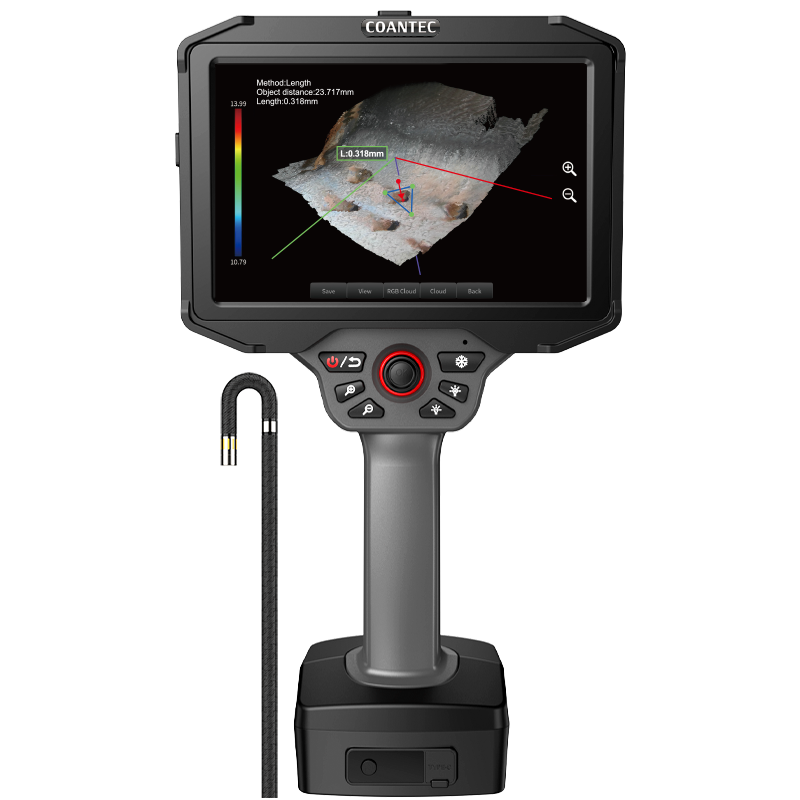
Ein Fiberskop ist ein optisches Inspektionsinstrument, das ein Bündel optischer Fasern verwendet, um ein Bild vom distalen Ende der Sonde zum Beobachtungsende zu übertragen.
Bei einem herkömmlichen bildübertragenden Fiberskop enthält das Faserbündel viele einzelne optische Fasern, die so angeordnet sind, dass die räumlichen Informationen des Bildes erhalten bleiben. Jede Faser überträgt einen Teil des Bildes, sodass der Bediener das Ziel durch ein Okular betrachten kann.
Ein Fiberskop besteht typischerweise aus:
Ein flexibler Einführschlauch
Eine Objektivlinse am distalen Ende
Ein bildübertragendes Faserbündel
An eyepiece or viewing system
An illumination system, often using a separate light source and illumination fibers
A control mechanism on some models for steering the distal end
The flexible probe makes a fiberscope useful for inspecting narrow passages, curved channels, and internal structures with limited access.
Traditional fiberscopes are valued for their flexibility and compact optical design. However, image quality can be affected by the number, density, and condition of the image fibers. Broken fibers may appear as dark spots or blemishes in the viewed image.
It is important to note that not every instrument containing optical fibers is a fiberscope. Some electronic video borescopes use optical fibers only to deliver illumination, while a miniature camera sensor captures the image.
The most important distinction is how the image is transmitted and displayed. However, probe construction, maneuverability, image documentation, and inspection requirements also influence which instrument is more suitable.
| Besonderheit | Industrial Video Borescope | Traditional Fiberscope |
|---|---|---|
| Image transmission | Electronic image capture and digital transmission | Optical image transmission through a fiber bundle |
| Image display | Electronic monitor or handheld screen | Typically an eyepiece or optical viewer |
| Bildqualität | Depends on sensor resolution, optics, illumination, and processing | Depends on fiber bundle quality, optics, illumination, and viewing system |
| Image recording | Commonly supports digital photos and video | Depends on the viewing system and available accessories |
| Probe flexibility | Available in rigid, flexible, and articulating designs | Typically flexible |
| Probe steering | Available on articulating models | Available on some models |
| Measurement functions | Available on selected models | Usually requires additional systems or specialized designs |
| Image transmission | Electronic | Optical in traditional image-transmitting fiberscopes |
| Typical applications | Engine inspection, turbine inspection, equipment maintenance, and defect documentation | Narrow passages, curved channels, and specialized optical inspection tasks |
These are general characteristics rather than universal rules. Some advanced fiberscopes can connect to digital imaging systems, while some industrial video borescopes are designed for very specialized applications.
The best comparison should therefore be based on the actual instrument configuration, rather than its product name alone.
Image quality is one of the most important considerations in industrial inspection, particularly when inspectors need to identify small cracks, corrosion, surface wear, or foreign object damage.
A video borescope uses an electronic image sensor, typically located near the distal end of the probe, to capture the inspection target. The image is then processed and displayed electronically.
Depending on the model, this architecture can support:
High-resolution still images
Real-time video inspection
Digital zoom and image adjustment
Photo and video storage
Inspection records for maintenance and quality control
Specialized dimensional measurement features
The actual performance depends on the image sensor, optical design, illumination, working distance, and image-processing capabilities.
A high-resolution display alone does not guarantee that an instrument can detect every small defect. Inspectors must also consider the clarity of the optical image and the conditions under which the target is observed.
A traditional fiberscope transmits the image through a coherent optical fiber bundle. Its image quality depends on the number and density of fibers, the optical design, the condition of the bundle, and the quality of the illumination.
Fiberscopes can provide useful visual information in confined spaces, particularly where their flexible construction is advantageous. However, the fiber structure can limit image detail compared with some modern electronic imaging systems.
If individual fibers become damaged, dark spots may appear in the image. These artifacts can make it more difficult to distinguish small surface defects.
For applications requiring digital image storage, repeatable inspection records, and integration with modern inspection workflows, a video borescope is often the more practical option.
For specialized inspections where a very flexible optical probe is the priority, a fiberscope may remain suitable.
The correct choice depends on the smallest defect that must be identified, the working distance, the available access path, and the required inspection documentation.
Probe flexibility is another important factor when inspecting complex internal structures.
A traditional fiberscope generally uses a flexible insertion tube that can follow curved access paths. This makes it useful for inspecting narrow channels and internal passages that cannot be reached with a straight probe.
Flexible industrial video borescopes offer similar access advantages. Some models also feature articulating probe tips that allow the operator to steer the camera toward a target without repeatedly withdrawing and repositioning the insertion tube.
For example, a four-way articulating video borescope may allow the inspector to direct the probe tip in multiple directions, making it easier to examine different surfaces within a confined component.
When selecting an instrument for a restricted access point, consider the following factors:
Probe diameter: The insertion tube must fit through the available opening.
Working length: The probe must reach the target without excessive unused length.
Bend radius: The insertion tube must accommodate the access path without exceeding its operating limits.
Articulation: Tip steering may be important when the inspection target is not directly in front of the probe.
Distal-end design: The camera, lens, and illumination must suit the geometry of the inspection area.
Neither a fiberscope nor a video borescope is automatically better in every confined space. The required probe dimensions and steering capabilities should determine the final selection.
Both instruments can be used for visual inspection of internal structures, but their strengths may differ according to the inspection task.
Aircraft engines contain components such as turbine blades, compressor stages, combustion chambers, and other internal surfaces that require careful inspection.
A video borescope can be advantageous when inspectors need to capture images, document findings, and compare conditions during subsequent maintenance inspections.
A suitable articulating probe can help inspectors examine surfaces from different viewing angles.
The instrument must be selected according to the engine manufacturer's inspection procedures, access-port dimensions, required viewing direction, and applicable maintenance requirements.
In automotive maintenance, inspection scopes can help examine cylinder walls, piston crowns, valves, and other internal engine components.
A compact video borescope may provide a convenient way to observe internal conditions and record images for troubleshooting.
A fiberscope can also be suitable for certain restricted passages, particularly when its probe construction matches the access requirements.
Gas turbines and other power-generation equipment contain internal components that can be expensive or time-consuming to disassemble.
Video borescopes can help maintenance teams examine accessible internal surfaces and create visual inspection records.
For these applications, probe length, articulation, image clarity, illumination, and operating temperature limits are important selection criteria.
Industrial inspection scopes can help examine internal surfaces in castings, pipework, gearboxes, hydraulic systems, and other mechanical assemblies.
The appropriate instrument depends on the geometry of the component, the available opening, the inspection distance, and whether the target requires only visual observation or more detailed documentation.
For long pipelines or large industrial structures, a dedicated pipe inspection camera or robotic inspection system may be more appropriate than a conventional handheld borescope.
The purchase price of an industrial borescope or fiberscope depends on more than the basic imaging technology.
Important factors include probe diameter, insertion length, articulation, optical performance, illumination, durability, accessories, and measurement capabilities.
Traditional fiberscopes may be attractive for certain specialized inspection requirements, but the condition of the image fiber bundle is important. Damaged fibers can degrade the viewing image and may require professional repair or replacement.
Video borescopes can offer convenient digital recording and image management, but more advanced systems may involve higher initial costs, electronic components, batteries, displays, and software-related considerations.
Before purchasing, evaluate the total cost of ownership, including:
Initial purchase price
Expected service life
Probe repair or replacement costs
Cleaning and maintenance requirements
Calibration or verification requirements, where applicable
Accessories and software
Operator training
Inspection time and documentation requirements
For industrial applications, the most economical solution is not necessarily the instrument with the lowest purchase price. A tool that matches the inspection task and reduces repeated inspections or unnecessary equipment disassembly may provide greater long-term value.
Choosing between an industrial video borescope and a fiberscope starts with the inspection requirements rather than the product category.
Determine whether the task involves general visual observation, defect identification, digital documentation, or dimensional measurement.
For applications requiring repeatable digital inspection records, a video borescope is often a strong candidate.
Identify the maximum permissible probe diameter and the available insertion length.
Do not select an instrument based on diameter alone. The probe must also accommodate the access path and reach the inspection target.
Determine whether the target can be viewed through a straight access path or whether the operator must steer the probe around bends or obstructions.
A flexible probe may be sufficient for some applications, while an articulating tip may be necessary for others.
Consider the smallest defect that must be identified, the target's surface characteristics, the working distance, and the available illumination.
For critical inspections, evaluate actual sample images or perform a practical demonstration using representative inspection targets.
Confirm whether the probe must withstand moisture, oil, cleaning agents, elevated temperatures, or other environmental conditions.
Verify the manufacturer's specified operating limits and ingress-protection rating. Do not assume that every inspection scope is suitable for hazardous atmospheres or high-temperature environments.
If inspection results must be shared with customers, maintenance teams, or quality departments, check whether the instrument supports image storage, video recording, annotations, reporting, or specialized measurement.
Dimensional measurement requires appropriate instrument capabilities and operating procedures; a clear image alone does not establish measurement accuracy.
Consider product availability, technical support, accessories, repair services, and the availability of replacement probes.
Matching these factors to your inspection requirements helps ensure that the selected equipment remains practical throughout its service life.
Not exactly. Borescope is a broad term for instruments used to visually inspect inaccessible areas. A traditional fiberscope is a type of borescope that uses an optical fiber bundle to transmit the image. Industrial video borescopes instead capture images electronically using an image sensor.
Neither is universally better. A fiberscope may be suitable for specialized applications requiring a flexible optical probe. A video borescope is often more convenient when digital imaging, video recording, image sharing, and inspection documentation are important.
Yes, depending on its configuration. Some fiberscopes can be connected to camera systems or digital viewing accessories. However, digital recording is generally more straightforward with an electronic video borescope designed with built-in imaging and storage features.
An industrial video borescope is often a practical choice for aircraft engine inspections that require digital image documentation and articulating probe control. However, the appropriate instrument must meet the specific engine manufacturer's inspection requirements and applicable maintenance procedures.
The correct diameter depends on the access opening, the internal geometry, the required working distance, and the available probe design. Always confirm the actual dimensions and clearance requirements before selecting an instrument.
Some advanced industrial video borescopes offer specialized measurement functions. Their suitability depends on the measurement technology, calibration or verification procedures, target conditions, and required accuracy. Ordinary visual inspection should not be treated as equivalent to a validated dimensional measurement.
Follow the manufacturer's instructions for cleaning, handling, storage, and inspection. Clean the probe and distal-end optics using approved methods, avoid exceeding the specified bending limits, and inspect the insertion tube for signs of damage before and after use.
Industrial borescopes and fiberscopes both provide access to internal areas that are difficult to inspect directly, but their image-transmission technologies and operating features can differ considerably.
A traditional fiberscope uses a coherent optical fiber bundle to transmit images and can be suitable for specialized inspections requiring a flexible optical probe. An industrial video borescope captures images electronically and often provides advantages in digital recording, image management, and inspection documentation.
When choosing between the two, consider the inspection objective, probe diameter, working length, articulation, image quality, illumination, environmental requirements, and total cost of ownership.
Urheberrecht © 2025. Coantec Ltd. Alle Rechte vorbehalten. Sitemap