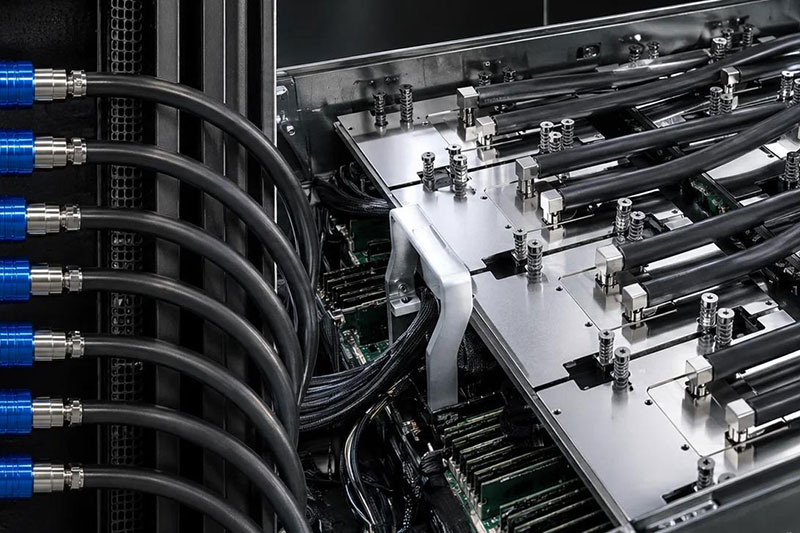

With the rapid development of artificial intelligence (AI), large-scale AI model training, high-performance computing (HPC), and cloud computing, server chip power consumption continues to increase. Traditional air cooling solutions are facing growing challenges, including insufficient heat dissipation efficiency, increased noise levels, and limited space utilization.
Liquid cooling technology, with its superior thermal transfer capability, is becoming a critical thermal management solution for high-performance servers and modern data centers.
Among various liquid cooling components, the liquid cooling plate (cold plate) plays a key role in heat dissipation. By circulating coolant through internal cooling channels, the cold plate efficiently transfers heat generated by high-power components such as CPUs and GPUs, maintaining stable operating temperatures for AI servers and computing systems.
However, cold plates feature complex internal structures, including microchannels, cooling chambers, welded joints, and sealing interfaces. During manufacturing, various defects may occur, such as:
Internal channel blockage and foreign particle contamination;
Welding defects, incomplete bonding, or micro-cracks;
Corrosion and oxidation on internal surfaces;
Machining burrs affecting coolant flow;
Sealing defects that may lead to potential leakage risks.
Due to their compact structures and enclosed internal channels, traditional inspection methods often struggle to fully evaluate cold plate conditions without damaging the component.
Therefore, industrial borescope inspection has become an important non-destructive inspection (NDI) method for ensuring the reliability and performance of server liquid cooling systems.
Modern server cold plates are typically manufactured from high thermal conductivity materials such as copper and aluminum alloys. As cooling channel designs become increasingly compact and sophisticated, manufacturers require more advanced inspection solutions.
Cold plate internal channels are extremely limited in size, making direct visual inspection impossible.
Inspection engineers need a miniature camera probe that can access narrow internal spaces and perform non-destructive visual inspection without cutting or disassembling the component.
Even minor internal abnormalities inside a cold plate can reduce cooling efficiency and impact server reliability:
Residual debris may restrict coolant circulation;
Machining burrs may disturb coolant flow paths;
Welding defects may create leakage risks;
Internal corrosion may reduce long-term reliability.
If these defects remain undetected, they may cause abnormal server temperatures, performance degradation, or even instability in data center operations.
As AI servers and data center infrastructure continue expanding, cold plate production volumes are increasing rapidly.
Traditional sampling inspections are no longer sufficient for advanced manufacturing environments. Manufacturers require an inspection solution that can:
Detect internal defects quickly;
Inspect components without destruction;
Improve inspection coverage;
Provide image and video records for quality traceability.
During cold plate manufacturing, industrial borescopes can support multiple quality control stages:
Inspect cold plates and semi-finished components to identify potential internal contamination, machining abnormalities, or manufacturing defects.
Verify internal conditions during machining, welding, and assembly processes, helping manufacturers optimize production processes and prevent defects.
Perform targeted inspections on finished cold plates, including internal channels, critical joints, and connection areas, ensuring compliance with quality requirements.
When servers experience abnormal temperatures or reduced cooling performance, industrial borescopes enable engineers to quickly locate internal causes and perform failure analysis.
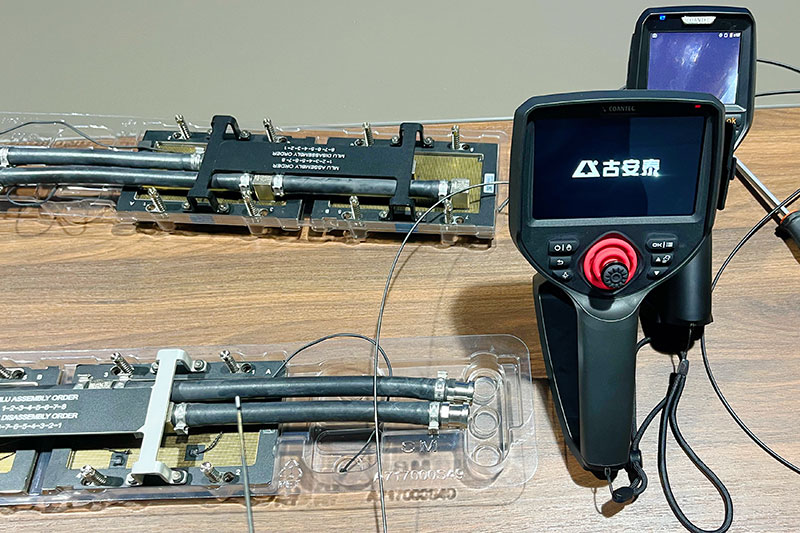
To address challenges in internal channel inspection, micro-defect detection, and quality traceability during cold plate production, Coantec provided an industrial borescope inspection solution for a Shenzhen-based electronics manufacturer, helping improve quality control capabilities throughout the manufacturing process.
The customer's cold plates are used in server cooling systems, where internal channel quality, cleanliness, and long-term reliability are critical requirements.
During production inspection, the complex internal structures of cold plates made it difficult for conventional methods to quickly evaluate channel conditions.
Meanwhile, destructive inspection methods such as cutting or disassembly were time-consuming and could compromise product integrity. The customer required an efficient and non-destructive inspection solution suitable for high-volume manufacturing.
Based on the customer's cold plate structure and inspection requirements, Coantec configured:
1.8 mm diameter probe tube;
2.0 mm diameter probe tube.
The miniature probes were inserted into internal cooling channels, enabling direct visual inspection of critical areas.
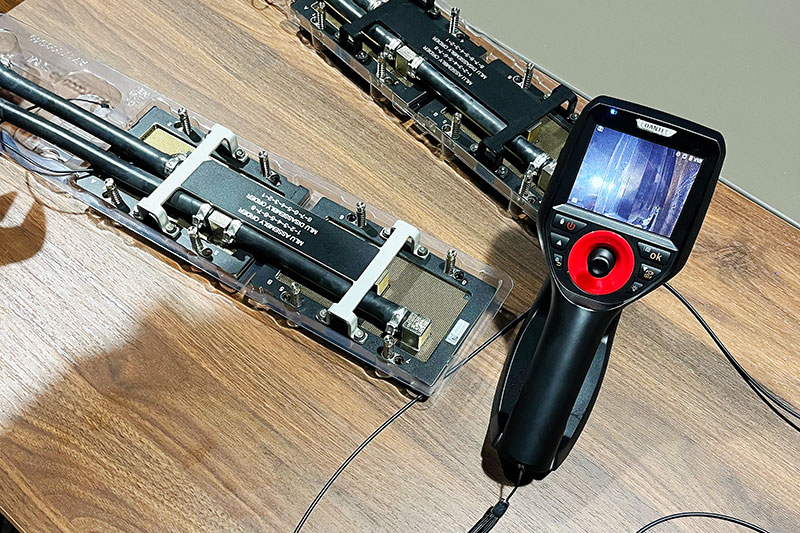
During inspection, the Coantec M40/C40 industrial borescopes provided clear visualization of:
Internal channel machining quality;
Metal surface conditions;
Manufacturing debris and foreign particles;
Local structural abnormalities;
Welding and connection areas.
For complex curved channel structures, the flexible articulation capability of the borescope probe enabled multi-angle observation, significantly improving inspection efficiency.
Meanwhile, high-resolution images and video recordings generated during inspection provided valuable data for:
Quality traceability;
Manufacturing process optimization;
Customer audits;
Quality management improvement.
Compared with traditional destructive inspection methods, the industrial borescope solution enables internal inspection without damaging the cold plate structure, improving both inspection efficiency and product reliability.
The application of Coantec M40 and C40 industrial borescopes in server cold plate inspection helps manufacturers achieve comprehensive improvements from defect detection to quality traceability.
Industrial borescope inspection enables visual verification of internal cooling channels, helping prevent thermal performance issues caused by burrs, debris, and internal defects.
High-resolution inspection images provide reliable evidence for each inspection process and support quality documentation requirements, including cleanliness management practices such as ISO 16232 and VDA 19.1 standards.
Without requiring destructive cutting or sectioning, industrial borescopes can complete internal channel inspections within minutes.
Improved inspection efficiency allows manufacturers to increase inspection coverage and move from traditional sampling inspection toward comprehensive quality control.
The fully modular design of the Coantec M40 allows one main unit to work with multiple probe diameters and configurations, meeting different inspection requirements.
The interchangeable probe design of the C40 series also enables flexible one-device solutions for various applications.
Compared with purchasing multiple dedicated inspection systems, modular industrial borescopes significantly reduce equipment investment.
More importantly, early defect detection helps prevent large-scale quality failures. Cold plate failures may cause:
CPU/GPU thermal throttling;
Reduced computing performance;
Potential damage to high-value server equipment.
Coantec industrial borescopes provide high-quality inspection images and complete inspection records, helping manufacturers meet strict quality audit requirements from data center and server customers.
Standardized inspection procedures and traceable inspection data strengthen supplier quality management and customer confidence.
Liquid cooling technology is accelerating the transformation of data center thermal management. As a critical cooling component, the manufacturing quality of cold plates directly impacts server reliability and operational stability.
From AI data centers and server facilities to advanced microchannel cold plates and conventional cooling structures, Coantec M40/C40 industrial borescopes provide manufacturers, server suppliers, and data center cooling system providers with reliable visual inspection solutions featuring:
High-definition imaging;
Flexible probe access;
Small-space inspection capability;
Non-destructive internal examination;
Complete inspection traceability.
As AI computing continues to expand worldwide, Coantec remains committed to advancing industrial visual inspection technologies, helping cold plate manufacturers and server supply chains improve quality control and build a stronger foundation for reliable data center operations.
Copyright © 2025. Coantec Ltd. All rights reserved. sitemap