
In air conditioner manufacturing, condenser and evaporator tubing plays a critical role in heat transfer. Foreign objects, manufacturing residue, blockages, significant deformation, or other internal issues can affect subsequent processes and overall product quality.
Unlike externally accessible components, the inside of heat exchanger tubing is typically a narrow, enclosed, and inaccessible space that cannot be inspected directly. This is particularly challenging for long tubing runs with bends and turns, where manual visual inspection cannot provide adequate coverage. Disassembly, meanwhile, can increase inspection time and labor costs.
As a result, during production quality control and troubleshooting, manufacturers need an efficient way to inspect the internal condition of tubing with minimal disassembly. An industrial videoscope provides a practical solution for this type of internal visual inspection.
Inspecting condenser and evaporator tubing may appear as simple as “inserting a camera into the tube,” but actual inspection conditions can place demanding requirements on the equipment.
First, the tubing may have a small internal diameter.
The probe diameter must be small enough to pass through the inspection opening and reach the target area. Therefore, a small-diameter borescope probe is essential for inspecting narrow tubing.
Second, the inspection distance can be significant.
When the target area is located far from the access point, an insertion tube that is too short will not provide sufficient reach to cover the required inspection area.
Third, tubing may contain bends and changes in direction.
Once the probe enters the tubing, its viewing direction must be adjusted according to the internal geometry. Otherwise, certain areas may be difficult or impossible to inspect effectively.
Fourth, production environments require fast and intuitive inspection.
Manufacturing operations typically prioritize inspection efficiency and ease of use. Inspectors need equipment that can be moved easily, inserted quickly, and provide real-time images of the internal condition.
For these reasons, an industrial borescope for condenser and evaporator tubing should be selected based on a combination of probe diameter, insertion length, articulation capability, image quality, and environmental protection.
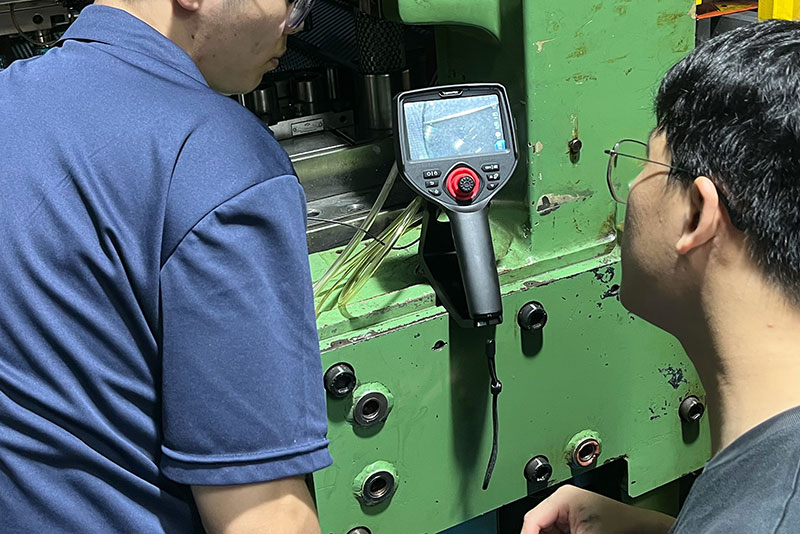
This application case comes from a production site of a leading air conditioner manufacturer in China. To address the challenges of small-diameter tubing, long inspection distances, and limited visibility inside condenser and evaporator tubing, the manufacturer uses the Coantec M40-3010 handheld HD industrial videoscope.
The system is equipped with an approximately 3 mm diameter probe, a 10 m insertion tube, and a 1-megapixel imaging system to inspect the internal condition of air conditioner condenser and evaporator tubing.
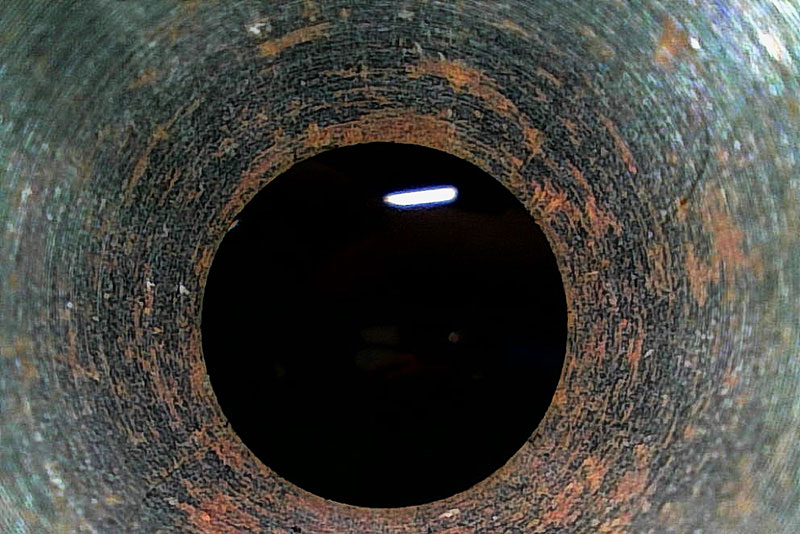
During inspection, operators can gradually advance the probe through the tubing while continuously observing the tube wall and internal space. When an abnormal area is identified, the operator can adjust the probe position and viewing angle for closer observation and capture relevant images or videos for subsequent quality analysis.
This portable videoscope inspection approach can reduce the need for extensive disassembly and help improve inspection efficiency on the production floor.
For heat exchanger tubing such as condenser and evaporator tubes, probe diameter and insertion tube length determine whether the borescope can actually reach the target inspection area.
The M40-3010 features an approximately 3 mm diameter probe, enabling access through certain narrow inspection openings. Its 10 m insertion tube provides the reach required for long-distance internal inspection.
Together, these features make the system suitable for applications involving small access openings and long inspection distances.
However, actual applicability depends on the internal diameter, bend radius, internal geometry, and access location of the tubing. Equipment selection should therefore be validated against the specific application conditions.
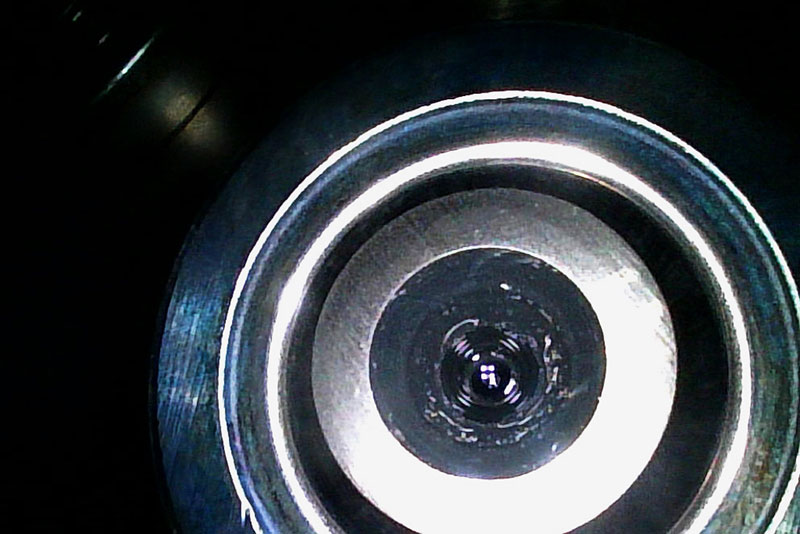
Another major challenge in long tubing inspection is whether the camera can actually view the target area after entering the tube.
When tubing contains bends and changes in direction, a probe with limited directional control may make it difficult for inspectors to actively position the camera toward the area of interest.
The M40 provides flexible probe articulation, allowing operators to adjust the camera direction according to the tubing geometry. This helps inspectors more effectively observe bends, turns, and other difficult-to-access areas.
Therefore, when selecting a 360° articulating videoscope, it is important not to focus solely on the stated articulation angle. More importantly, the probe should be able to advance, articulate, and provide an effective view under the actual tubing conditions.
Air conditioner manufacturing environments are not always laboratory-like. Inspection equipment may encounter moisture, dust, and contaminants generated during production. The environmental protection of the probe is therefore another important consideration.
The M40 probe features IP68-rated protection against dust and water, helping improve its suitability for demanding industrial inspection environments.
For manufacturers that perform frequent on-site inspections, probe protection, durability, and maintenance requirements should also be considered when selecting an industrial borescope.
An industrial borescope is primarily designed to provide internal visual inspection. For condenser and evaporator tubing, inspectors can use a borescope to check for:
Foreign objects or manufacturing residue inside the tubing;
Localized blockages or obstructions;
Significant deformation of the tube;
Visible abnormalities on the internal tube surface;
Other visible issues resulting from manufacturing, processing, or assembly.
When an abnormality is identified, inspectors can capture images or videos and combine the visual evidence with applicable process and quality requirements for further evaluation.
It is important to note that industrial borescope inspection does not replace all other non-destructive testing (NDT) methods. Defects within the material itself, wall-thickness variations, and other conditions that cannot be reliably identified through visual inspection may require additional inspection methods and comprehensive evaluation.
Different tubing configurations require different inspection solutions. Equipment selection should not be based on a single specification.
Actual Inspection Condition | Key Specification to Consider |
Narrow tube access | Probe diameter |
Long inspection distance | Insertion tube length |
Bent or curved tubing | Probe articulation capability |
Need to identify small abnormalities | Image quality |
Industrial operating environment | IP rating / environmental protection |
Multiple inspection targets and tube sizes | Interchangeable probes / modular design |
For manufacturers inspecting tubing with different diameters, inspection depths, and internal configurations, a modular industrial videoscope can provide greater configuration flexibility.
With interchangeable probes, the system can be adapted to different inspection requirements, expanding the range of applications that can be covered by a single borescope platform.
For the challenging task of inspecting the internal surfaces of air conditioner condenser and evaporator tubing, the Coantec M40-3010 provides a portable and efficient visual inspection solution with its approximately 3 mm probe, 10 m insertion tube, 1-megapixel imaging system, and flexible articulation capability.
For manufacturers, industrial borescope inspection is more than simply “taking a picture inside a tube.” By enabling inspectors to access, observe, locate, and document internal conditions, a borescope converts otherwise inaccessible spaces into visual inspection data that can support production quality control, troubleshooting, and root-cause analysis.
The access point should be selected based on the tubing layout, access opening size, and target inspection area. Ideally, the access point should provide a direct path to the target area while allowing the probe to be manipulated effectively. For complex tubing configurations, reviewing the product or tubing layout first can help identify potential inspection paths before conducting an on-site validation.
Forcing the probe when significant resistance is encountered may damage the probe and could potentially affect the tubing being inspected. The recommended approach is to stop advancing, retract the probe, and adjust its direction. If necessary, another access point or inspection path should be considered.
Do not determine the required length based solely on the overall tubing length. Instead, estimate the actual path length from the inspection access point to the farthest target area, while allowing additional length for bends, articulation, and operator handling. The required insertion tube length should be selected based on the maximum actual inspection distance.
If the access diameter, inspection depth, and internal geometry of both tubing types fall within the borescope's operating range, the same main unit can be used with an appropriately configured probe. For applications involving significantly different tube sizes and inspection conditions, a modular borescope with interchangeable probes provides greater flexibility.
First, document the abnormality by recording its location, images, and video. The findings should then be evaluated against the applicable product and process requirements. If visual inspection alone cannot determine the nature or severity of the defect, additional methods such as dimensional measurement, pressure testing, or other appropriate NDT techniques should be considered.
Copyright © 2025. Coantec Ltd. All rights reserved. sitemap