

For years, the industrial borescope industry has been moving toward smaller and smaller probe diameters. From 3.9 mm and 2.8 mm down to sub-millimeter designs, manufacturers continue to push the limits of miniaturization. As a result, many buyers assume that a smaller probe automatically means a better borescope.
In reality, that is not always the case.
While ultra-thin probes can access extremely tight spaces, they often require compromises in image quality, illumination performance, durability, and handling. For most industrial inspection tasks, the question is not how small the probe can be, but whether it can consistently deliver clear images, reliable operation, and long-term durability in the field.
That is precisely why the 4mm borescope remains the preferred choice across a wide range of industries.
Whether inspecting wind turbine gearboxes, gas turbines, automotive engines, pressure vessels, pipelines, or welded structures, technicians continue to rely on the 4mm borescope because it offers the best balance between accessibility and inspection performance.
A larger probe diameter provides more room for optical components, image sensors, and illumination systems. This allows a 4mm borescope to capture brighter, sharper images, particularly in deep cavities and low-light environments where defect visibility is critical. Cracks, corrosion, wear patterns, coating damage, and foreign object debris are often easier to identify when image quality is not sacrificed for probe size.
Just as importantly, a 4mm borescope remains compact enough to access the vast majority of industrial inspection ports. In many applications, it delivers better steering control and greater stability than ultra-thin probes, making it easier for inspectors to navigate complex internal geometries and reach target areas efficiently.
Durability is another reason why the 4mm borescope continues to dominate industrial inspections. Smaller probes are naturally more vulnerable to damage from bending, abrasion, and repeated use. A 4mm borescope offers a stronger structural platform, helping reduce repair frequency and lowering overall operating costs over the lifetime of the equipment.
Of course, modern inspection requirements are becoming increasingly diverse. Different applications may require different viewing directions, probe lengths, or insertion diameters. As a result, flexibility has become just as important as probe size itself.
This is the philosophy behind Coantec's inspection solutions. While the company has successfully developed ultra-thin borescope systems with probe diameters as small as 0.95 mm, it continues to invest heavily in advancing the capabilities of the 4mm borescope, recognizing that it remains the most practical solution for the majority of industrial inspections.
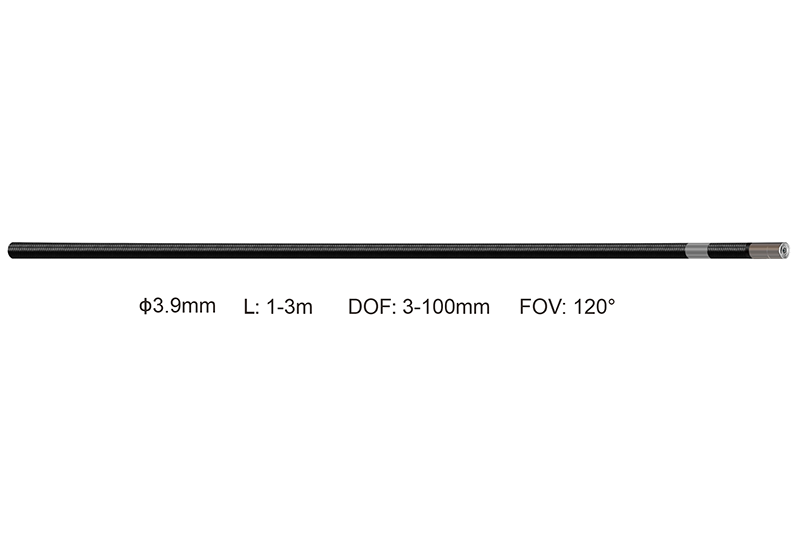
Coantec's modular platform allows inspectors to configure a system according to the specific demands of each application. Probe diameters ranging from 0.95 mm to 6 mm can be paired with different optical configurations and insertion tube lengths, enabling a single platform to support a wide variety of inspection scenarios.
For 4mm borescope applications, illumination options include both front-mounted LED lighting and advanced rear fiber-optic illumination. By relocating the light source away from the probe tip and transmitting light through optical fibers, the system can achieve significantly higher brightness while reducing heat generation at the inspection point. This is particularly beneficial when inspecting deep cavities, turbine components, and other challenging environments where illumination directly impacts inspection quality.
The insertion tube itself is engineered for demanding industrial conditions. A multi-layer tungsten-alloy braided construction provides excellent resistance to abrasion, oil, and moisture while maintaining the flexibility required for navigating complex internal structures. With an IP67 protection rating, the system is designed to perform reliably in harsh industrial environments.
The industry's pursuit of ever-smaller probes is understandable, but effective inspection is rarely determined by probe diameter alone.
For most inspection professionals, success depends on obtaining clear images, reaching the inspection area efficiently, and relying on equipment that performs consistently day after day. In that respect, the 4mm borescope continues to set the benchmark.
It may not be the smallest option available, but it remains one of the most capable, versatile, and trusted inspection tools in modern industrial maintenance.

Copyright © 2025. Coantec Ltd. All rights reserved. sitemap