
In industries such as aerospace, gas turbines, petrochemical processing and automotive manufacturing, many critical components are located inside narrow, enclosed, or otherwise inaccessible spaces.
Industrial borescopes enable inspectors to access these areas through a flexible insertion tube and display internal conditions in real time, making them an essential visual inspection tool for non-destructive testing (NDT).
However, achieving clear and reliable inspection images depends on more than just the camera and optics.
In most industrial inspection environments, the area being inspected has little or no ambient light and may be completely dark. The amount of useful image information captured by the imaging system therefore depends heavily on the illumination available at the inspection point.
For this reason, illumination is a critical part of an industrial borescope imaging system and one of the key factors affecting real-world inspection performance.
So, what types of illumination are commonly used in industrial borescopes? What are the differences between LED, fiber-optic and laser illumination? And which technologies are better suited to different inspection applications?
To understand the role of illumination, it is helpful to first understand how an industrial borescope forms an image.
In simple terms, the light source illuminates the target surface. The borescope optics collect the reflected light, and the image sensor converts that optical information into electronic signals, which are then processed and displayed as an image.
The imaging process can therefore be summarized as:
Light illuminates the target → Reflected light enters the optics → The image sensor captures the information → Image processing → Display
Without sufficient illumination, even a high-resolution image sensor may struggle to produce a clear and usable image.
This is particularly important in industrial inspection, where inspectors often need to identify very small surface features and defects. Cracks, corrosion, burn damage, erosion and scratches on turbine or engine components can easily be obscured by insufficient illumination, shadowed areas or image noise.
Therefore, the imaging capability of an industrial borescope should not be evaluated solely by resolution or display size. The performance of the illumination system, optics, image sensor and image-processing technology must also be considered as an integrated system.
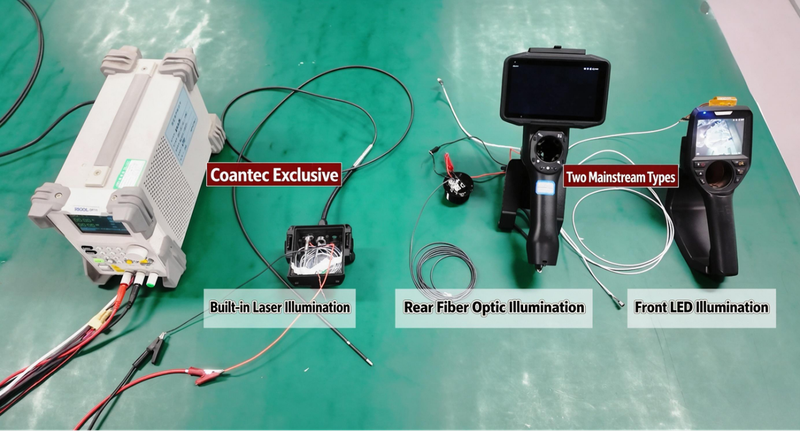
LED illumination is currently the most widely used lighting solution in industrial borescopes and videoscopes.
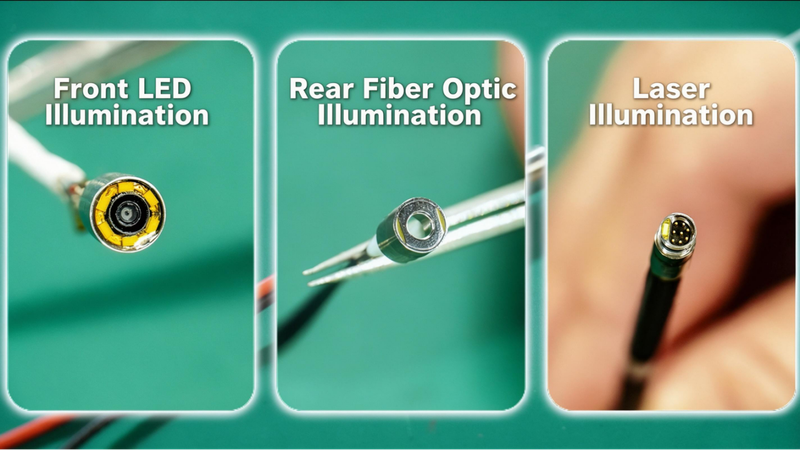
LEDs are compact, energy-efficient, long-lasting and relatively easy to control, making them particularly suitable for equipment with extremely limited internal space. In many industrial borescopes, miniature LEDs are integrated close to the camera at the distal end of the insertion tube, providing direct illumination of the inspection area.
For applications such as automotive engine inspection, mechanical component inspection, internal pipe inspection and routine equipment maintenance, inspection distances are typically relatively short. Under these conditions, LED illumination can meet the requirements of most routine visual inspections.
These advantages have made LED technology the dominant illumination solution in the industrial borescope market.
However, LEDs do not perform equally well in every inspection environment.
As the inspection space becomes larger and the viewing distance increases, light naturally spreads over a wider area. The amount of useful illumination reaching a distant target is therefore reduced. Inspectors may need to reposition the probe repeatedly and move the distal end closer to the target in order to obtain sufficient image brightness and detail.
For large and deep inspection environments, improving effective long-distance illumination therefore becomes an increasingly important challenge.
Unlike LEDs mounted directly near the camera, fiber-optic illumination separates the light source from the distal end of the borescope.
The illumination source can be located in the main unit or in a separate external light source, while optical fibers transmit the light to the distal end of the instrument.
This technology has long been used in professional industrial endoscopic inspection systems.
Because the light source is not constrained by the extremely limited space available at the probe tip, the system can provide greater flexibility in selecting higher-output or more specialized illumination sources.
For professional inspection applications with higher illumination requirements, fiber-optic systems can therefore offer greater flexibility in overall optical system design.
However, fiber-optic illumination can also increase system complexity. The light source, fiber bundle and borescope system must be properly connected and matched, while field operation may involve additional equipment, connections and optical coupling requirements.
From a technical perspective, fiber-optic illumination emphasizes the separation of the light source and the probe, allowing more flexibility in light-source configuration. LED illumination, by comparison, focuses more on compact integration and convenience.
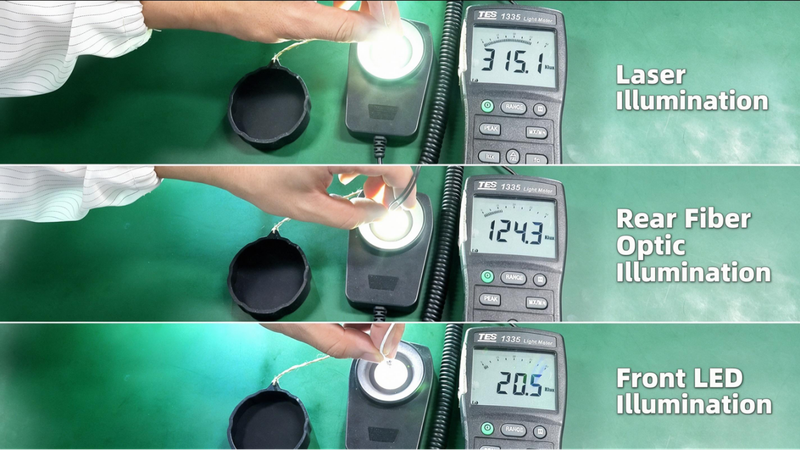
Compared with LED and conventional fiber-optic illumination, laser illumination represents a more specialized technical direction in industrial borescope applications.
One of the key characteristics of laser light is its strong directionality and high energy concentration.
This does not simply mean that a laser is “brighter than an LED.”
More importantly, with appropriate optical design, laser energy can be directed and distributed more effectively toward the inspection target, creating new possibilities for illuminating objects at longer distances and in deep inspection environments.
This can be particularly valuable when inspecting large and complex industrial equipment.
For example, during the inspection of large aero engines, gas turbines and other complex equipment, the inspector may not always be observing a small target located close to the distal end of the borescope. Instead, the inspection target may include turbine blades, combustion chambers or other structures located within a large and deep internal space.
If illumination is effective only at close range, the inspector may need to repeatedly reposition the insertion tube or divide a large inspection area into multiple sections.
More effective long-distance illumination can make it possible to observe larger target areas from a more suitable working distance, creating additional flexibility for inspection in large and deep spaces.
Therefore, the value of laser illumination is not simply about achieving higher brightness. Its real significance lies in improving illumination efficiency for specific long-distance and large-volume inspection environments where conventional lighting technologies may face limitations.
Of course, laser illumination also requires careful optical system design.
Industrial equipment often contains highly reflective metallic surfaces. Strong reflections can produce localized highlights or overexposure. For this reason, the laser illumination system must be properly matched with the optical design, image sensor and image-processing algorithms in order to deliver useful inspection performance.
In practical applications, these three illumination technologies should not simply be classified as “advanced” or “outdated.”
Instead, each represents a different technical approach designed for different inspection requirements.
Illumination Technology | Key Characteristics | Typical Applications |
LED Illumination | Compact, easy to integrate, mature technology | Routine industrial inspection at short distances |
Fiber-Optic Illumination | Separates the light source from the probe and supports more flexible light-source configurations | Professional inspections with higher illumination requirements |
Laser Illumination | Strong directionality and concentrated optical energy, offering potential advantages for long-distance illumination | Large, deep and long-distance industrial inspection environments |
Therefore, when selecting an industrial borescope, it is not accurate to assume that laser illumination is automatically better than LED illumination.
For routine close-range inspection of mechanical components, LED illumination can provide stable and reliable performance. For specialized applications requiring greater illumination capability or longer observation distances, fiber-optic or laser-based solutions may offer additional advantages.
The most suitable illumination technology depends on the inspection object, working distance, internal space and the specific characteristics of the defects being inspected.
As industrial inspection targets become increasingly complex, a single white-light source may not be sufficient for every application.
Different materials and surface conditions reflect light differently. The same defect may also appear differently under different illumination conditions.
As a result, some next-generation industrial borescopes are beginning to offer a wider range of specialized illumination options, including different wavelengths and illumination methods.
The purpose of multi-source illumination is not simply to add more lights to the system.
Its real value is to provide inspectors with more suitable observation conditions for different inspection objects and tasks.
In other words, the key question is changing.
In the past, the focus was often:
“Is the light bright enough?”
Today, the more important question is becoming:
“What type of illumination can help the inspector identify the target features more effectively?”
The development of industrial borescope illumination reflects the changing requirements of industrial inspection.
In the early stages, illumination primarily needed to solve one problem:
Making the invisible visible.
As high-definition imaging technology developed, the focus shifted toward:
Seeing more clearly.
Today, as industrial inspection increasingly involves large-scale equipment and intelligent visual inspection technologies, illumination systems must also address new requirements:
Seeing farther. Seeing more. And working more effectively with imaging algorithms.
As a result, the illumination system is no longer simply an independent light source module. It is becoming increasingly integrated into the overall imaging system.
The light source determines how the target is illuminated. The optical system determines how reflected light is collected. The image sensor records the information, while image-processing algorithms influence how the final image is presented and analyzed.
Only when these elements work together effectively can an industrial borescope deliver meaningful visual inspection performance.
As laser illumination enters industrial borescope applications, one important development direction is miniaturization and system integration.
Traditional professional laser illumination systems often rely on separate light-source modules. While this approach may be acceptable for large stationary inspection systems, it can reduce convenience and operational efficiency for handheld industrial borescopes designed for field inspection.
The more equipment and connections required, the greater the impact on portability and ease of use.
This raises an important technical question:
Can the laser emission system be integrated directly into the handheld industrial borescope itself?
This is not simply a matter of adding a laser to the device.
Integrating a laser emission module into a handheld borescope requires careful consideration of power supply, thermal management, optical coupling, internal space and overall system reliability.
For this reason, integrated laser illumination is fundamentally a test of a manufacturer's system-level engineering and integration capabilities.
The Coantec BLX Series AI Industrial Borescope represents one approach to this development direction by integrating the laser emission module directly into the handheld main unit, combining laser illumination with the overall borescope system in a more compact design.
Currently, Coantec BLX is the only integrated handheld industrial borescope solution in China that incorporates the laser emission module directly into the main unit.
This development reflects a broader trend in which laser illumination is gradually evolving from a separate professional light-source technology toward more compact and portable industrial visual inspection systems.
The primary purpose of an industrial borescope is to inspect areas that cannot be directly observed. However, the ability to achieve a clear inspection image depends on far more than the camera alone.
From LED illumination to fiber-optic light transmission and laser illumination, different technologies have emerged in response to changing industrial inspection requirements.
LED illumination meets the needs of most routine close-range inspections. Fiber-optic illumination provides greater flexibility for professional light-source configurations. Laser illumination, meanwhile, is opening new possibilities for long-distance, large-space and deep-cavity inspection.
As aerospace engines, gas turbines and other high-end industrial equipment place increasingly demanding requirements on visual inspection, illumination will continue to evolve from a simple supplementary lighting function into a critical component of the overall imaging system.
Future competition in industrial borescope technology will therefore extend beyond specifications such as resolution, display size and probe diameter.
It will increasingly focus on the integration and coordination of:
Illumination · Optics · Imaging · Algorithms · System Engineering
The transition of laser illumination from specialized external light sources toward integrated handheld systems may become an important part of this evolution.
A high-performance industrial borescope does more than help inspectors see inside. With the right illumination, it helps them see the details that truly matter.
Copyright © 2025. Coantec Ltd. All rights reserved. sitemap