

When using an industrial borescope to inspect engines, piping, castings, molds, and other internal structures, the probe often needs to move forward or backward or change its viewing angle. You may notice that the image is sharp when the lens is close to the inspection target, but becomes blurry as the lens moves farther away.
This is closely related to the depth of field (DOF) of the industrial borescope.
So, what is depth of field in an industrial borescope? How is it formed? What factors affect it? Is a larger depth of field always better? And how should you evaluate the DOF specification when selecting an industrial borescope?
Understanding these factors can help inspection professionals determine whether a borescope is suitable for a specific inspection application.
Depth of field is often simply described as the “range over which an image remains in focus.” From an optical perspective, however, this definition is not completely precise.
The target is actually in perfect focus only at a specific focal plane. When the target moves away from this plane, slight defocus occurs. However, as long as the resulting blur remains sufficiently small, the image can still appear sharp to the human eye or imaging system.
The blur produced by defocus is known as the circle of confusion. When the circle of confusion remains below an acceptable limit, the target is perceived as being in focus. The range extending in front of and behind the focal plane is the depth of field.
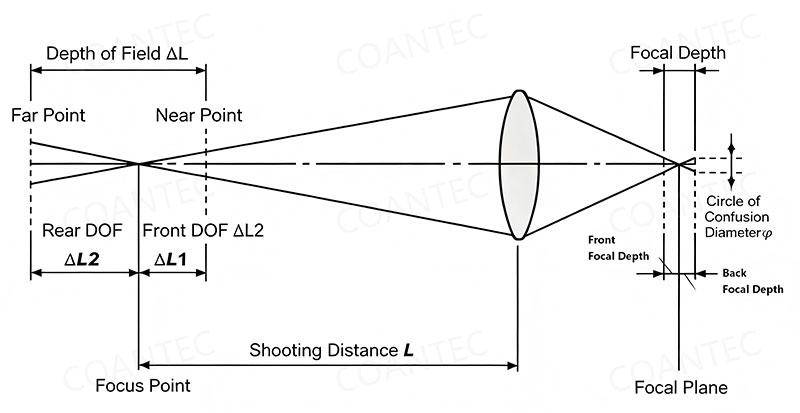
Imagine the space in front of the lens as an inspection zone:
Lens → Near Clear Region → Best-Focus Region → Far Clear Region
As long as the inspection target remains within the effective depth of field, the image can maintain an acceptable level of clarity even when the inspection distance changes.
In simple terms:
Depth of field is the range of distances over which an inspection target can remain acceptably sharp.
Therefore, DOF does not simply indicate how far an industrial borescope can “see.” Instead, it describes how much variation in target distance can be accommodated while maintaining acceptable image clarity.
For industrial borescopes, depth of field is likewise a range rather than a single fixed distance. Its practical value is to:
Maintain stable, usable image clarity as the distance between the lens and inspection target changes within a certain range.
It is important to note that depth of field is not an isolated or universally fixed value. It is influenced by factors such as lens design, working distance, aperture, and imaging conditions. Therefore, DOF specifications should always be evaluated in relation to the intended inspection application.
One of the key differences between industrial borescopes and conventional cameras is that the inspection space is restricted and the distance to the target often changes during inspection.
For example, when inspecting engine blades, the lens may need to observe surfaces at different distances. When inspecting an internal casting cavity, the target may extend from a nearby surface to a deeper area. During pipeline inspection, the probe may continuously move through the pipe.
If the effective depth of field is limited, even a small change in the distance between the lens and target can noticeably affect image clarity. The operator may then need to constantly reposition the probe to find the optimal viewing distance.
A suitable depth of field can cover a wider effective inspection range, allowing the probe to move within that range while maintaining relatively stable image quality.
From an industrial inspection perspective, therefore, the value of depth of field is not simply “seeing farther.” It is the ability to maintain usable image clarity as the inspection distance changes.
Not necessarily.
Depth of field is an important optical performance parameter, but it should not be used alone to determine whether an industrial borescope is better than another.
Different inspection tasks have different imaging requirements.
For example:
Large cavities and equipment interiors: A wider clear range can make it easier to observe structures at different distances.
Welds, cracks, corrosion, and machining burrs: Fine detail resolution and image quality may be more important than simply maximizing DOF.
Deep holes and narrow pipes: Probe diameter and insertion capability are also critical.
Dimensional inspection: Measurement capabilities and accuracy need to be considered in addition to image clarity.
Therefore:
An industrial borescope does not necessarily perform better simply because it has a larger depth of field. The ideal DOF should match the actual inspection distance and defect-identification requirements.
Depth of field is closely related to the optical design of the lens and the conditions under which the borescope is used.
Lens focal length, aperture, and optical configuration all affect depth of field. Because industrial borescope probes are typically very small in diameter, the lens must balance depth of field, resolution, field of view, and overall image quality within a highly constrained space.
As the distance between the lens and the inspection target changes, the imaging condition also changes. Therefore, the DOF specifications provided by manufacturers should be interpreted together with their corresponding test conditions rather than compared independently.
Internal industrial environments are often poorly lit, making the illumination system an important part of the overall imaging performance.
It is important to distinguish between the two:
Depth of field determines how wide a distance range can remain acceptably sharp, while illumination determines how clearly details can be seen within that range.
The two factors are related to overall image quality but should not be confused.
Different targets have different clarity requirements.
Observing a large structural feature is different from identifying a small crack, corrosion spot, scratch, or machining defect.
For this reason, industrial borescope selection should start with what needs to be inspected and then determine the appropriate optical characteristics.
For inspection professionals, understanding how to apply a DOF specification is more useful than simply knowing its definition.
A practical evaluation can be done in three steps.
First, determine the typical distance between the lens and the inspection surface once the probe is inserted into the equipment. Also consider how much this distance is likely to change during inspection.
If the lens-to-target distance varies significantly, pay particular attention to whether the DOF adequately covers the required inspection range.
If the objective is simply to observe internal structures, overall image quality and viewing coverage may be the main considerations.
If the inspection requires identifying cracks, corrosion, porosity, scratches, burrs, or other small defects, resolution, illumination, and image detail should also be evaluated.
When inspecting pipelines, engines, castings, gearboxes, and other complex internal structures, the probe typically needs to move continuously.
A suitable depth of field can improve image stability during probe movement. Industrial borescope selection should therefore consider depth of field, working distance, probe diameter, image resolution, field of view, illumination, articulation, and protection rating as a complete set.
Only when these specifications match the inspection target can the borescope deliver an effective internal visual inspection solution.
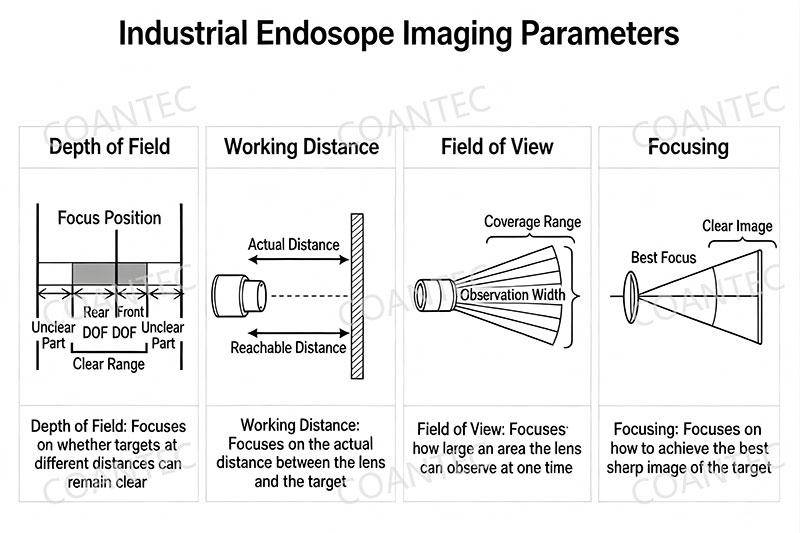
When reviewing industrial borescope specifications, depth of field, working distance, field of view, and focus are often listed together. However, they describe different aspects of optical performance.
A simple way to distinguish them is to ask four questions:
Working Distance (WD): How far is the lens from the inspection target?
Depth of Field (DOF): Over what distance range around the focal position can the target remain acceptably sharp?
Field of View (FOV): How much of the target area can the lens capture at one time?
Focus: How is the lens adjusted or designed to achieve the sharpest image at a particular distance?
In simple terms:
Working distance determines how far away you inspect; depth of field determines how much distance variation can remain clear; field of view determines how much you can see at once; and focus determines where the image is sharpest.
During industrial borescope inspection, the probe typically moves forward, backward, and in different directions inside the equipment. The working distance therefore does not remain constant.
This is why it is important to consider not only the minimum focusing distance or a single nominal working distance, but also whether the effective depth of field covers the actual inspection range.
Many industrial inspections are not static photography. Instead, operators move the probe while continuously observing the target.
This is common when inspecting pipelines, engines, gearboxes, castings, molds, and other internal structures.
A lens with a sufficiently broad effective depth of field can reduce the need for frequent repositioning caused by small changes in inspection distance, making continuous visual inspection more convenient and efficient.
Therefore, the practical value of DOF lies in improving inspection efficiency and image stability during probe movement.
In practical applications, depth of field ultimately affects image stability and inspection efficiency.
When a probe moves inside engines, automotive components, precision castings, pipelines, molds, and other confined spaces, maintaining stable image clarity across the actual working distance makes it easier to continuously observe internal structures. This provides a reliable visual basis for defect identification, image documentation, and subsequent evaluation.
Depth of field should therefore not be considered as an isolated specification. It needs to work together with probe diameter, resolution, field of view, illumination, and articulation to meet the requirements of a specific inspection task.
Coantec has extensive experience in industrial borescope and industrial vision inspection technologies, continuously advancing optical imaging solutions for different inspection applications. For example, the Coantec C40 Series features interchangeable insertion tubes, allowing users to select different probe diameters, lengths, and depth-of-field configurations according to the inspection space and target distance.
Therefore, when designing or selecting an industrial borescope, the goal is not simply to maximize the DOF value, but to match the effective imaging range to the actual inspection requirements.
Depth of field is essentially the range of distances over which a lens can maintain acceptable image clarity under specific imaging conditions.
It is not simply a measure of how far an industrial borescope can “see.” Instead, it is closely related to the focal plane, circle of confusion, aperture, focal length, working distance, and imaging system.
For industrial borescope inspection, the key question is not whether the DOF value is as large as possible, but whether:
The depth of field covers the actual inspection distance while providing sufficient image clarity for the defects being inspected.
By understanding the principles of depth of field and evaluating it together with probe diameter, resolution, illumination, field of view, and articulation, users can select an industrial borescope that is better suited to complex, confined, and inaccessible inspection environments.
No. Depth of field depends on the lens optical design, aperture, working distance, and specific imaging conditions. The manufacturer's test conditions and the actual inspection environment should therefore be considered when evaluating DOF.
Different manufacturers may use different definitions, test conditions, and criteria for acceptable image sharpness. When comparing products, check the lens configuration, working distance, test conditions, and imaging criteria associated with the stated DOF.
Some fixed-focus industrial borescopes are optically designed so that common inspection distances fall within their effective depth-of-field range. This allows the probe to move without frequent focus adjustments, making fixed-focus systems well suited to continuous internal inspection.
A lens has a specific best-focus position. When the target moves away from this position, some degree of defocus occurs. Once the resulting circle of confusion exceeds the acceptable limit, the image becomes noticeably blurred.
Copyright © 2025. Coantec Ltd. All rights reserved. sitemap